Manufactured famine
Over 70 per cent of Gaza’s built structures now lie flattened, reduced to rubble by an unrelenting campaign of bombardments and ground assaults that has not spared homes, hospitals, schools or...
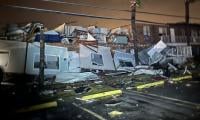
Over 70 per cent of Gaza’s built structures now lie flattened, reduced to rubble by an unrelenting campaign of bombardments and ground assaults that has not spared homes, hospitals, schools or places of worship, leaving behind a skeletal landscape of destruction.
The Strip’s critical infrastructure – electricity grids, water pipelines and sewerage networks – has been systematically dismantled, not merely collateral damage but deliberate erasure of the means to sustain civilian life.
Conservative death toll estimates exceed 62,000, recording one of the highest proportions of child deaths in any modern siege or urban war; more than 17,000 children have been killed, their small bodies buried under collapsed walls or carried to overcrowded morgues.
Nearly the entire surviving population has been forced into conditions unfit for human existence, crammed into less than 12 per cent of the Strip’s original area, sheltering in half-destroyed buildings or temporary plastic-sheet tents, subject to curfews, targeted raids and constant threat from aerial and artillery strikes. Displacement has brought no safety, people are trapped in overcrowded pockets where the air smells of sewage, clean water is a rarity and basic healthcare is an unreachable luxury.
The so-called Gaza Humanitarian Fund, set up jointly by Israel and the US as a supposed lifeline, has proven both grossly inadequate and dangerously compromised. Desperate families risk their lives approaching aid convoys or distribution points, where Israeli forces have repeatedly opened fire or strikes have fallen nearby. The search for food has become a death sentence; more than a thousand Palestinians have been killed in or around food lines since early summer. For the children of Gaza, who make up almost half of its population, the toll has been especially devastating. Their vulnerability, smaller nutritional reserves, and reliance on caregiving structures have now been obliterated, meaning they succumb faster to hunger, dehydration and preventable diseases.
Over the past 21 months of war, this demographic has borne the brunt not only of the bombardments but also of the hunger that stalks every home. The humanitarian crisis has reached an acute phase where starvation is not an incidental outcome of war but a deliberate instrument of warfare. The most recent Integrated Food Security Phase Classification (IPC) report of July 29 warns that Gaza meets two of the three technical thresholds for a formal famine declaration, at least one in three children is now acutely malnourished, one in five people faces an extreme lack of food. Although the third measure death rates from starvation and disease is hard to confirm in conflict zones, available evidence suggests it is climbing fast.
Approximately 39 per cent of Gazans report not having eaten for several consecutive days. In many districts severe acute malnutrition rates have more than quadrupled over the past two months, surpassing 15 per cent – a figure considered catastrophic by humanitarian standards. In hospitals that still function, skeletal infants lie in overcrowded wards where doctors, operating without electricity or medicines, can do little but watch their tiny patients fade. The World Food Programme and Unicef warn that without immediate, unrestricted aid access, tens of thousands more children could die in the coming months.
Gaza’s food crisis is compounded by the obliteration of its agricultural base: farmland has been bulldozed, irrigation systems destroyed, fishing waters blockaded and livestock killed either directly by strikes or indirectly through lack of feed and care. This eradication of self-sufficiency ensures total dependency on external aid, which is then throttled to a trickle.
The broader picture is one of deliberate, sustained strangulation, the systematic dismantling of life’s essentials combined with bureaucratic and military obstacles to relief. The IPC’s July 29 alert states in stark terms that Gaza is in ‘Phase 5 – Catastrophe’ in many areas, warning that the death toll from hunger and disease is likely to rise steeply without immediate, unfettered humanitarian access.
Yet, despite these warnings, the global response has been lethargic. Muslim leaders, once vocal on Palestine, have limited themselves to rhetorical condemnations, their inaction betraying a paralysis in the face of geopolitical pressures. The UN has issued repeated appeals, but the Security Council remains deadlocked, with vetoes and political bargaining undermining even calls for a ceasefire.
Major global powers like the US and EU members have either openly supported Israel’s military objectives, adopted cautious neutrality or confined themselves to humanitarian pledges that fall far short of actual needs. Aid convoys are sporadic and heavily restricted, often stuck at checkpoints for days while perishable supplies spoil in the heat. On the ground, aid workers describe conditions as the worst they have seen in any modern conflict, with some likening the situation to orchestrated famine campaigns of the past.
In public statements, senior officials from Unicef, the World Health Organization and the World Food Programme have broken with their usual diplomatic restraint, calling the situation in Gaza “a manufactured famine” and warning that the targeting of food systems and obstruction of aid may constitute war crimes under international law. Yet accountability remains elusive. Israel denies using starvation as a weapon, framing its siege as a legitimate security measure against Hamas, while its allies echo this position or remain silent.
Palestinian health officials, meanwhile, report that the number of starvation-related deaths is almost certainly undercounted, as many die unseen in their homes or isolated camps beyond the reach of even emergency responders. Eyewitness accounts tell of families reduced to boiling weeds and animal feed to survive, of children collapsing in schoolrooms from hunger, of parents skipping meals for days so their children might have a fraction more food.
International journalists, when allowed brief supervised access, confirm these scenes, though many outlets admit their coverage is hampered by restrictions and the sheer scale of destruction. What makes this crisis particularly damning is that it is unfolding in plain view, with real-time documentation through social media, satellite imagery and UN situation reports, yet the machinery of international diplomacy grinds on at its usual slow, politicised pace.
The Gaza siege has thus become a litmus test of the world’s willingness to uphold the most basic principles of humanitarian law. The use of starvation as a weapon is explicitly prohibited under the Rome Statute of the International Criminal Court. Yet, in Gaza, this prohibition has been rendered meaningless by political inertia and selective enforcement. Every day that passes without decisive action cements a precedent that in certain conflicts, civilian lives can be extinguished en masse without consequence. For the people of Gaza, the moral debates in distant capitals offer no relief from the daily realities of empty pots, contaminated water and the constant dread that their children will not survive the week.
In this context, the failure of Muslim leaders, the UN and global powers to halt the siege is not merely a failure of policy but a collapse of moral responsibility. History will not remember the careful diplomatic balancing acts or the procedural delays; it will remember the images of skeletal children and the knowledge that the world, fully aware, let them starve.
The question now is not whether Gaza is on the brink of famine – the data, the images and the testimony have answered that – but whether the international community is willing to allow famine to be normalised as an acceptable tool of war.
Without immediate, unfettered humanitarian access, a ceasefire and the restoration of basic services, Gaza’s humanitarian crisis will harden into one of the most lethal man-made famines of the modern era, a tragedy whose architects and enablers will be judged not only by history but, for those who believe, by a far higher tribunal.
The writer is a trade facilitation expert, working with the federal government of Pakistan.