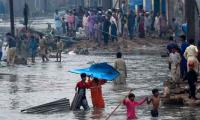
Despite the devolution of the Disaster Management Authorities post the 18th Amendment to the provinces, there has been little or no contingency planning for rain-induced disasters. Those who credited good governance for the last two years’ calm may want to reconsider; it was luck, not leadership, that spared us. A lack of precipitation simply left our fragile contingency systems unexposed till the worst came.
If only adding words to the constitution could alleviate the plight of citizens. Article 9-A which was added in October 2024 to the constitution, was supposed to provide every Pakistani with a “clean and healthy environment”. Things have shaped up differently though, and the numbers tell a very different tale, with scores dead across the country in the past few days alone due to rain havoc. The NDMA’s 2025 Monsoon Infrastructure Guidelines were released on schedule, emphasising pre-disaster planning. These protocols just seem like a duplication, mimicking guidelines issued from 2022, which themselves echoed 2020’s version. One might conclude that disaster management, like much else, has merely been reduced to an annual copy-paste exercise.
The Supreme Court declared in July that government delays in implementing climate reforms violate citizens’ fundamental rights. Parliament had already responded by passing Article 9-A. The floods arrived anyway, apparently unaware of their ‘unconstitutionality’. In May this year, the IMF approved a $1.4 billion climate loan to help Pakistan build resilience to natural disasters through “strengthening public investment processes” and “improving coordination”. Interestingly, just two months after the loan’s approval, tourists were being swept away on Babusar Road. The coordination between the loan’s approval and its implementation appears to have encountered familiar delays. Not a single dollar of the climate funding has actually been disbursed as yet, exposing a textbook case of mismanagement.
For those seeking more tangible evidence of our progress, consider the billion-rupee early warning system installed in Bagrot Valley under the UNDP-funded GLOF-II Project. On August 2, when a glacier burst killed a 12-year-old boy and injured his father, the system reiterated the government’s inefficiency and played its part by remaining silent. Opposition leaders, ever ungrateful, have alleged ‘large-scale corruption’ in such protection projects, which brings to light why we installed this billion-rupee system in the first place.
District Disaster Management Authorities, according to recent reports, remain “inactive or under-resourced until emergencies strike”. They operate, it seems, on an as-needed basis; the need being determined by media attention a lot more than weather forecasts. When floods arrive, meetings are convened, leaves are cancelled and officials coordinate rescue efforts from their offices.
In Layyah, our revered engineering feats have set new records, albeit in the wrong direction. A newly-constructed bridge embankment, engineered to modern standards, surrendered to a mere 300,000 cusecs of water. Local residents vividly recalled how the same area weathered 800,000 to 1,000,000 cusecs in 2010 without incident. Progress, it appears, flows backward in Punjab. Thousands have relocated to what a report delicately termed ‘under the sky’ – our most democratic housing scheme yet.
Punjab allocated Rs795 billion for “climate resilient” infrastructure. Gilgit-Baltistan has already accumulated Rs20 billion in damages; an impressive national return on investment by any standard. The prime minister visited the National Emergencies Operation Centre. Conferences, as usual, were held. Amid this red tape-ism, the Babusar cloudburst destroyed a wheat depot, a girls’ school, four bridges and two mosques. The army helicopters, as per tradition, arrived after the disaster rescuing 200 people.
The Met Department continues issuing warnings about heavy rains triggering floods in areas where heavy rains have always triggered floods. Local authorities monitor low-lying areas for potential urban flooding, though the monitoring rarely translates into prevention. Our cities’ drainage systems, designed for smaller populations and simpler times, remain overwhelmed by entirely predictable monsoon patterns. The pattern of development continues unabated. Houses are built in riverbeds, environmental assessments are circumvented, and natural waterways are treated as prime real estate. When the inevitable occurs, we discuss the unprecedented nature of these very precedented disasters.
The Tarbela Dam situation illustrates our approach perfectly. Water levels approaching capacity are treated as breaking news rather than basic hydrology. We await flood waves with the surprise of those who’ve never consulted a calendar, despite monsoons arriving with metronomic regularity.
Pakistan has become remarkably efficient at securing international assistance for disasters we’re remarkably inefficient at preventing. Of the $10.99 billion pledged after the 2022 floods, we’ve received $4.9 billion – just enough to ensure we’ll need more pledges after the next scheduled catastrophe. This is our 28th IMF programme in 35 years. At current rates, we may soon have more climate loans than climate policies, more disaster frameworks than functional drains, more constitutional articles than rescued citizens. The poor, as always, bear the highest cost. They build where they can afford to build, knowing the risks because they have no alternatives. When floods come, they lose what little they have while committees debate what went wrong; the same things that went wrong last time, and the time before.
Real solutions exist but require what we seem incapable of: sustained attention beyond crisis cycles, enforcement of existing laws and recognition that annual disasters treated annually as surprises are neither natural nor inevitable. They are choices, made repeatedly, with predictable consequences. Our new constitutional right to a clean and healthy environment currently includes the right to drown in predictable floods, collapse with substandard housing, and wait for rescue operations that begin after the damage is done. The environment may not be clean or healthy, but it is certainly constitutional.
Perhaps next year will be different. Perhaps the guidelines will be implemented, the drains will be cleared and the warnings will be heeded. Or perhaps we’ll reconvene to discuss the unprecedented nature of the monsoon that arrives, as it always has, right on schedule. One suspects miraculous intervention may be our most reliable disaster management strategy yet. After all, in Pakistan, some traditions are worth preserving. Even the deadly ones.
The writer is an economist and an educationist.