
How Pakistan wooed Trump and rattled India: FT
Trump administration's ties with Islamabad appear to be blossoming, while India has faced scorn
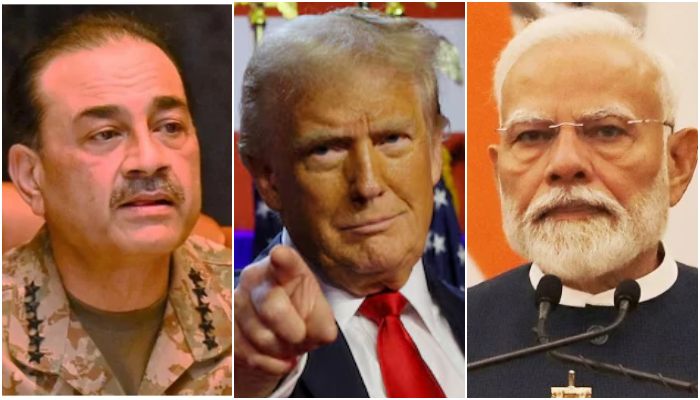
Pakistan’s army chief has pulled off a diplomatic surprise twice this summer, winning warm receptions from US President Donald Trump and top US generals, signalling an unexpected thaw in Washington-Islamabad ties even as relations with India sour, reports The Financial Times.
The report written by Humza Jilani in Islamabad, John Reed in New Delhi and James Politi in Washington, is replicated here: “Pakistan’s chief of army staff Asim Munir smiled for the camera this weekend, arm in arm with a top American general — his second warm welcome this summer into the heart of the US establishment.
Munir travelled to Florida for the retirement of General Michael Kurilla, the commander of US military forces in the Mideast, who has previously praised the Pakistan strongman for a “phenomenal partnership” in the fight against terrorism. To General Dan Caine, America’s top military officer, Munir passed a plaque and an invitation to visit Pakistan.
Even more remarkably, in June Munir had a two-hour private lunch in Washington with Donald Trump, just a month after Pakistan and arch-rival India fought their bloodiest military confrontation for decades.
It was an astonishing reception for a man who, despite wielding the country’s most powerful office, is not a head of government -- and even more so for an official representing Pakistan. Relations with Washington were assumed to be heading for the rocks after the re-election of Trump, who once accused the nuclear-armed country of 240mn people of offering the US “nothing but lies and deceit”.
Instead, the Trump administration’s ties with Islamabad appear to be blossoming, while India -- which was left seething by Munir’s White House welcome -- has faced scorn despite Narendra Modi’s previous friendly bond with Trump.
“What’s happening in US-Pakistan relations is a surprise. I would describe the relationship now as one that’s enjoying an unexpected resurgence, even a renaissance,” says Michael Kugelman, a non-resident senior fellow at the Asia Pacific Foundation. “Pakistan has very successfully understood how to engage with such an unconventional president.”
India and Pakistan’s contrasting diplomatic fortunes have the potential to upend geopolitics in volatile South Asia and are already feeding into trade, where the US gave Islamabad a relatively light 19 per cent tariff while hitting New Delhi with a punitive 50 per cent.
Trump also promised a deal to develop what he called Pakistan’s “massive Oil Reserves”, while Pakistan is offering other investment opportunities to the US, hoping to revive its bailout-dependent economy.
The newfound US admiration for Pakistan is partly the fruit of a charm offensive concocted by Pakistan’s senior generals, leveraging counterterrorism co-operation, outreach to business people close to Trump and deals covering energy, critical minerals and cryptocurrencies — all accompanied by a cascade of flattery for the White House.
Leaders in Islamabad believed they needed to urgently get into the good graces of the erratic president and some of his allies who had been deeply critical of Pakistan over its alleged support for the Taliban during Nato’s war in Afghanistan.
Project 2025, a pre-election blueprint that has inspired many early Trump administration moves, lambasted Pakistan’s military-dominated regime as an “intensely anti-American and corrupt” client of China. Members of Trump’s inner circle also targeted increasingly autocratic Pakistan’s treatment of jailed former prime minister Imran Khan. A bipartisan group in Congress began to draft legislation to impose sanctions on Munir over Khan’s imprisonment.
“We had no idea what to expect with him, but the general consensus was that it was likely going to be rough,” said one senior Pakistani diplomat.
Pakistan’s turnaround was helped early on by what the US saw as an important arrest. In March Asim Malik, the head of Pakistan’s Inter-Services Intelligence spy agency, delivered a high-value Isis-K operative who the US said was behind a 2021 bombing in Kabul that killed more than 180 people, including 13 US soldiers. His capture earned Pakistan Trump’s praise in his March State of the Union address, when the US president also lambasted India over high tariffs.
Crucially, too, Pakistan deployed a form of crypto diplomacy to make its way into Trump’s inner circle.World Liberty Financial, a Trump-backed cryptocurrency venture, signed a letter of intent with Pakistan’s crypto council in April, when its co-founders visited Pakistan. Zach Witkoff, the son of US special envoy Steve Witkoff, said during the trip that Pakistan had “trillions of dollars” of mineral wealth ripe for tokenisation.
Since then, Bilal bin Saqib, Pakistan’s minister for crypto and blockchain, has emerged as a shadow diplomat, taking part in trade talks with Washington and pitching Pakistan’s crypto potential to figures close to Trump’s family and advisers.
Pakistani officials also point to their conduct during the May conflict with India as having bolstered their credibility with Trump. In their telling, Pakistan displayed a combination of strength and restraint, shooting down a handful of Indian jets but refraining from massive escalation, while the US and Gulf states worked the phones to secure a ceasefire.
Islamabad also gave credit to Trump for brokering the truce with New Delhi -- to the point of nominating the US president for the Nobel Peace Prize. Trading his khakis for a suit and tie this weekend, Munir again heaped praise on the US president when speaking to a group of Pakistani-Americans in Tampa.
Munir said Trump’s “strategic leadership” had prevented “many wars in the world”, according to a Pakistani official.“Trump needs success stories to proclaim and Pakistan is happy to give them to him”, says Husain Haqqani, a former US ambassador to Pakistan now at the Hudson Institute, a think-tank in Washington.
By contrast, Modi has taken a more flinty approach. The day before the lunch with Munir in June, the Indian leader had a testy phone call with the US president about his role in the truce. Modi then publicly contradicted Trump by saying the agreement with Pakistan did not come about because of American intervention, but was at Pakistan’s initiative and took place through existing channels of communication between the two countries’ armed forces.
“Prime Minister Modi firmly stated that India does not and will never accept mediation,” India said in a summary of the call.Munir’s visit to see the president, which came as the US prepared military strikes on Iran, also helped Pakistan’s military chief tout another facet of their relationship: military and intelligence co-operation.
Munir essentially offered Pakistan as a trusted back channel between the US and its adversaries Iran and China, a strategy that harks back to the Pakistan of the 1970s that facilitated Richard Nixon’s opening of US relations with Communist China.
While Pakistan rebuked Washington for the strikes against Iran, the country continued to try to cast itself as a mediator between the US and its foes. In late July, Munir flew to Beijing, where he toured the headquarters of the People’s Liberation Army and promised Chinese foreign minister Wang Yi that he would protect Chinese workers in Pakistan from insurgent attacks.
And in between warm encounters with US Centcom commander Kurilla, who received military honours from Pakistan’s government in late July, Munir has also welcomed Iranian President Masoud Pezeshkian to Islamabad.
“Pakistan is a rare country that is friends with China, Iran, the Gulf states, to a lesser extent Russia, and now, again, the US,” said Marvin Weinbaum, a senior fellow at the Middle East Institute in Washington. “The US sees Munir as someone who can play a useful strategic role, and the Pakistanis keep their lines open to everyone but know to pull back when one relationship is clashing with another.”
For India, the burgeoning relationship between Trump and its arch-rival has caused deep irritation, aggravated by its own failure to fend steep tariffs on its far bigger economy. Trump first levied a 25 per cent tariff on India, then doubled it to 50 per cent because of Russian oil purchases. “It will take some time to get over the lack of trust here,” said one person briefed on the events.
Indian officials are also irked at seeing military-ruled Pakistan rewarded after luring Washington with business deals. “It’s very easy to deal with dysfunctional systems,” the person said — a reference to the ease with which Pakistan turned what looked like a weak position at the start of Trump’s term into a win.
Current and former Pakistani officials and analysts warn that Trump could still turn on Islamabad if it fails to deliver. Most of Pakistan’s natural resource riches are either unproven or lie in volatile provinces beset by insurgencies that led to 2,000 deaths last year. Pakistan’s economy relies on a $7bn IMF bailout and debt rollovers from China and Gulf allies. -- FT


-
 State institutions ‘fail’ to perform constitutional duties: KP CM
 -
 CTD orders psychological testing of police on VVIP security duty
 -
 Navy busts drug consignment valued at $130m
 -
 Three ex-secretaries in race for ETPB chief post
 -
 Punjab govt forms 71 JITs to probe cases against banned TLP
 -
 Some UNSC members ignoring broader reforms, seeking privilege: Pakistan
 -
 PAC body discusses non-recovery of Rs15bn gas cess
 -
 Pakistan received $2.29bn foreign loans in first 4 months of 2025