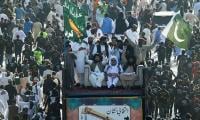
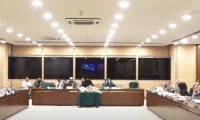
ISLAMABAD: PTI parliamentarians Monday created uproar and raised slogans in the National Assembly after Speaker Sardar Ayaz Sadiq disallowed Barrister Gohar to speak on a point of order during the question hour.
Meantime, PTI Member Iqbal Afridi pointed out lack of quorum. However, on counting, the house was found in order. Ridiculing the protesting PTI members, PPP MNA Agha Rafiullah said, “They are not sincere with Imran; they do not want his release, rather they are doing all this for the social media.”
Through a resolution, the House demanded that the government celebrate the 1500th Miladun Nabi (SAW) in a befitting manner at the official level by organising events and ceremonies and illuminating the main building, highways and roads.
The resolution also called for promoting peace, brotherhood and harmony across the country and observe the occasion with complete respect, unity and religious fervour. Meanwhile, the National Assembly in connection with the National Minorities Day, adopted a resolution demanding of the government to include a part of speech of Quaid-e-Azam Muhammad Ali Jinnah to the Constituent Assembly of Pakistan on August 11, 1947 regarding religious freedom in the national curricula.
The founder of the nation in speech said, “You are free; you are free to go to your mosques, you are free to go to your temples or to any other places of worship in this State of Pakistan. You may belong to any religion or caste or creed — that has nothing to do with the business of the State.”
The resolution originated from the minority MNAs Naveed Aamir Jeeva, Dr. Darshan, Ramesh Lal and Nelson Azeem, and was also signed by other law-makers from the government and opposition benches.
Meanwhile, Minister of State for Interior Talal Chaudhry informed the House that the government was taking all possible steps to make air travel affordable and improve visa facilities for Pakistani pilgrims going to Iran, Iraq, and Syria after the suspension of land routes.
Responding to a calling attention notice on the problems faced by pilgrims due to the sudden policy changes, he said air travel was currently expensive because of peak-season rates but the government was trying to arrange special flights at lower fares so that pilgrims can reach Iraq before 28 Safar.
Addressing the concerns of PTI chief whip Malik Aamir Dogar, he said the government does not plan to permanently close the traditional land routes, and that this year’s decision was made only to protect the citizens’ lives.
He said land travel had been stopped this year due to the security concerns, including the Iran-Israel conflict, which had increased risks for the travelers. He said Iraqi authorities had also been engaged to extend visa validity. Normally, visas require pilgrims to travel and return before 28 Safar, but the government wants to adjust this according to the new travel schedule.
He said the government had also approved more than 131 extra flights by Pakistani and foreign airlines to Iran and Iraq to meet the demand, while fare discounts will also be offered to Zaireen.
A special committee has been set up with members from the Shia Ulema Council, Majlis Wahdat-e-Muslimeen (MWM), and other groups to ensure that travel and visa facilitation is implemented in a transparent and efficient way.
Responding to another calling attention notice, Federal Minister for Parliamentary Affairs Dr. Tariq Fazal Chaudhry informed the House that the National Disaster Management Authority (NDMA) operates round-the-clock to deal with disasters such as floods, earthquakes, and other emergencies.
Talking about the lack of earthquake awareness campaigns and preparedness drills, particularly in Karachi, he said the NDMA carries out regular risk assessments and technical evaluations to address natural calamities.


-
 Aurangzeb confirms Saudi Arabia $10bn interest, says B2B shift ongoing
 -
 Pakistan to build artificial island to boost oil exploration
 -
 Special pink bus service launched for women on Green Line route
 -
 Same number plates from other provinces lead to wrong e-challans for Karachiites
 -
 State institutions ‘fail’ to perform constitutional duties: KP CM
 -
 CTD orders psychological testing of police on VVIP security duty
 -
 Navy busts drug consignment valued at $130m
 -
 Three ex-secretaries in race for ETPB chief post