
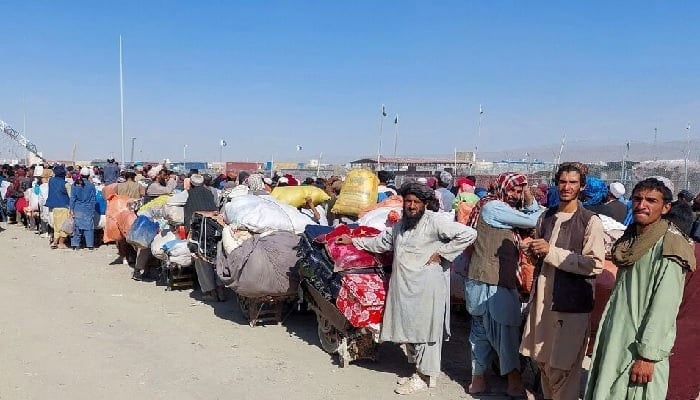
PESHAWAR: Hundreds of thousands of Afghans living in Pakistan for over four decades have started packing up after the government’s final call for repatriation.
A large number of these Afghans run businesses worth billions of rupees in different parts of Khyber Pakhtunkhwa and the rest of the country. They have begun winding up operations after recent orders by the federal and provincial governments.
The Afghan businessmen own factories, shops, restaurants, transport vehicles, while thousands of others work as pushcart vendors selling fruits, vegetables, and other items in Peshawar and many other areas of KP. They also own thousands of properties in various localities.
There are hundreds of shops owned by Afghan nationals in Board Bazaar, Tehkal, Afghan Colony, Faqirabad, Gulbahar, Rashid Garhi, Phandu, Kohat Road, Hayatabad, GT Road, Badaber, and many other areas.“We think the time is over for us in Peshawar. We have started packing up our businesses and resolving other issues, but we need some time to do it properly,” said Khan Mohammad, a shopkeeper on Kohat Road. He added that his entire family was in shock, as they had always considered Peshawar their home.
Countless Afghans were born in Pakistan and have rarely visited their homeland in recent decades.“I and all my siblings were born in Peshawar. We have never seen any part of Afghanistan in our lifetime,” said Ulas Khan, a 32-year-old fruit vendor. He said some of his family members had married locals and were now worried about the future of their children and spouses.
An Afghan businessman estimated that his countrymen were running businesses worth billions of rupees in Peshawar and other parts of Pakistan, and said they needed sufficient time to wind them up.
Some businessmen want an extension of their stay, while others demand easier visa rules and conditions so they can continue to look after their businesses.
Over the past few months, Afghan men and women have approached the Peshawar High Court, citing marriages with local citizens, but were directed to return to Afghanistan.
The Peshawar district administration last week held meetings to finalise arrangements for the repatriation of Afghan refugees from next month. Similar preparations have begun in other districts.
The government, in the first week of August, directed the repatriation of all categories of Afghan refugees settled in Pakistan since the Soviet invasion of Afghanistan.“The Government of Pakistan has decided to repatriate all Afghan nationals holding Proof of Registration (PoR) Cards. It is clarified that all Afghan nationals whose PoR cards expired as of June 30, 2025, are now staying illegally,” stated an order issued by the Khyber Pakhtunkhwa Department of Home and Tribal Affairs, following a similar directive from the federal government.
Previously, Afghan nationals without legal documents or those with Afghan Citizen Cards (ACC) had been ordered to return to Afghanistan.
The order further stated that all Afghan nationals without valid documents and Pakistani visas are now staying illegally under Pakistani immigration laws, and are expected to return to their country voluntarily and respectfully.
The KP government said it had made arrangements to carry out the process in an organised and dignified manner at established repatriation points in Peshawar and Landikotal.
The United Nations High Commissioner for Refugees (UNHCR) expressed concern over Pakistan’s intention to forcibly return Afghan refugees holding PoR cards, saying such individuals have been recognised as refugees for decades.
“Their forced return would violate international principles and Pakistan’s own long-standing humanitarian approach,” the UNHCR said.
The UNHCR recently estimated there are around 2.1 million Afghans in Pakistan, of whom 1.3 million hold PoR cards, with over 52 percent living in KP.
In addition, there are about 800,000 Afghans holding ACC cards, most of them in KP, as well as tens of thousands without any documents.
PoR card holders were registered with UNHCR support in 2006, while ACC card holders were documented in 2017 under the National Action Plan.
In 2023, the government set October 31 as the deadline for unregistered foreigners, after which hundreds of thousands of Afghans returned to their homeland via Torkham and other border crossings.




-
 State institutions ‘fail’ to perform constitutional duties: KP CM
 -
 CTD orders psychological testing of police on VVIP security duty
 -
 Navy busts drug consignment valued at $130m
 -
 Three ex-secretaries in race for ETPB chief post
 -
 Punjab govt forms 71 JITs to probe cases against banned TLP
 -
 Some UNSC members ignoring broader reforms, seeking privilege: Pakistan
 -
 PAC body discusses non-recovery of Rs15bn gas cess
 -
 Pakistan received $2.29bn foreign loans in first 4 months of 2025