US tariffs, trade tensions to dent growth in Asia and Pacific: ADB
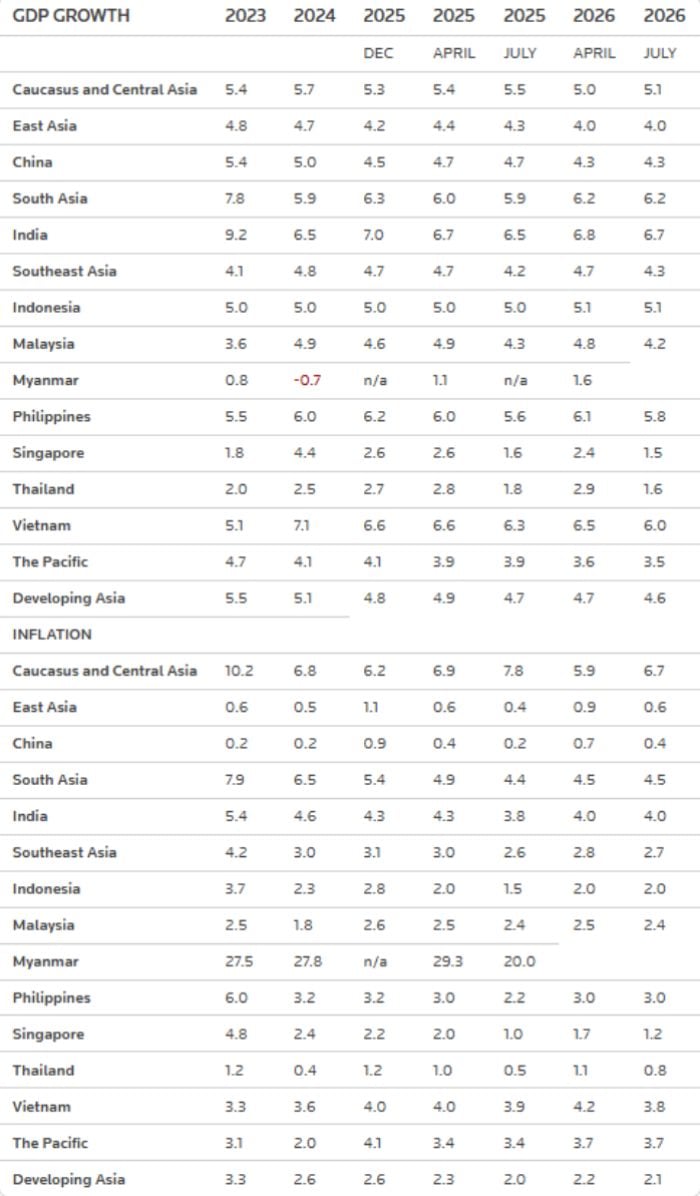
ADB cut its 2025 growth forecast for the region to 4.7% from a projection of 4.9%
MANILA: Higher US tariffs and global trade uncertainty have further dimmed the economic outlook for developing Asia and the Pacific, the Asian Development Bank (ADB) said in a report on Wednesday, as it revised down its growth forecasts for the region for both this year and the next.
Domestic demand is expected to come under pressure due to a combination of geopolitical tensions, supply chain disruptions, elevated energy prices, and ongoing uncertainty in China’s property market, according to the latest Asian Development Outlook report.
The ADB downgraded its growth projection for 2025 to 4.7%, down from its April forecast of 4.9%. The outlook for 2026 was also lowered slightly to 4.6%, from an earlier estimate of 4.7%.
"Asia and the Pacific has weathered an increasingly challenging external environment this year. But the economic outlook has weakened amid intensifying risks and global uncertainty," ADB Chief Economist Albert Park said.
Among the subregions, Southeast Asia is expected to slow the most, with growth now projected at 4.2% in 2025 and 4.3% in 2026, down from earlier forecasts of 4.7% for both years.
"Economies in the region should continue strengthening their fundamentals and promoting open trade and regional integration to support investment, employment, and growth," Park said.
The ADB defines developing Asia and the Pacific as 46 economies ranging from China to Georgia to Samoa, and excluding countries such as Japan, Australia and New Zealand.
The forecasts were made shortly after President Donald Trump said the US and Japan had struck a deal that includes a 15% tariff on Japanese exports, lower than a threatened 25% rate. Trump also announced a new 19% tariff rate for goods from the Philippines, below the threatened 20% levy flagged earlier this month but still above a 17% rate announced in April.
Trump has upended global trade flows with tariffs on nearly every trading partner, with almost all countries facing a 10% tariff that took effect in April and many facing steep additional tariffs from August.


-
 Qualcomm and Apple extend global patent licensing agreement: What to know
 -
 Chinese AI startup DeepSeek hits $1 billion annualized revenue run rate following API price hikes
 -
 Morgan Stanley staffer accidentally emails Asia deal to outsiders: Key details to know
 -
 Oil prices drop for fifth straight session amid hopes for Iran diplomacy and Saudi pipeline
 -
 Apple aims to take on Microsoft, Nvidia in a rush to lower AI costs with new devices
 -
 SoFi launches first U.S. stablecoin settlements on Mastercard: What users need to know
 -
 Banks raise red flags over AI shopping bots and scam risks: What to know
 -
 Alibaba shares jump 5% as it debuts 'most powerful' AI chip and 10-trillion-parameter model