Germany's far right targets greater influence in new parliament
AfD came second only to conservative CDU-CSU alliance, which is currently in negotiations to form a govt with SPD
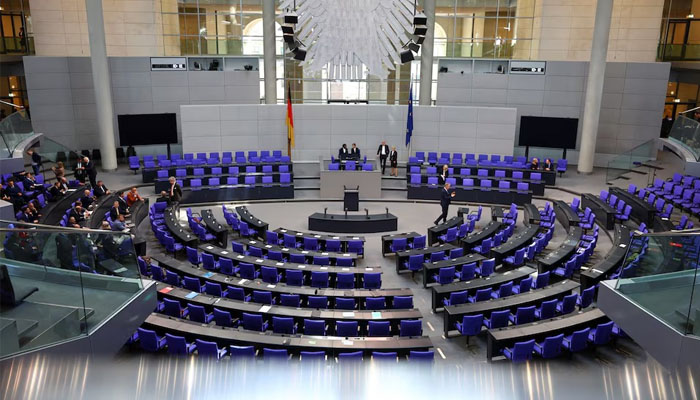
Germany's new parliament sits for the first time on Tuesday, with a record number of MPs from the far-right AfD expected to lay claim to several senior positions in the chamber.
The Alternative for Germany (AfD) came second only to the conservative CDU-CSU alliance, which is currently in negotiations to form a government with the Social Democrats (SPD) of outgoing Chancellor Olaf Scholz.
Julia Kloeckner of the CDU is expected to be elected as the new president of the Bundestag after it convenes at 11:00 am (1000 GMT).
The AfD scored 20.8% of the vote in February's election, almost doubling the number of lawmakers it has in the lower house, with 152 of the 630 seats.
As the second-largest party, the AfD would typically be entitled to various senior positions, including influential roles in parliamentary committees.
However, other parties have previously organised to keep the AfD out of such positions to maintain a long-held "firewall" against allowing the far right into positions of power.
"We will claim all the rights and all the positions we are entitled to as the second-largest group in the parliament," Bernd Baumann, the head of the AfD's parliamentary group, told AFP.
"If our political opponents continue to try to deprive us of our rights and our posts, they will be ignoring the will of more than 10 million voters who have made us the largest opposition group," he said.
The AfD wants to nominate a vice president of the parliament, as well as the presidents of several committees.
It is also demanding a place on a parliamentary body responsible for overseeing Germany's intelligence services.
Several chapters of the AfD are under surveillance by intelligence services as they have been classified as right-wing extremists.
SPD lawmaker Lars Castellucci argued that while "the parliamentary participation of the AfD must be guaranteed", precautions must be taken with regard to parties "when there are doubts about their compliance with the constitution".
The conservatives have been more cautious with their censure, with the CDU's Patrick Schnieder pointing out simply that "every candidate must submit to a democratic election" for parliamentary posts.
Parliamentary procedure gives every party in the Bundestag a vice president, but the AfD, which has returned deputies since 2017, has so far failed to get the votes to have its candidates elected.
For the committees, the parties typically decide among themselves who is allocated the head of which group.
As the expected main opposition in the Bundestag, with almost a quarter of the seats, the AfD will receive a greater share of state financing for parties, be allocated more staff and get more speaking time.


-
 Germany’s far-right AfD projected to win another state victory, as Merz’s CDU plunges
 -
 Russia could test NATO in coming months, European intelligence chiefs warn
 -
 Australia bans card payment surcharges from Oct 1: Here's What the RBA changes mean
 -
 Former Chile president Michelle Bachelet exits race to lead United Nations
 -
 Trump says massive DC triumphal arch will house ammunition and rooftop sniper facilities
 -
 Taiwan minister makes rare trip to China for APEC meeting in first under Lai
 -
 Italy plans school veil ban and limits on foreign students per class: Here’s why
 -
 Ukraine strikes Moscow with drones and Flamingo missiles during Russian election