Civilians' military trial: SC judge laments 'arson' trend
"Why do you want SC to intervene in matters that are parliament's responsibility?" questions Justice Afghan
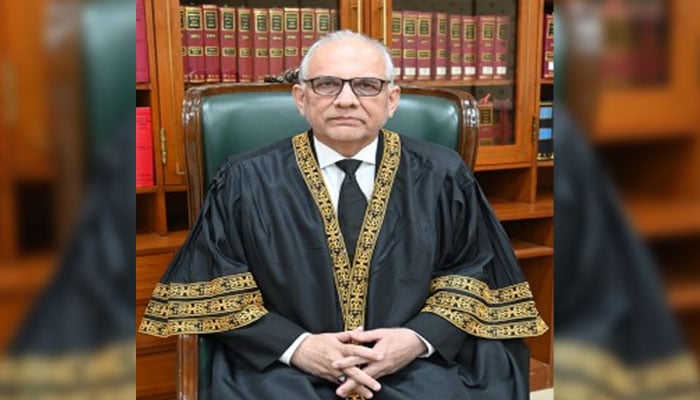
ISLAMABAD: Noting that vandalism had taken place inside the Lahore Corps Commander's House on May 9, 2023, Supreme Court's Justice Hasan Azhar Rizvi on Tuesday lamented that acts of arson and destruction had now become a trend.
The judge's remarks came during a hearing by a seven-member constitutional bench headed by Justice Amin-Ud-Din Khan during an intra-court appeal against military trials of civilians.
During the hearing, Advocate Salman Akram Raja, while representing convicted Arzam Junaid, argued that the main verdict stated that courts could not be established beyond Article 175(3) of the Constitution.
Representing convicted accused Arzam Junaid, presented arguments before the court, Advocate Salman Akram Raja argued that the main verdict stated that courts could not be established beyond Article 175(3) of the Constitution.
In response, Justice Muhammad Ali Mazhar noted that in service matters, initial hearings are conducted at the departmental level.
Raja further asserted that Article 175(3) should also apply to army officers. Justice Naeem Akhtar Afghan observed that the Constitution was enacted in 1973 and that the 18th Amendment had reviewed martial law regulations.
"Why do you want the SC to intervene in matters that are parliament's responsibility?" he questioned.
Justice Afghan added that the issue would be examined if a military officer was involved and urged that the counsel to stay within the limits of the said case.
He also mentioned that India had amended its laws through parliamentary legislation. Meanwhile, Justice Rizvi pointed out that footage of the May 9 incidents had been broadcast on television, highlighting the damage inflicted on the Corps Commander's House.
He remarked that breaking into homes and damaging property had become a culture, drawing comparisons to incidents in Bangladesh and Syria. At this, Justice Jamal Khan Mandokhail commented that entering any citizen's home was also a crime.
Justice Rizvi then questioned whether there had ever been similar attacks on Corps Commanders' Houses anywhere in the world. In response, Raja stated that such attacks had occurred and that he could provide examples.
Justice Mazhar inquired whether the legal concerns raised in previous court rulings had been addressed through legislation. Justice Mandokhail remarked that the parliament seemed to be preoccupied with other matters, stressing that discussions being held in court should instead take place in the parliament.
Raja argued that judicial authority should be exercised in the sentencing process, citing past decisions by the Balochistan High Court that protected civilians during martial law.
He also referenced a significant ruling by Justice Waqar Seth (late) of the Peshawar High Court, which was even mentioned at the International Court of Justice but was later suspended by the SC. He reiterated that no court could be established beyond Article 175(3).


-
 Punjab by-polls: Notices served on minister, SAPM for ‘violating’ election code of conduct
 -
 27th Amendment empowers FCC to hear all constitutional cases: minister
 -
 JF-17 attracts strong attention at Dubai Airshow as friendly country inks procurement MoU
 -
 US lawmakers laud Punjab govt's initiative to modernise brick-kiln
 -
 Security forces gun down 30 terrorists in multiple IBOs in KP: ISPR
 -
 MQM-P calls for new province in Sindh
 -
 US report validates Pakistan military edge over India: PM
 -
 Banned TTP poses serious threat to Pakistan security: UNSC panel