SC grants govt additional time to file appeal against NAB amendments' verdict
"There is now a right of appeal under the Practice and Procedure Act," AGP says in a statement
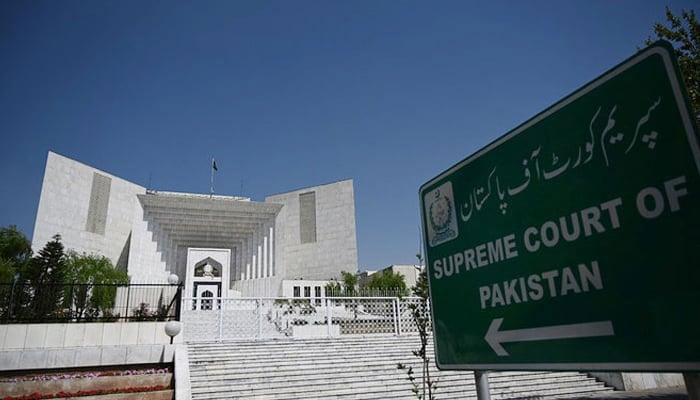
As the Supreme Court (Practice and Procedure) Act 2023 came into force, the apex court Tuesday granted 15-day time to the federal government to file its appeal against its decision striking down amendments to the National Accountability Bureau (NAB) laws.
The Attorney-General for Pakistan Mansoor Awan said the extension has been sought to add additional grounds in the appeal against the judgment issued by SC on September 15 pertaining to the case.
"There is now a right of appeal under the Practice and Procedure Act," the AGP said in a statement.
The SC, on September 15, ruled to strike down some amendments made to the National Accountability Ordinance (NAO), 1999. The NAB amendments case was related to public importance; thus, it fell under the original jurisdiction of the superior court i.e. Article 184(3) of the Constitution.
The time limit for filing a revision against the SC decision expired on October 15 with the government seeking 15 more days for filing an appeal.
The government was, however, supposed to file the appeal against the NAB amendments verdict today.
With the application of the SC law following the top court's decision to uphold it, additional time has now been granted to the government.
Through the appeal, the government is likely to ask the SC to annul the decision against the NAB amendments and order its restoration.
Meanwhile, petitioner Zubair Ahmed Siddiqui has filed an appeal against the same verdict of the apex court.
Last week, Pakistan People's Party (PPP) Senator Farooq H Naek filed a review petition against the aforementioned decision on October 14.
The lawyer filed the review petition on behalf of a citizen named Abdul Jabbar, who was neither party in the litigation nor did he belong to any political party. However, he was directly affected by the judgment against the NAB amendments, as an accountability reference against him was pending.
It should be noted that the SC had, in a majority decision of 10-5 on October 11, upheld the law formulated to regulate the affairs of the top court, but noted that although the right to appeal provided against a decision taken under Article 184(3) will not be applicable retrospectively, it will apply to those ruling which were issued after the law came into effect.
The Parliament had passed the Supreme Court (Practice and Procedure) Act, 2023, in April, and the apex court struck down the amendments to the NAB law in September, allowing the right to appeal.


-
 Punjab by-polls: Notices served on minister, SAPM for ‘violating’ election code of conduct
 -
 27th Amendment empowers FCC to hear all constitutional cases: minister
 -
 JF-17 attracts strong attention at Dubai Airshow as friendly country inks procurement MoU
 -
 US lawmakers laud Punjab govt's initiative to modernise brick-kiln
 -
 Security forces gun down 30 terrorists in multiple IBOs in KP: ISPR
 -
 MQM-P calls for new province in Sindh
 -
 US report validates Pakistan military edge over India: PM
 -
 Banned TTP poses serious threat to Pakistan security: UNSC panel