Airbus unveils new wing development centre for next generation aircraft
New facility will help Airbus accelerate the design, build and testing of wings, says statement
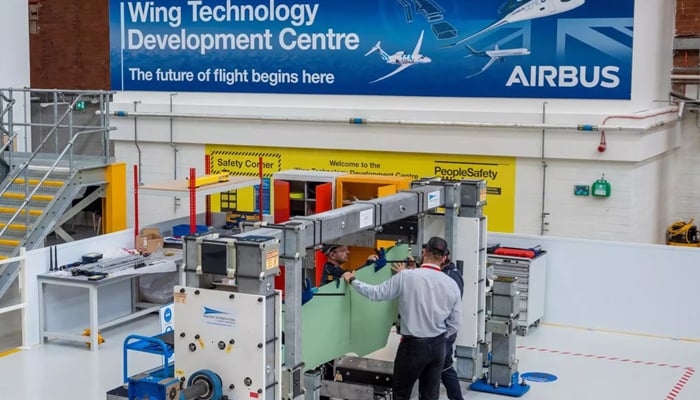
Airbus has unveiled a new wing development centre to further improve the performance of its wings for next generation aircraft amid competition with Boeing which researches an elongated, ultra-light concept called Transonic Truss-Braced Wings.
Airbus is investing further in its UK innovation capabilities, with the opening of a new Wing Technology Development Centre (WTDC) at its Filton site on Wednesday, the planemaker announced on its official website.
“The facility, which will be used to build and test demonstrators for a range of programmes and research projects, was opened by Nusrat Ghani, UK Minister of State at the Department for Business and Trade,” it added.
The new facility will help Airbus accelerate the design, build and testing of wings for next generation aircraft, by using the latest technology and world-leading demonstrators to further improve the performance of its wings.
Alongside engine optimisation, making wings longer, leaner and lighter is one of the biggest opportunities to improve fuel efficiency, reduce CO2 and ultimately work towards the aviation industry’s ambition to achieve net zero carbon emissions by 2050, the aerospace company said.
“The new Wing Technology Development Centre will help us to ground our research in practicality. A key element of how we deliver technology for next generation aircraft wings is through Wing of Tomorrow (WoT), our largest research and technology programme led by the team in the UK, Airbus head of filton site Sue Partridge said.
“Last week, we achieved a critical milestone in the programme when our second wing demonstrator was completed by the team in Broughton, Wales and delivered to the WTDC. Here it will be prepared for structural testing in our Aerospace Integrated Research and Technology Centre (AIRTeC),” the official added.
The WoT programme allows Airbus to explore new manufacturing and assembly technologies so future generations can continue to benefit from flying.
“It’s about preparing our people, technology, industrial system, supply chain and digital and physical capabilities for next generation aircraft. We’re leveraging industry partners and the very best digital tools and automation to identify potential technology bottlenecks that may slow us down in the future. The foundations we lay now will help us build better and faster when the time comes,” the official statement added.


-
 Micron gives Taiwan workers up to 68 months pay after strike threat
 -
 SpaceX landed its fourth billion-dollar AI customer
 -
 EU approves major investment in Ukraine’s air defense: How patriot missiles work
 -
 EU watchdog sounds alarm over risk of abrupt market correction
 -
 Channel 4 to cut hundreds of jobs in major restructuring: What to know
 -
 Google commits $15B to Finnish AI infrastructure, marking its largest-ever European investment
 -
 No ticket? New TSA program lets non-travelers past airport security
 -
 Singapore raises ministers’ salaries for the first time in 15 years: Here’s why