
Gone are the days of Badar Munir,but Pashto films still draw crowds in Karachi
Karachi
Muhammad Irfan, who lives in Hijrat Colony, drives a rickshaw for six days a week, but takes a day off on Sundays to watch Pashto movies at Mussarat cinema in Nazimabad.
Irfan has been watching Pashto movies since 1995. “In recent years, several cinemas running Pashto films have been closed,” he lamented. “Now I go to Nazimabad to watch movies.”
Many cinemas in Karachi have shut down and replaced with shopping malls and residential buildings. At the city’s multiplexes, mainly Hindi, English and few Urdu movies are screened. However, there are still a few cinemas that run Pashto films.
There were over 25 cinemas screening Pashto movies in the city until 10 years ago, say Pashto cine-goers, producers and directors, and cultural activists.
“Only in the Orangi and Nazimabad, there were Metro, Shahzad, Chaman, Regent and Mussarat cinemas exclusively screening Pashto movies,” said Irfan.
“But now we only have one cinema in Nazimabad. The rest have been closed.”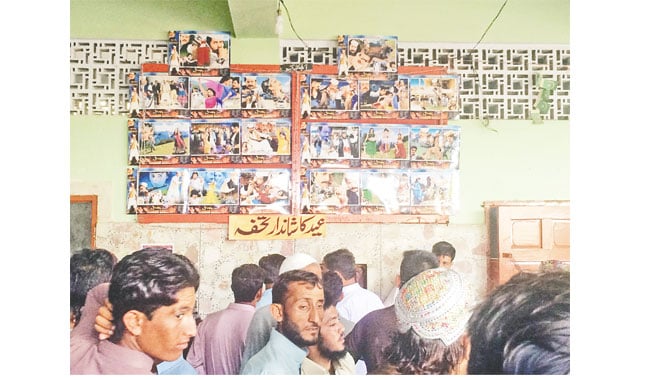
Last month, Nargis and Lalazar – two of the four Pashto movie cinemas in Landhi – were converted to wedding halls.
At Sheesh Mehal cinema in Landhi 89, dozens of cine-goers have gathered after Friday prayers to by tickets to watch a Pashto movie.
Akbar Shah, a cinema employee, said Fridays and Sundays were their busiest days when Pashtun cine-goers, most of them industrial workers and public transport drivers, spared time to watch movies.
“After the introduction of cable TV, CDs, internet, and mobile phones, the number of cine-goers has decreased to a great extent,” Shah told The News. However, he added that as Landhi had a large Pashtun population, the number of cine-goers at his cinema was still satisfactory.
Karachi and Pashto film industry
Karachi has its own significance in the Pashto film industry.
Badar Munir, the biggest superstar of Pashto movies, drove a rickshaw in Karachi before he landed a job in showbiz as a lighting technician for a Waheed Murad film.
In 1970, Murad recommended Munir to some directors who decided to make the first Pashto film.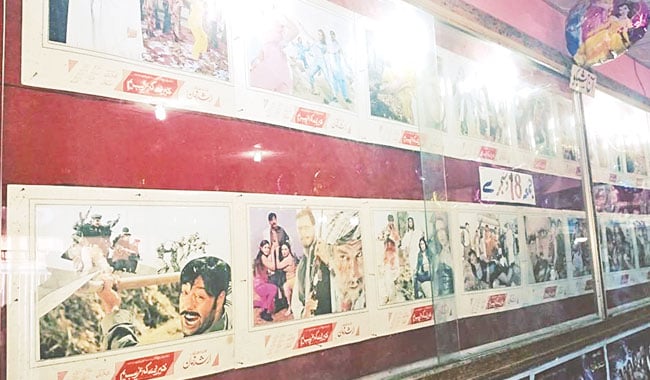
Sher Alam Shinwari, a Peshawar-based researcher on Pashtun culture, said Munir was cast as a hero, along with Yaseem Khan as the heroine, in a film, “Yosaf Khan Sher Bano”, based on a Pashto folk story. “The success of that movie paved way for Pashto film industry,” Shinwari told The News.
However, the film industry shifted to Lahore from Karachi in the 1980s.
Until the 1990s, even Pashto music cassettes were released at Karachi’s Lea Market and Juna Market, but after that this business too moved to Peshawar and other parts of the country.
Key source of revenue
After Indian movies’ comeback in Pakistan, Urdu and Punjabi films are up against stiff competition. However, the Pashto movies continue to retain their niche.
Pashto film producers and directors say that because of the large Pashtun population in Karachi, the city serves as a key source of revenue for their industry.
Karachi hosts the world’s largest urban Pashtun population, surpassing those in Peshawar, Quetta and Kandahar and Kabul. They have been considering shifting their focus to Karachi, where they believe the future of Pashto films lies.
Arshad Khan, a film producer, said they were working hard to make Pashto movies and wanted to introduce them in other parts of the country. “But the security situation and lack of government support are the main obstacles in achieving that,” Khan told The News.
The Pashto movies released in 2015 included “Charta Khanan Charta Malangan”, “Wale Mohabbat Kol Gunah De”, “Nave De Yave Shippe”, “Zoye Da Bad-Amla”, “Da Badmasha Nu Badmash”, “Ma Chera Ghareb Sara”, “Pakhtun Pa Dubai Kay”, “Mayin Kho Lewani Vi”, “Zwee Da Sharabi”, and “Malang Pa Dua Rang”.
The actors who performed in these movies included Ajab Gul, Shahid Khan, Arbaz Khan, Jahangir Khan, Asif Khan, Shahsawar Khan, Mohammad Hussain Swati, Zara Shiekh, Sobia Khan, Babrak Shah, Afreen Pari, and Shafqat Cheema.
Violence, vulgarity replace romance
Cultural activists have been criticising the Pashto filmmakers for a long time for introducing exaggerated violence and outrageous vulgarity in their movies.
Sarwar Shamal, a Karachi-based Pashtun cultural activist, said violence and vulgarity in Pashto movies has been a problem for many years.
“The recent Pashto movies that contain only violence, guns, and vulgarity have nothing to do with Pashtun culture,” Shamal told The News.
“Even the titles of movies such as “Khandani Badmaash”, “Dama”, “Gandagir”, and “Charsi” are offensive.”
He said the Pashtun community wanted the revival of Pashto films’ past glory and movies like “Yosaf Khan Sher Bano”.
Shinwari said cinema was a good medium to counter militancy in the Pashtun region as pro-peace messages could be promoted through quality movies.
“For this purpose, the industry needs the government’s financial support. Producers are ready to invest and make good movies,” he added.


