Print Story
X




Lata Mangeshkar was the bridge between contemporary music and melodies derived from the rich repertoire of compositions that had travelled down generations
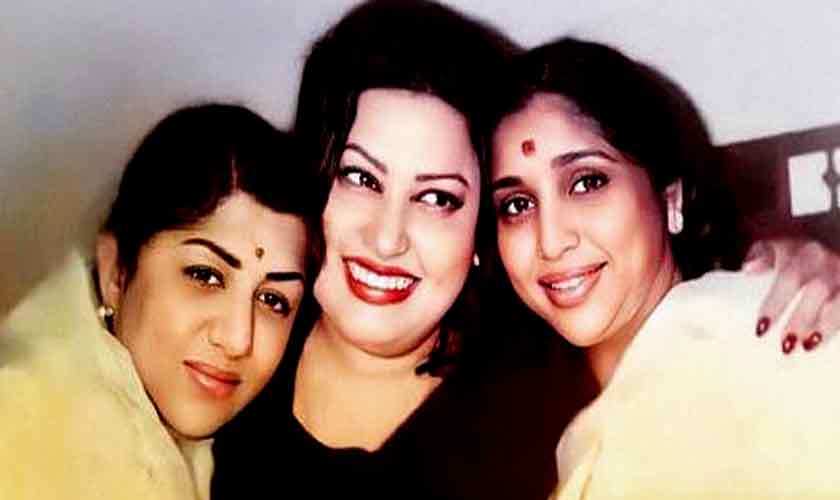
When Lata Mangeshkar was in her prime, the Indian films were banned in Pakistan. The only way to watch those was a quick trip to Kabul. In Britain, too, Indians films were screened sporadically in an odd theatre at odd hours. There were none in the United States and some were screened in East African countries but very few Pakistanis visited those states.
The songs she sang were not as readily available then as they were later. Very few people had gramophone players and the days of the cassette and VCR lay in the future. Through the All India Radio, people in Pakistan drank deep from the Indian film music. The stations that broadcast film songs were Vivat Bharati and Radio Ceylon. There was always a ready ear for the new releases and then these were hummed even more than the songs of Pakistani films. Actually, no distinction was made between the films made in India and those produced in Pakistan as only a few were made here. There were only a few filo production centres in the subcontinent. The vocalists, the composers and the instrumentalists as well as actors, writers, technicians and others travelled between these centres and contributed to the genre with song and dance as its core.
A film song, as an independent entity, was heard without the aid of the character or plot. This has been the main feature of the film song in the subcontinent. It established its autonomous credentials and could be heard as music in itself. Among those early vocalists, composers and instrumentalists who helped established this norm, the most outstanding and enduring were the two sisters: Lata Mangeshkar and Asha Bhosle. The musical content was so strong that the song stood by itself; the rest was imbibed and understood in pure musical terms.
Lata Mangeshkar’s early ta’lim with her father must have been instrumental in the sur ki sadhana, perfecting the note. It was the pacca pun of the sur where she never faltered despite all the changes that took place in singing. She never let herself be pressured into abandoning the intonation which is peculiar to our musical vocabulary.
The biggest challenge for the vocalists and composers of the new film genre was the diversity of the listening public. The virtuosity of music was limited to a small circle. They patronised the musicians and it was they who set the standard for that virtuosity. The musical expression was very well-wrought and the exposure to a diverse audience was met with great sagacity by the likes of Lata Mangeshkar as she refused to compromise on talent and class. She raised the bar for film music in the process.
Lata Mangeshkar was primarily a film vocalist. The transparency in her voice made it ideally suited to be adapted to the large number of heroines spread over decades. Unlike earlier vocalists, the peculiarity of the voice may have been a hindrance in singing songs for various heroines, who were many. The ability to adjust quickly and be prompt with imitation must have been her asset and must have gone a long way in guaranteeing her success. A quick learner is always appreciated by the composer and his team. Those who struggle and take a long time may find themselves unsuited for a medium and form where time is money.
Lata Mangeshkar’s talent was recognised by Master Ghulam Haider, who was desperate to boost her profile by giving her a solo number which he did in the movie Majboor. The song was not an instant hit and it was left to Khem Chand Prakash to compose a number for her that established her stature in the film song category. Aayega Aanewala was an instant hit and gave her the break after which she never looked back.
Sajjad Hussain, a great composer, once quoted Aman Ali Khan, Lata’s ustad in film music, as saying that she was a very quick learner. The ustad spent hours and hours in creating an extremely difficult musical phrase or movement for the shagird as to pose a challenge for her, but every time he realised that the shagird was quick on the draw, and effortlessly in the first go would follow him without floundering. What is technically called jagah laina came naturally to her.
Because of the early death of her father, Dinanath Mangeshkar, who was from the Gawalior Gharana, she was forced to work for a living at a very young age. Most composers were reluctant to engage her because they found her voice too thin and without the usual sonorous weight and dismissed it as not properly infused with musicality. This was considered a vice by the early composers. However, she turned this into a virtue. Her talent was recognised by Master Ghulam Haider, who was desperate to lift her profile by giving her a solo number which he did in the movie Majboor. The song was not an instant hit and it was left to Khem Chand Prakash to compose a number for her that established her stature in the film song category. Aayega Aanewala was an instant hit and gave her the break after which she never looked back. Next in line were many composers who then went on to capitalise on her talent. Their expertise added variety, richness and verve to her singing. Those early composers included Husn Lal Baghat Ram, Anil Biswas, Naushad and Shankar Jaikishan.
When Noor Jehan left for Pakistan, the field was wide open for her and she took no time in conquering the territory to become the undisputed queen of film music in one of the biggest film industries of the world.
Lata Mangeshkar’s success was also because she was the bridge between the music as we know it now and the melody-based music of the days when the film song derived its inspiration from the rich repertoire of musical composition that had travelled down generations. The new genre was quick to exploit the rich heritage and by crafting a three minute song with one asthai and two/three antaras to establish a new form. Unlike some greats, she was generous to mention those who influenced her and those she admired and in that connection she often mentioned Noor Jehan and Mehdi Hassan.
The first real attempt to invite Lata Mangeshkar to Pakistan was made during the first government of Benazir Bhutto. In the first phase, Pandit Ravi Shanker was to be invited. This was to be followed by others including Lata Mangeshkar. However, certain religious/political groups took to the streets to protest against this. This was one of the very few instances in history of street protests being held to stop an artiste from visiting and performing for a welcoming audience. The shaky government found it convenient to withdraw its invitation and placate the anti-India and anti-culture lobby in the country. The opportunity was lost and later it became even more difficult, even when there was a sudden easing of tensions during Pervez Musharraf’s regime. Lata Mangeshkar was past her prime by then.
She was lucky that her talent was recognised and that she was rewarded for it in her lifetime. The awards she won were too numerous to even count and remember. Among others, she received Bharat Ratna, the highest civil award of India and the highest award for films named after Dada Sahib Phalke.
The author is a culture critic based in Lahore