

Print Story
X




Meesha Shafi and Abdullah Siddiqui talk about their smash hit, ‘Hot Mango Chutney Sauce’.
The collaborations between Meesha Shafi and Abdullah Siddiqui with the latest one being ‘Hot Mango Chutney Sauce’, are entertaining for sure, but so is listening to the two discuss working together. Luckily, Instep found them chatting about the song in a conversation which delved deeper into the song and did so with great humour.
With the emergence of rap music and electronic music being embraced by contemporary artists, the line between mainstream and independent music is blurring. Meesha Shafi’s newest song, ‘Hot Mango Chutney Sauce’ - produced by Abdullah Siddiqui - is the present (viral) example. A 360 degree turn from their first collaboration, ‘Magenta Cyan’, ‘Hot Mango Chutney Sauce’ pays ode to desi culture, according to Meesha Shafi.
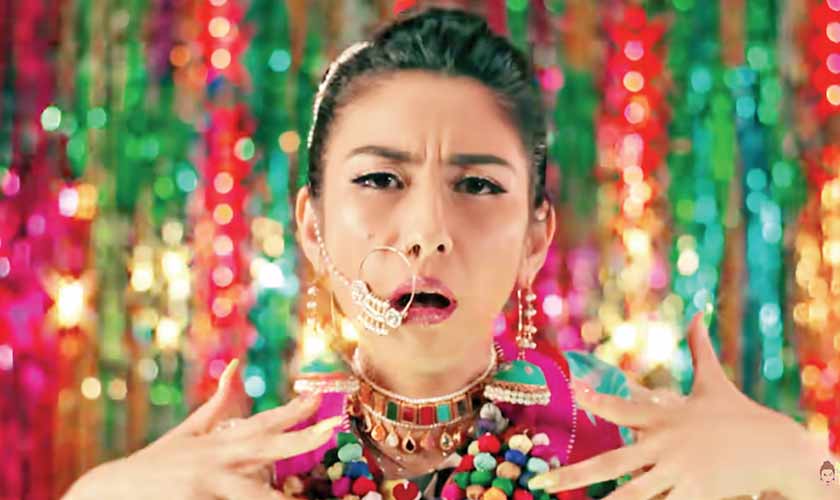
Look beyond the vibrancy of the colourful music video, the truck and how Lahore is shown in untamed fashion, the layers of the lyrical puns do represent a deeper nuance. A reflection on the Lahori society and what makes you a part of it or ineligible is just one of the many ideas delivered in the guise of puns and rollicking tongue-twisters. Capitalism, check, self-expression, check and a killer track, check.
The complexities that are part and parcel of our culture are addressed in unique fashion because it isn’t overt. Meesha Shafi has struck another chord with this song as you probe the audio-visual landscape repeatedly.
The song, produced by Abdullah Siddiqui, and co-directed by Meesha Shafi (Canada) and Awais A. Gohar (Lahore) has a huge cast besides Meesha; you also have Swineryy, Zara Peerzada, Eman Suleman, Baemissal, Rubab Ali, Abdullah Siddiqui and Hashim Ali. It’s good to see a prominent mainstream artist such as Meesha Shafi keeping an open mind and working with lesser-known names such as Mughal-e-Funk (the trance-inducing ‘Sakal Ban’) or wonder boy Abdullah Siddiqui.
As Abdullah Siddiqui and Meesha Shafi spoke about the song’s larger meaning on Instagram last week, we caught some of that conversation to understand its many textures.
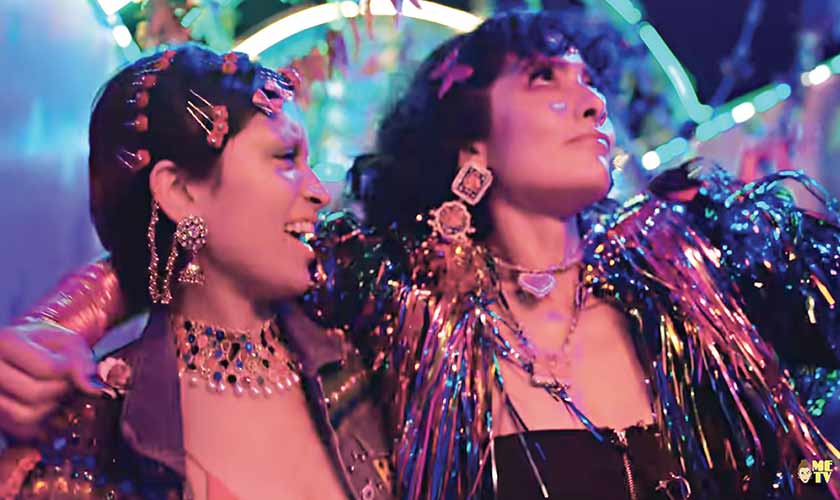
Speaking about the entire cast within the video, Meesha noted, “Each of them is so fearless; they ooze individualism. Their sass and substance is what I wanted in this music video. Desi girls want to have fun and be unapologetic and be themselves. There is no pretense, and to have that kind of flamboyance, which you do to please yourself. We rarely get to see a woman admiring herself from a woman’s eye but through the Male Gaze.”
Abdullah noted how Awais gives you pointers but lets it become improv. “You have the stage; you know what to do,” said Abdullah about co-director Awais A. Gohar.
Meesha explained that the whole (Herculean effort behind the song) is organic. “The idea was to have fun without thinking who is watching and what they’re thinking. And that’s something you cannot trap in direction too much (that vibe); Awais has this guerilla style of filmmaking, not formal at all.”
Both Abdullah and Meesha agreed that Awais didn’t make the music video voyeuristic. “It’s like they’re your friends,” laughed Abdullah, before Meesha reflected on why the song is called ‘Hot Mango Chutney Sauce’ “Living here in Canada, things are referred to such as chai-tea, naan-bread so it’s interesting because there is a post-colonial mashup. It’s interesting how language and identity are such a marriage. In South Asian context, Chutney Sauce is a reality. So, that’s the thing. There is also creative license.”
“It’s a phrase but it’s so lovely,” added Abdullah.
“We don’t always have to draw lines between our musical personalities. I afford myself a range of things and there’s so much to do and enjoy. You can’t keep doing the same thing,” said Meesha, while answering a question.
“During the finishing session, we laughed a lot while making this song,” revealed Meesha to which Abdullah concurred. From a shot at capitalism to the male gaze to an ode to women of true substance to the heritage city of Lahore and desi culture unloaded, Meesha Shafi has written a song that may be diametrically opposite to her other hits including ‘Amrit’, ‘Leela’ and ‘Mein’, it also shows that she is unwilling to box herself in any one genre or label but is looking to explore music that is vibrant and soulful, empowering and exciting.
While Meesha will continue to release music in the future, Abdullah Siddiqui has dropped Side-B of dead Beat poets, making this his fourth album.