Print Story
X




The notion that knowledge must be guarded and accessed by only a few rather than many is slowly losing currency. Even the Punjab government is planning to digitalise its archives -- for public information
The news that the Punjab government is planning to digitalise its archives is a welcome initiative.
William Dalrymple has written a number of informative books in the last couple of decades. They carry an immense reservoir of information that he was able to dip into at the Punjab government’s facilities. One wonders why the same information was not freely available to other researchers -- especially local ones -- to delve into the available resource to take another look at our history, especially the one prefaced as colonial.
It may be said, however, that most of our historians and cultural experts rely more on hearsay. The oral tradition is firmly entrenched, and subsequent analysis is meant only to prove initial assumptions. This approach can be attributed in part to the lack of access to documented sources stashed away as classified information.
Usually, the governments, and previously the courts, had most of the resources. The documentation took place under the aegis of departments or agencies where these were treated with utmost secrecy. In most of the ancient societies, knowledge or information was power or the shortest route to power. These were valued and treated as treasures, which needn’t be shared with others, especially those not deserving of them.
The dissemination of knowledge was only meant for a privileged few. The general public was not a part of it.
This attitude has prevailed over thousands of years. Thankfully, now, with greater acceptance of the democratic values, things have changed in some societies, it must be said grudgingly, while in others the old systems have reinforced themselves under fancy modern nomenclatures.
This Brahmanical approach is still the norm in centres of power that have the privilege to access information. But from renaissance onwards in Europe, the general tenor has been the spreading out of knowledge, backed by the value of empowering not only those at the helm of affairs. But this was not uniformally shared by all. It is said that one of the reasons why the Ottoman Empire collapsed was its refusal to use the printing press in the fear of knowledge becoming commonplace. It had to be guarded and accessed by only a few rather than many.
But, other than the more widespread dispensation of the democratic values, innovations in technology also made the task easier and affordable. Digitalisation is one such step in the right direction. There is so much information and storage of record that can prove the basis for solid research and subsequent findings.
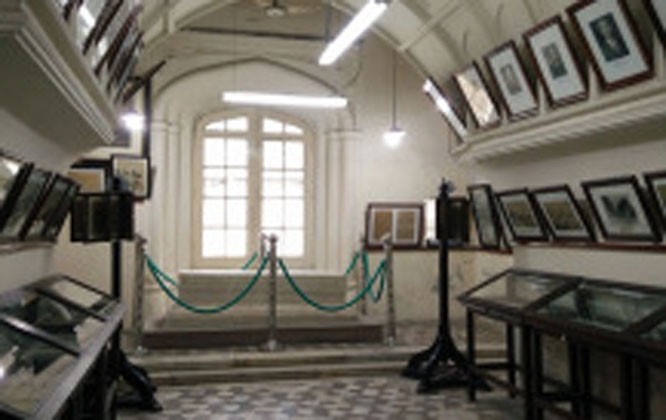
The Archives Department itself is housed in a historic place. It is said to be the tomb of Anarkali, the famous dancing girl who dared to dream of winning the heart of a crown prince and ascending the throne as Malika Aaliya of Shahenshah-e-Hind. It was in the same vicinity that Ranjit Singh had his army headquarters established on the wishes of Generals Ventura and Allard. Later, it was made into a church.
The structure still stands as a seat of the Punjab government, where the affairs of the province are administered through its secretariat.
It is said that the available documents go back to the reign of Shahjehan. Punjab has been witness to so much -- the centralisation of zeal of Aurangzeb and its collapse, the anarchy of dozens of invasions by Nadir Shah and Ahmed Shah Durrani, the consolidation under the Sikhs as a separate kingdom and the eventual takeover by the British to establish their Raj.
The entire record of the freedom and other movements and personalities involved must have been filed somewhere through secret sources. Access has been denied to the lay citizen.
Even now information available through oral sources probably outstrips the documented public knowledge. It should be recorded and preserved as the need for oral sources, once dismissed is now being realised acutely. With the facility of recording the oral narrative, it can be stored rather than transcribed as must have happened in the past.
It is about time that the mindset of secrecy and possession be shed aside and more openness be displayed in dealing with our past, especially the documented past. In many societies, most of the classified information is thrown open to the public after a certain number of years. Here, too, the past of the land, its people and its rulers should be put on display for a more even handed reading and understanding of history. It will also be of immense help in framing the policies of future.