Print Story
X




For successful, practising artists, the only place that allows them to think beyond their work is where they teach
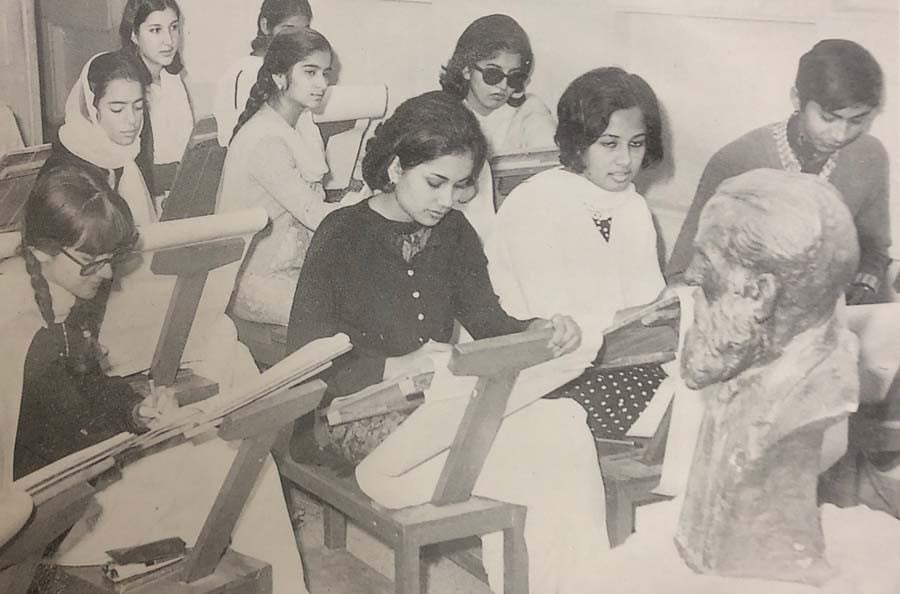
Zahoor ul Akhlaq once said, "Having a strong academic art training gives me the opportunity to loosen up well and try to explore myself."
In other countries, successful practising artists avoid teaching at art schools, at least on a regular basis, but Pakistan’s case is different. Even in India only a few top-league artists are art teachers. They include late KG Subramanyam who taught at Santiniketan and Faculty of Fine Arts, Baroda; Ghulam Mohammed Sheikh who is still teaching at Baroda, and Jatin Das at Faculty of Fine Arts, Jamia Millia Islamia, New Delhi.
On the other hand, going back to the days of Anna Molka Ahmed at the Department of Fine Arts, Punjab University, and Shakir Ali at the National College of Arts (NCA), several prominent artists have been engaged as teachers. The list is long and includes Khalid Iqbal, Zahoor ul Akhlaq, Salahuddin Mian, Ijaz ul Hassan, Zubeida Javed, Saeed Akhter, Salima Hashmi, Iqbal Hussain, Lala Rukh, Bashir Ahmed, Rahat Naveed Masud, Anwar Saeed, and Afshar Malik.
In Karachi, Ali Imam, Rasheed Ahmed Arshed, and Nahid Raza have taught at the CIAC, Karachi Arts Council, while Mansur Rahi and Rabia Zuberi taught at the Karachi School of Art. Meher Afroze left the Indus Valley School of Art and Architecture (IVSAA) only recently after educating many generations of artists. Samina Mansuri, David Alesworth, Iftikhar Dadi, Elizabeth Dadi, and Naiza Khan were part of the faculty at the IVSAA. AR Nagori and Musarrat Mirza were professors at the University of Sindh.
As new art schools came up, we saw leading artists becoming associated with teaching. Yet, some of our most celebrated artists such as Sadequain, Jamil Naqsh, Shahid Sajjad, and Ismail Gulgee never taught (at art schools). This tradition, so to speak, has been upheld in recent times by the likes of Waqas Khan.
Unlike India or some other countries where artists can live off their work, there is no support for artists in Pakistan. Teaching at art schools is thus considered a safe bet.
There was a time when artists would give away their work to whoever asked for it. The value of canvases has appreciated manifold in recent times, but the artists might not have any idea about the market at the time when they were painted. Today, the market dominates the art scene.
The work of our contemporary artists sells exceptionally well at auctions, art fairs and exhibitions across the globe. Adeela Suleman, Risham Syed, Mohammad Ali Talpur, Ali Kazim, Imran Qureshi, and Rashid Rana can happily live off the money their works generate. Yet they prefer to fully engage with an art faculty, spend time with their students, and at the end of the month receive a (paltry) paycheque.
What is it that compels them to continue teaching? There may be many reasons. To begin with, to be hired as an art teacher was always considered an attractive proposition in Pakistan.
The other reason may be a sense of social responsibility. There was a time when artists acquired art training under the guidance of teachers at an institution. Later, when they were able to express themselves and earn from that ability, they wanted to return that ‘debt’ -- to that institution or another. They felt obliged to train young artists.
There may be other not-so-altruistic motives. In a country that has a closely connected (read limited) art world, it is considered safe to be associated with an art institution; it ensures a huge number of fans in the form of former students. More than this, association with an art institution enhances your visibility on the local art scene -- a necessary orbit, if you mean to stay relevant.
Besides, in a culture where there is no discourse on art or artists’ ideas and practices, the art institutions provide spaces to have interactions of that kind away from the market. The discourses and analyses are conducted as a routine at art schools.
The galleries are frequented by visitors who are in awe, or by collectors queuing up to acquire the works on display. The only place where you get a chance to think beyond your work is where you teach. There you can’t be obsessing over your own artistic vision; you have to step back, look at others’ works, and encounter differing viewpoints.
Thus, the main reason for major artists working at art schools for meagre pays, perhaps, is that when they teach, they don’t just teach students, they also teach themselves about how to think and rethink style and convention.