Print Story
X




Dance Day celebrations in Lahore paid tribute to the dance masters of the country
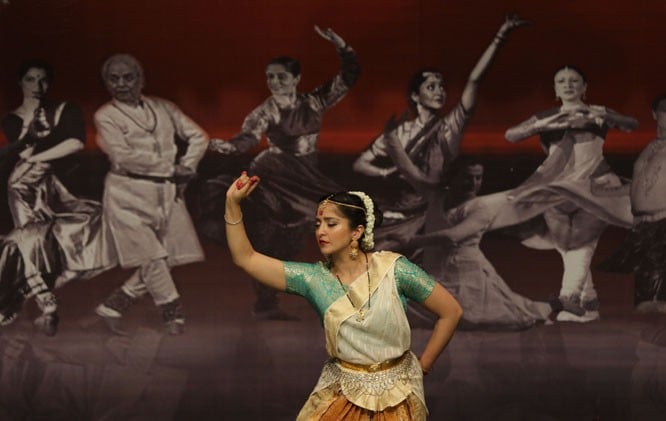
Dance Day was celebrated last week at the Alhmara in collaboration with the Pakistan National Council of the Arts in Lahore.
It is a little difficult to write about dance in Pakistan because it has a definite disconnect with the general tenor of society, particularly among its middle classes, even though the tradition of dance in our culture can be traced back to the dancing girl of Mohenjodaro. Of the few artifacts and sculptures that were saved or have survived the ravages of time, the dancing girl of Mohenjodaro has been one explicit statement on the significance of dance and probably other genres like music in that society.
A lot of water has flown under the bridges of the River Indus, still Pakistan is uneasy with its past, especially in its relationship to the land that now constitutes this country.
Land does bring with it the assets of its heritage, and no matter who forms the ruling class, the general thrust passively resists the changes imposed from the top and resurfaces in its pristine or altered form to be the catchphrase of various forms of cultural expressions. This cumulated expression constitutes the bedrock of culture, and it fashions the kind of government and institutions that take shape.
There has been a conscious attempt to dissociate with the past -- particularly the past which was non-Muslim and all the other strains that have greater degree of syncretism in them. In this continuous struggle at a purging of sorts, the performing arts, if not all the arts, have suffered the most.
In the odd 700 years of Muslim rule, dance developed as a sophisticated form of art. Gradually it assumed diverse forms: classical, folk, religious and banally social. The classical forms have declined because the classical expression does not have the support of the class that sustained it. The efforts in spurts to be awami have taken the sheen off classical forms and have rendered them as an indulgence of the ruling classes. The religious forms have also not survived because of a strict and fundamental reading of Islam. It has however managed to just exist under the surface in its quasi-religious interpretation of mystical practices at shrines. The folk forms too have lingered on without any sustained input, becoming less and less visible in the various melas that are held to celebrate the harvesting of crops, while in its social form, it has mutated in the various marriage ceremonies across the provinces. Since these have not been treated with any degree of seriousness, only as passing fun with no innovation in design and development, the various experiments conducted in Indian films have taken over the tone and tenor in these dance ceremonies.
What we have now are pockets of dance that are there due to certain platforms mostly funded mostly by the state. And it was these institutions that featured more in the dance performances that were staged on Dance Day. Meant to be a tribute to all the dance masters that this land or this tradition respects, it particularly focused on late Zafar Dilawar who tutored and mentored dance classes at the Pakistan National Council of the Arts against all odds.
The dances consisted of a fusion representing different civilisations and cultures. Attan, a traditional dance of Khyber Pakhtunkhwa, took the lead. Amna Mawaz Khan, an Islamabad-based dancer and a student of the veteran Indu Mitha, performed Bharatnatyam. She has been dancing since the age of 11 and holds a lot of promise.
The peacock dance, originally choreographed by Zafar Dilawar, was the culmination of the evening. A duo of male and female dancers, deriving inspiration from the courtship of the peacock and the peahen, performed well.
Generally, a layperson attempts to piece music together through its lyrics, and in dance through some kind of a storyline. It is supposed to provide the underpinning of a performance. In the effort to understand and not imbibe the dance performances it generally peters down to some kind of a tableaux rendering. The various dance groups that want to contemporise their expressions have been forced to reduce their performances to it. Much of the dance that is choreographed thus is a round some idea, promoting patriotism or some religious value or to a lesser degree loyalty to some ideology. But the pitfall in all this is that the finesse that abstraction extends, which is supposed to provide the formal autonomy to the act by labelling it as dance, finds itself missing.
The end result is a story told through movements which does not rise to the level of an art form.