Print Story
X




Why the desired objective of the initiative has not been achieved, ever since the red buses were launched on city roads by the Punjab government
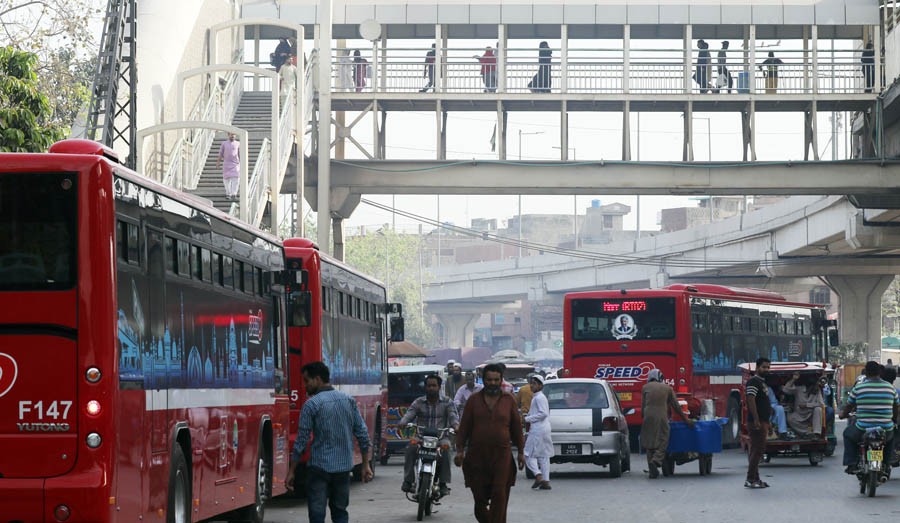
The sight of the newly introduced, fancy red buses on the city roads is quite refreshing for the citizens. Now they can enjoy the comfort of travelling in these fully air-conditioned vehicles that come by the brand name SpeedO. What’s more, these offer subsidised rates.
Connectivity with the metro bus service has also increased thanks to these buses that are supposed to run on ‘feeder routes.’
However, despite all their merits, the buses are mostly found vacant. Occasionally, you may see a couple of passengers engaged in some argument with its staff.
Shahid Ali, who owns a shop in Urdu Bazar, says that he recently tried to board the bus but its staff wouldn’t let him until he bought a metro card worth Rs200. He says he wanted to take the ride for the sake of experience, so there was no point in him making the purchase. "The card has only Rs70 as usable credit after all," he reveals.
There are others who can’t find the formerly Lahore Transport Company (LTC) buses that they would routinely take to reach their desired destinations. Of course, this has happened after certain routes were cancelled out.
Tariq Iqbal, a marketing executive in a private firm, has his own story to tell, "I, together with my five family members, wanted to go by the red bus. We thought it would cost us around a hundred rupees. But we were in for a shock, when we were told that each of us needed to have our own cards made. This meant spending a total of Rs1,000, even though we had to travel a short distance."
The question arises as to why the desired objective of the initiative has not been achieved ever since these spanking clean, red-hot creatures were launched by the Punjab government. The target market doesn’t seem to have got the benefits promised. If that is the case, it has to be seen as to how can these obstacles be removed and the people facilitated in the best possible manner.
Sources in the Punjab government say it is simply an issue of awareness and the people shall soon realise that the integrated transport system cannot be cash-based.
Ozair Shah, GM, Punjab Mass Transit Authority (PMA), is of the view that a 200-rupee metro card has a balance of Rs70; the rest is the cost of the card.
When prompted that the cards could be free of charge, he says, "That’s not possible. Why, because the service provider has sourced these [cards] from abroad and got special chips installed that obviously cost them something.
"With the help of these cards, we can keep track of different legs of a journey."
Shah also speaks of the discount packages that the users can avail.
Presently, there are 200-odd new, improvised public buses that have been introduced on feeder routes for the Lahore Metro Bus. These buses connect commuters from different parts of the city with the 27-km corridor of Metro.
The contract of operating these buses was awarded to Daewoo Pakistan that has also been handed over the possession of two bus depots -- one at the Lahore Railway Station, and the other in Green Town -- free of cost by the government.
According to sources in PMA, the said buses offer the facility of e-ticketing and GPS tracking. Besides, there are features like automated announcements about the arriving stations, surveillance system, ramps for the wheelchair-bound, seats for the specially challenged, and door sensors for passengers’ safety. Information about the temperature inside the bus is also displayed on the screen on top.
These things, the sources claim, shall benefit the common man as the subsidy will reach them directly. No person owning a car will get on it just to avail the subsidy.
The arrangement is such that the Daewoo Express which has invested Rs3 billion in the procurement of the 200 buses, including 162 large and 38 small ones, shall operate the buses on the feeder routes. The PMA shall pay Rs165 and Rs140 per kilometre for large and small buses respectively. The small buses are supposed to operate on congested routes so that they do not get stuck for long.
Initially, 200,000 passengers shall benefit daily as estimates suggest each bus can transport around a thousand passengers per day.
Ozair Shah reveals that the flat fare of Rs20 per trip is charged from the passengers travelling in feeder buses, irrespective of the distance travelled, while there are no additional charges for the passengers transferring from a feeder bus to the Metro.
Similarly, no additional fare is charged from passengers transferring from Metro to a feeder bus. An additional fare of Rs5 per trip is charged if the passenger transfers from one feeder bus to another.
A maximum of Rs25 is charged as fare for three trips. As per details, the passengers can transfer to the next bus within 30 minutes to avail a discounted fare.
"These calculations can only be made with the help of cards," Shah says.
He admits that the project is faced with initial hiccups. "It is true that the people, especially those travelling in groups, resent the high cost. The government is looking to find a viable solution to such issues.
"This integrated system was planned keeping in view the regular commuters. We didn’t see the issue of family trips coming. Having said that, the government is looking into the issues, and will try to simplify things for the public."
A lot of regular commuters are also complaining that they are left stranded as many bus routes have been closed to divert passengers to feeder buses. Nasir Hussain, Deputy Manager, Communication, Lahore Transport Company (LTC), explains that the routes are not closed but being re-alligned. "These [routes] shall be adjusted, and buses plying on these shall be shifted to other routes proposed under a study made for integrated bus operations.
"We are informing the people about these realignments so that they can use the routes that best suit them," he says.