

Print Story
X




A visit to Shalamar Bagh makes you wonder if the full potential of this historical monument as a tourist destination has been explored or there is a need to put things in order
Nestled in the midst of congested localities in the Northern Lahore and along the route of the Orange Line Metro Train (OLMT) on GT Road, the majestic Shalamar Bagh is of great historical and cultural significance.
Built during the reign of Mughal Emperor Shah Jahan in 1642 A.D., the monument is known especially for its wonderful waterworks, the once-spectacular terraces, gardens and indigenous trees and fountains that in the lower deck are powered by gravitational force.
Currently, it has been in the news due to the feared violation of country’s antiquity laws in case the OLMT corridor is built close to it and the stay order issued by the apex court in this regard. The monument is on UNESCO’s world heritage list and supposed to be protected by the government of Pakistan as per the best international practices.
Against this backdrop, one wonders whether the full potential of this place as a tourist destination has been explored or there is a need to put things in order.
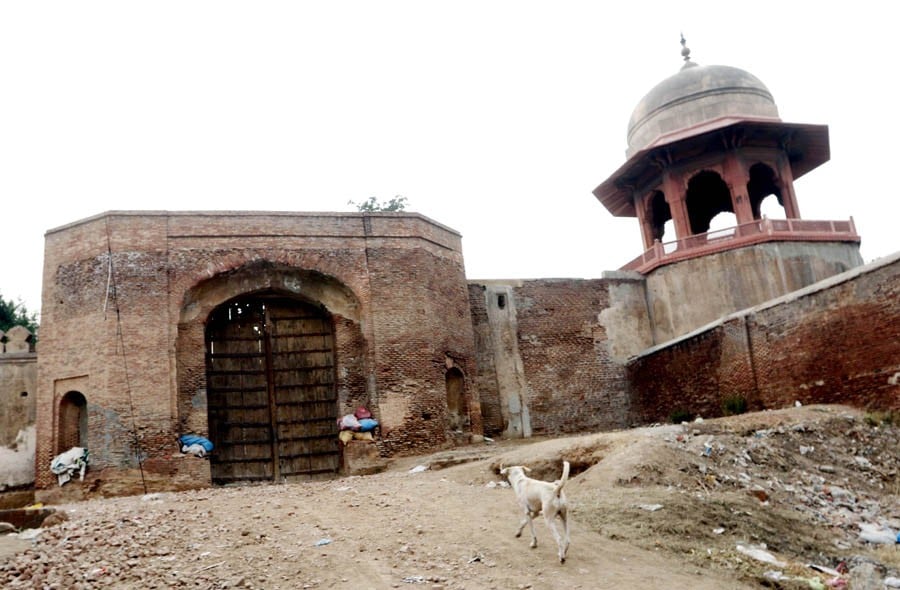
A visit to the place shows that the place is surrounded by encroachments and illegal construction in the immediate vicinity. Besides, its interior is worn-out. Though the authorities claim conversation and restoration work is underway, its pace seems to be quite slow. Surprisingly, the responsible government representatives are not found there and the visitors have to deal with private contractors and their henchmen.
TNS talked to different individuals to get a clear picture of the situation and know about their observations, reservations as suggestions.
Usman Shirazi, a Canadian national of Pakistani origin, who visited Shalamar Bagh with his family sometime ago, says he was taken aback by what he saw there. He says that right before the entrance to the garden they were confronted by some highly uncourteous people sitting inside the ticket office and having some sort of a private party.
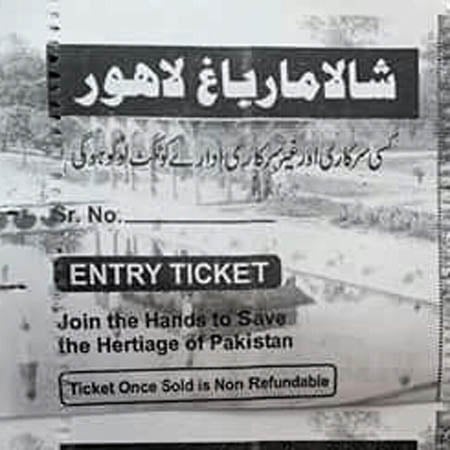
The tickets the family received did not carry any serial numbers, nor did they have the price mentioned on them. They were charged Rs30 per ticket but there was no way to confirm whether this was the rate approved by the government. Unlike what is the practice at places of public/tourist interest, there was no notice board there mentioning details of fares for different categories such as children, adults, senior citizens etc., and the timings.
Interestingly, the Urdu text printed on the ticket is also grammatically incorrect and makes one laugh at whosoever drafted it.
Shirazi tells TNS that when he asked the guards about the irregularities they told him not to argue and proceed to the gate if he wanted to visit the place.
Shirazi and his family members had their next encounter with a stout middle-aged man with overgrown moustaches. The guy asked for the CNIC of the 20-year-old boy (Shirazi’s son) on doubts that he was a foreign national, and demanded Rs500 if this was the case. Shirazi got furious, and asked the person to show any printed instructions or ticket about the government-fixed fare for foreigners. But there was no response to his question.
Shirazi says as he had lived and grown up in Lahore, the current state of the historical site made his heart bleed. His point is that instead of going for conservation of this heritage site and taking its full ownership, the Punjab archaeology department has left it at the disposal of daily wager staff of contractors.
Besides, there is no record of gate money which on the one hand makes exploitation of visitors easy and on the other hand keeps the government in the dark about the revenue potential of the site. Shirazi’s point is that in the absence of an expected income a contract amount cannot be decided.
Shahid Sheikh, the owner of a beauty products shop in the neighbouring Baghbanpura, says he comes to Shalamar Bagh for a walk almost every day. "Only if I am in before 8 [in the morning], the entry is free."
To him, the attraction of the place as a heritage site is not much as people mostly come here for a morning walk or for picnics. This may be due to the fact that this is the only ‘public park’ in the area, especially after the University of Engineering & Technology (UET) grounds were made out of bounds for the outsiders. In this scenario, the place is a blessing for the general public, but the bad part is that the conservation work has been going on here for ages.
Sheikh adds that the running fountains used to be the biggest attraction of the Bagh but for the last many years these are hardly seen. "In winters, the fountains are made operational for one or two hours during the day, and in summers you don’t see any water in the channels.
"When the visitors complain, they are told that the fountains are run for a short time because of the fear of dengue mosquito breeding."
Sheikh believes this is not the case, "The fountains remain non-operational as the department wants to save electricity costs, especially when the earning from ticket counter is limited."
Usman Shirazi adds, "The terracotta bricks were missing [when we visited the place], the walls had soot settled on them, different doors along the boundary wall were in bad shape and had developed holes. Besides, the tea-stalls and canteens had been set up on grass instead of brick structure.
"I would say it was in far better condition many years ago," he says.
An official of the Punjab Archaeology Department says that though there are issues yet to be resolved the situation is not as bleak as it is cracked out to be. He speaks of a lot of improvement that has been made over the years, including utilisation of the land adjacent to the Shalamar Bagh’s boundary wall to build a complex with parking facilities, a gazebo, a ticket house, toilets etc.
"This piece of land has been ravaged by Sunday bazaar stalls," he reveals. "Today, however, it has a boundary wall and a gate. A proof of our good work is that the UNESCO removed it from the list of endangered heritage sites in July 2012."
Talking about the sale of blank tickets, the official says this is the domain of the private contractor, "If he does so, action will be taken against him. They have been given clear instructions to print the price and serial number on the tickets."
The official, not wanting to be named, also adds that there has been a lot of propaganda against the Punjab Archaeology department by entities that tried to gain an administrative control of the place. He seems to be pointing towards the Federal Archaeology department and the Walled City Lahore Authority (WCLA) that succeeded in taking control of Lahore Fort for some time.
On the need for conservation work, the official says that a Rs300 million budget was approved by the Punjab government for this purpose in 2007, and the work is in progress. Besides, Rs85 million have been approved to acquire properties adjacent to the walls of the monument in order to create a buffer zone.
"A survey is underway, on the order of the commissioner of Lahore. Once it is done, land acquisition process shall be started. If needed, more funds will be demanded from the government for the purpose."
In the end, he discloses that another Rs10 million have also been allocated for the introduction of illumination at the site after dark.
Due to the sensitive nature of the site being on UNESCO heritage list, and the controversy regarding the OLMT project, none other than the director general of the Punjab Archaeology department is allowed to speak to media on record. TNS tried to contact him but he was apparently out of Lahore and not available for comment.