

Print Story
X




Experts from Pakistan and India call for new adaptive approaches and techniques to end water crisis between the neighbours
The historic Indus Water Treaty (IWT) between Pakistan and India, brokered by the World Bank back in 1960, has provided a river water-sharing formula that has weathered all storms and even continued to work when the two countries had gone to wars.
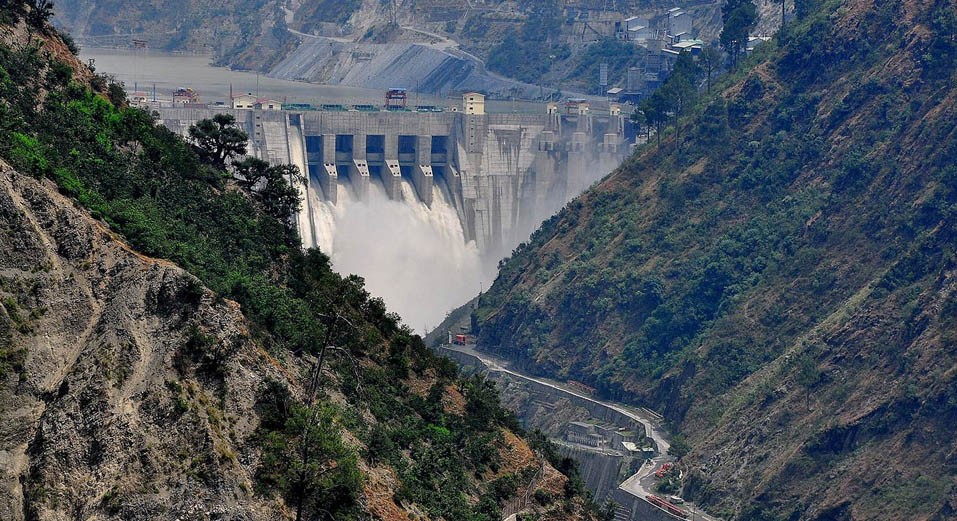
According to the treaty, three western rivers -- Indus, Jhelum and Chenab -- of the Indus water system were allocated to Pakistan while India was given right over the waters of rivers Ravi, Sutlej and Bias. Being an upper riparian state, India was also barred from building dams for water storage on the rivers awarded to Pakistan. However, India has constructed storages like Baglihar Dam on the Chenab River and is in the process of constructing Kishanganga and Ratle dams on the Neelum-Jhelum and Chenab rivers.
Pakistan has objected to the designs of these dams and alleged that India wants to deprive it of its due share of waters in the Indus river system. On the other hand, India asserts it is not violating the treaty and designs of the dams are not objectionable at all. It also asserts that it has the right under the treaty to consume up to 20 per cent of the water of rivers awarded to in Pakistan.
The latest twist in relations between the two countries was seen when Indian Prime Minister Narendra Modi threatened last September to revoke the water sharing formula and aggressively follow the policy of building dams on the western rivers. To many, it was a tactic by Modi to mount pressure on Pakistan following the Uri attack in the Indian-administered state of Jammu and Kashmir. He unequivocally expressed in the presence of media that "blood and water cannot flow together" and hinted at blocking the flow of waters to Pakistan.
The situation right now is that Pakistan has approached the World Bank to intervene whereas India wants appointment of a neutral expert to review the situation and decide. The World Bank has decided to set up a Court of Arbitration (CoA) to settle the dispute though the process was paused for the time on Indian request. The dispute has attracted immense international attention and the US and the World Bank are calling on India and Pakistan to solve it amicably.
Suleman Khan, Chairman, Sindh Taas Water Council, thinks the issue is simple but made complex intentionally. "Under the IWT, India can use water of the rivers given to Pakistan only for run of the river projects." This, he says, means that India may keep water for a couple of hours in small reservoirs and release it for power production during the hours when energy demand is high. "It has also been decided that all the water flowing down these rivers has to be released by India towards Pakistan within a week and in quantities that do not harm any cause."
On the contrary, Khan says, "The reservoir capacity and design that India is working on are objectionable to Pakistan as it fears the former will stop its waters and divert them towards its lands." He says India desperately needs water to cultivate land as deep as in Raj Kumari in the South and it is known to all how it has grown grapes and olives in Rajasthan region that neighbours Tharparkar in Pakistan. "Both these regions are equally fertile but one can easily see the difference. It’s a big human tragedy that hundreds of infants die of hunger in Tharparkar that could have been used for food production if watered properly."
Khan also holds country’s experts and politicians responsible for the mess as they failed to get Neelum-Jhelum Dam constructed in two and a half decades. India has built Kishanganga dam on this tributary of River Jhelum and even won the case in the international court. He says this was for the reason that the IWT mentions any tributary of Jhelum can be diverted by India if there are no Pakistani uses. "If we had completed Neelum-Jhelum Dam and proven its uses we would not have lost the case."
Khan laments that Pakistan is wasting 35 Million Acres Feet (MAF) water every year due to absence of enough reservoirs. The estimated cost of this water, he says, is around $70 billion. "India also capitalises on this point and demands more water on grounds that Pakistan will ultimately waste it," he concludes.
Shakil Ahmad Romshoo, Professor and Head of Department of Earth Sciences, University of Kashmir, Hazratbal, Srinagar, Kashmir, believes IWT is a fair and balanced treaty for sharing the Indus waters. However, he says, the mistrust and the festering conflict of Kashmir has adversely affected the smooth operation of the treaty during the last two to three decades.
He thinks the ongoing hydropower projects, particularly on the Chenab, though well provided under the treaty, have also raised suspicion and concerns in Pakistan that India might, at some point in future, assert its geographic advantage on controlling Indus water.
"Being the lower riparian, Pakistan’s objection to every hydropower project in J&K state during the last two decades partly stems from this anxiety and insecurity. The recent threats of India about the abrogation of the treaty have further deepened that suspicion." On the other hand, Romshoo says, people in India complain that for every hydropower project in Jammu and Kashmir, a clearance from Pakistan needs to be sought and despite fulfillment of all formalities, objections from the Pakistan side never end. "Kishanganga project is an apt example of that and in the last few decades Pakistan has raised objections to every legitimate and illegitimate hydropower activity by India in the state of Jammu and Kashmir," he says,
He believes the dominant perception in Pakistan mistakenly shares the view that its rights to Indus rivers are undermined by Indian "violations" of the IWT and holds India responsible for its water woes. In his opinion, "India has nothing to do with Pakistan’s water woes that mainly arise from the inefficient water use and allegations of inequitable distribution of water between various provinces there. Therefore, Pakistan needs to look inwards to address its water issues."
Similarly, he says, the reduced flow of river waters into Pakistan since 1990s is not the result of any violation of IWT by India but primarily due to the depleting snow and glacier cover in the upper Indus basin under changing climate.
Romshoo believes despite several divergences, the two nations have convergent concerns about climate change, environmental degradation, water-, food- and energy-security. He says the two countries need to rebuild cooperation, through sustained dialogue, to remove distrust over conflicting issues. "I believe that the cooperation that builds on existing frameworks over the sharing of waters may also offer informed pathways to confidence and peace-building."
Romshoo fears any discord over the sharing of Indus waters will have grave consequences for security and stability in South Asia. "Loose talk on the IWT by India has raised fear and insecurity among Pakistanis which needs to be avoided, if, India wants to win over the peace-loving constituency in Pakistan. The Indian leadership should set to rest any intent to tinker with the IWT."
Dr Uttam Kumar, Fellow of Institute for Defence Studies and Analyses (IDSA), New Delhi, with expertise in climate change and water security, thinks the current discord has a lot to do with the existing relations between India and Pakistan. He thinks there are some responsibilities that Pakistan, as a lower riparian, must also show and one such responsibility is to create an environment of peace and goodwill. "When the politics is not right, nothing can be right."
He says another responsibility that Pakistan must seriously consider is to bring the disputes over technical features of the hydro projects that India is entitled to build within the bilateral dispute resolution mechanism of the Permanent Indus Commission. "It has become a habit for Pakistan to seek arbitration on projects that India is building upstream."
In what appears to be an enforcement of what Suleman Khan has said earlier, Dr Kumar says Pakistan needs to seriously look into its water management approaches. "Increasingly, water is being challenged by erratic flow pattern and an ever-increasing demand. So, adaptive approaches, techniques and new methods will be important. These are the areas in which Pakistan and India can work together either within the treaty or forming new mechanisms and joint partnership."
Syed Jamaat Ali Shah, former commissioner of Pakistan Commission of Indus Water, does not agree that it is just a war rhetoric of Modi and that India does not want to violate the treaty. He says it is a fact India has succeeded in restricting the role of World Bank.
Shah points out that Pakistan requested the World Bank for arbitration only when India did not agree to discuss the issue bilaterally at forums like Indus Water Commissions. "The treaty allows India limited use of the rivers given to Pakistan according to certain conditions and restrictions. The objection of Pakistan is less about the projects and more about their technical designs as there is no justification in building reservoirs having storage capacity many times more than allowed under the treaty. Even the height of the spillway gate has to be according to prescribed conditions and acceptable to both the countries."
Shah says being an upper riparian, India does not have much to lose. "It will be Pakistan that will suffer if there is any revision in the treaty." Shah also advises those in power not to depend too much on China and try to pursue the case themselves. "It is too optimistic to expect China to block water of Brahmaputra River just in retaliation. China can only stop 3 per cent water of Brahmaputra and the rest has to flow into India," he adds.