Print Story
X




The government mulls measures to counter smog for lack of the capability to measure atmospheric pollution scientifically
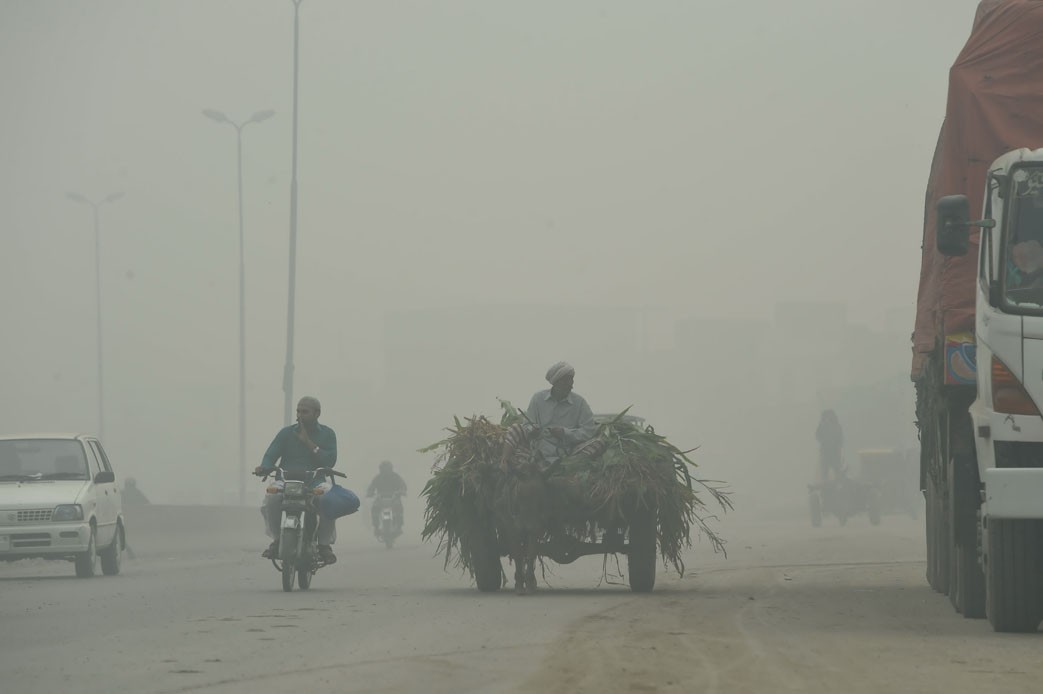
Over the past couple of years, the city of Lahore and adjoining areas have routinely seen the phenomenon of smog formation, with the advent of cooler weathers. As the temperature drops and air condenses, moisture is formed and the particular matter present in the air settles down on it.
Simply put, smog is a blend of smoke and fog. In Lahore’s case, it is assumed to be a mixture of pollutants in the air caused by industrial emissions, burning of vehicular fuels, and dust particles suspended in the air due to the ongoing development projects in the city.
While smog disappears or loses its density in the event of a shower, this year it has persisted because of the prolonged dry spell. As it usually contains a combination of smoke and poisonous gaseous material such as sulfur dioxide and nitrogen oxide, the citizens exposed to it are likely to develop respiratory issues, asthma, a reduced resistance to lung infections and colds, eye irritation and so on.
This year, several environmental experts and government officers on the Pakistani side have blamed smog formation on the unchecked crop burning in Indian Punjab and excessive use of firecrackers during the Diwali week.
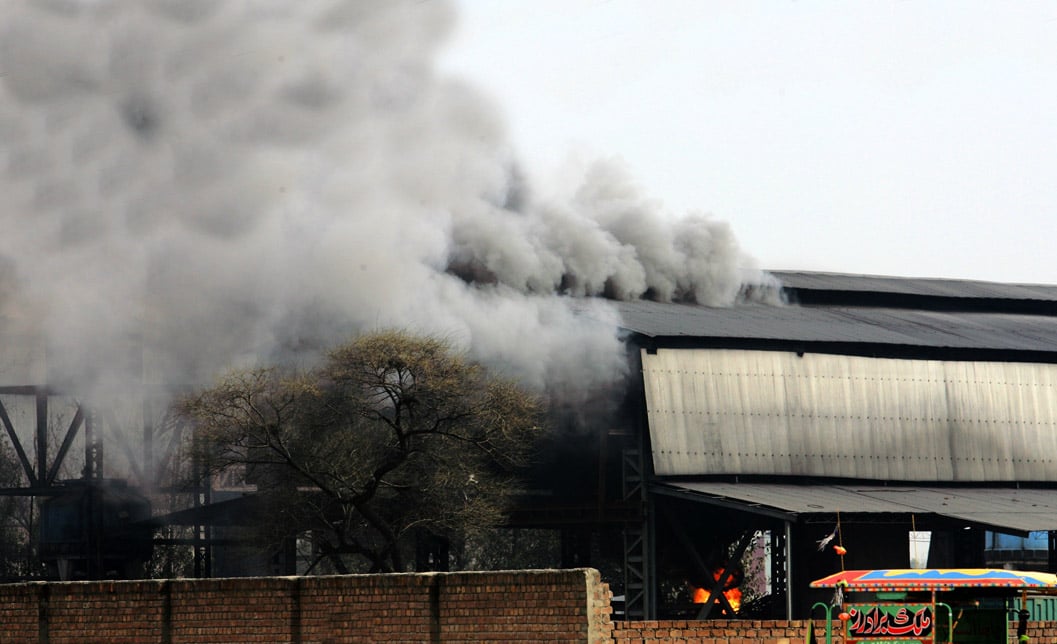
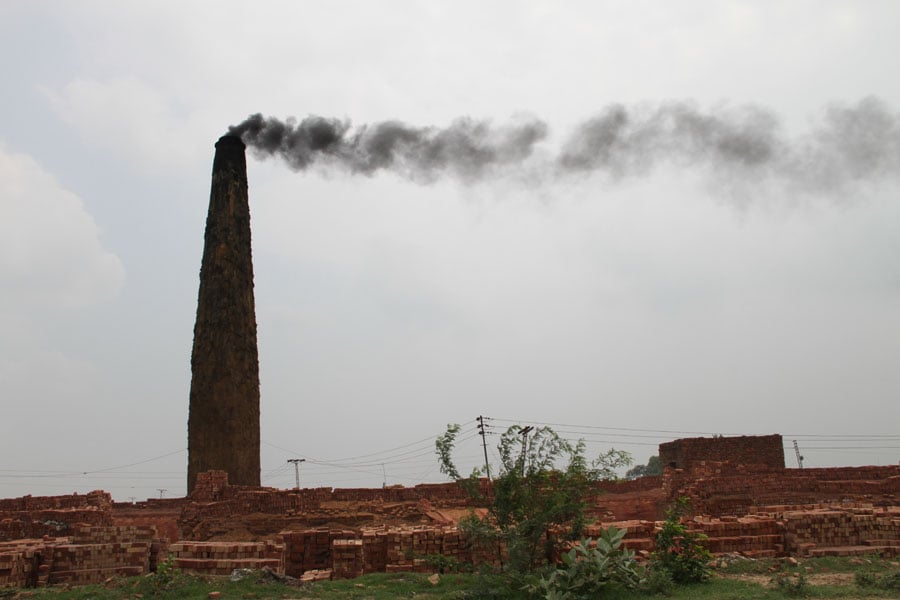
Then there are those who believe it is just an attempt to shift responsibility for the mess on external factors and cover up for our own inability to keep the environment clean. To them the excessive burning of fossil fuels, unclean industrial emissions, burning of coal in industries such as brick-making, traffic jams and vehicular emissions, cutting of trees, presence of dust in the air thanks to the ongoing development projects, burning of solid waste etc are responsible for the formation of smog.
For their part, the local administration in New Delhi has taken certain measures -- they have shut down a coal-based thermal power unit, banned construction and demolition work, and put an end to the burning of trash at landfill sites. They are also considering introducing an odd/even numbering system where selective vehicles shall be allowed to come out on the road.
As the areas on this side of the border are also heavily affected by smog, the government has announced its plan to tackle the menace in its own way. TNS spoke to experts and government representatives to get an idea of what lies on the cards. Naseemur Rehman, Director, EPD Punjab, said "measures have been taken by the committee [that has been] formed to look into the causes that led to the formation of fog, besides suggesting correctives."
For example, he said, the traffic police has been directed by the Secretary Environment Punjab to ensure the flow of traffic at any cost. "When too many vehicles are stuck at a spot and they emit smoke for long, the immediate environment is polluted by harmful substances.
"In the presence of cooler temperatures, the suspended particles stay put, as there is a blanket around."
Rehman also spoke of a ban on two-stroke rickshaws that pollute the air. "From now on, the assemblers shall not be allowed to produce these [two-stroke rickshaws]. The few that are still there shall have to upgrade themselves."
Additionally, the Punjab Forests Department has also been advised to take strict action against those who burn wood or leaves in forests as well as the crop residue.
In particular, strict action has been taken against the industries that are using substandard fuels such as waste tyres and rubber shoes. According to the director of EPD Punjab, 38 such industrial units were sealed by the government for contributing to pollution and releasing harmful particulate matter in the air.
Besides, the different chambers of commerce and industry have been requested to ensure that all their members adopt environment-friendly practices at their respective units.
Naseemur Rehman said that cases around 300 industrial units in and around Lahore had been sent to the environmental tribunal for not using emission control/purification technologies and emitting hazardous smoke in the air.
The good news is that 225 of these units have installed equipment such as wet scrubbers that separate harmful particulate matter from smoke before it is released in the air. "Those who do not comply shall be dealt with severely," he added. "Such instructions have been issued before as well but from now on the focus shall strictly be on the implementation of laws and rules, and awarding punishment to the polluters."
Dr Farrukh Chishtie, former head of the Department of Space Science at the Institute of Space Technology (IST), Islamabad, was cautious in identifying the causes behind the formation of smog in and around Lahore. Talking to TNS, he said, "Unfortunately, the problem here is that the EPD Punjab does not have the capability to measure impurities in the air in different locations.
"In the absence of knowledge about the pollutants present here, it is impossible to suggest solutions. It’s just like writing a prescription without diagnosing the disease or getting a test done from a pathological lab."
Chishtie said that Pakistan had been provided with instruments that could measure atmospheric pollution by Japan International Cooperation Agency (JICA). "But since 2011, these are lying unused, especially due to the complications in the aftermath of the devolution of environmental control as a provincial subject."
He lamented the fact that the federal Environment Protection Agency (EPA) was powerless whereas the provincial environment departments had not been delegated all the functions and powers of the federal authority. "It is a basic principle of science that measurement and abatement go hand in hand. If there is no measurement, how can a remedy be proposed and the results of such actions measured?"
He agreed that trans-boundary issues could lead to such a phenomenon but in the absence of scientific evidence it would be inappropriate to arrive at such conclusions.
On the other hand, Dr Qamar uz Zaman Chaudhry, former director general of Pakistan’s Meteorological Department said the reason behind the formation of fog in Lahore and other parts of Punjab "is [that] a large number of coal-based industries are concentrated on the other side of the border in areas such as Rajasthan. No doubt, there are local factors also at play, such as vehicular and industrial emissions, cutting of trees, use of unhealthy fuels etc."