


Print Story
X




Why Toba Tek Singh was picked as the location for the historic Kissan Conference
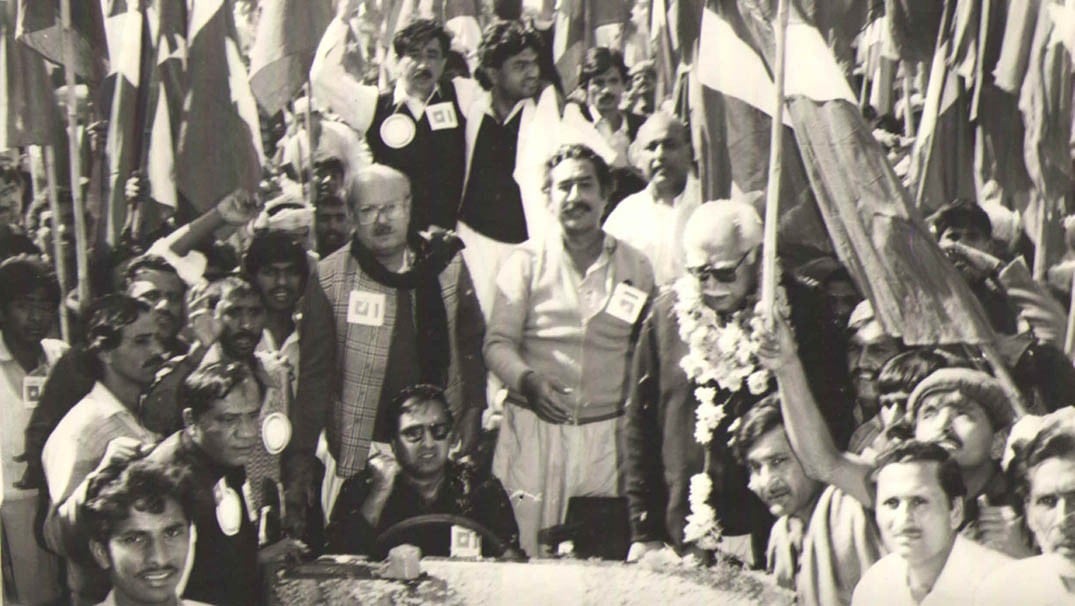
The Kissan Conference, held in 1970 at Toba Tek Singh, is a missing link in Pakistan’s history. Peasantry, despite being a mainstay of our socio-economic structure, has not drawn the historians’ attention, which is lamentable to say the least. No history book available in Pakistan alludes to it even tangentially. Peasantry as a class does not figure at all in our social analysis. Like other sections of the society, peasants are divided on sectarian, ethnic and caste basis. That division prevents them from coming together for a joint and meaningful action.
Besides, our history and political studies have become hostage to high politics, which has shrunk space for the class that traditionally produces surplus value for other communities to live off. It has been oppressed, exploited and ignored nonchalantly.
In the wake of mass protests by peasants and middle-level landowners against the government’s policies, events such as the Kissan Conference acquire new relevance.
However, before discussing the Kissan Conference, the unique town of Toba Tek Singh merits a brief introduction. It will also help us understand why Toba was picked as the site for holding the Kissan Conference.
Located in central Punjab, Toba Tek Singh is spread over 3,252 square kilometres and comprises large areas of lowlands that flood frequently during the rainy season. The floods originate from the Ravi River which runs along the southern and south-eastern borders. It was initially a tehsil of Lyallpur (later Faisalabad) but was conferred the status of a district in 1982.
According to the 1998 census of Pakistan, the population of this town was 905,580. Of this, 720,601 were Muslims and 184,979 were non-Muslims, mainly Christians. But a 2008 survey estimates the population to have risen to 1.39 million.
Toba Tek Singh is named after a Sikh religious figure, Tek Singh. Legend has it that Tek Singh was a kind-hearted man, a Sufi by nature, who served water and provided shelter to the worn out and thirsty wayfarers passing by a small pond or ‘toba’ in the local Punjabi dialect. The pond eventually came to be known as Toba Tek Singh. Toba was exactly where the railway station exists today. The surrounding settlement acquired the same name with time.
There is also a park in the city, named after Tek Singh.
No one knows much about Tek Singh’s family or clan. He died in a small hut that he had built near the pond with no relatives but only well-wishers and admirers around him.
Ahmed Bashir (late) reveals that the revolutionaries like Bhagat Singh and Sohan Singh Josh originally belonged to Toba Tek Singh. Saadat Hasan Manto’s famous short story Toba Tek Singh also signified dynamism and revolt.
Read also: A missing link -- II
The British founded Toba Tek Singh in the last quarter of the 19th century when a canal colonisation made some headway. In a short span, it became an agrarian hub. People from all over the United Punjab moved here as farmlands were allotted to them. Most of the migrants belonged to Lahore, Jalandhar and Hoshiarpur districts.
In 1906, the population of Toba was 148,984. It comprised of 342 villages, including Toba Tek Singh (population, 1,874), the headquarters, and Gojra (2,589), an important grain market on the Wazirabad-Khanewal branch of the North-Western Railway. The land revenue and cesses in 1905-1906 amounted to Rs470,000.
Toba exists on a level plain, wholly irrigated by the Chenab Canal. The soil, which is very fertile in the east of the district, becomes sandy towards the west. Its boundaries were somewhat modified at the time of the formation of the new district of Faisalabad. Most people that settled here by the turn of the century were peasant proprietors and not big landlords.
Abdullah Malik, a renowned scholar, once averred, "Peasant proprietors do have the class consciousness as well as the general level of political awareness, which rest of the agrarian classes don’t possess". Thus, they have a disposition, which constantly nudges them for change and freedom.
In the 1965 elections, Ayub Khan managed to win from Toba barely by two votes. That factor succinctly explains why Toba had been the epicentre of peasant politics directed against the elite of every hue.
The central location of Toba might be another major reason. It was situated at an equal distance from Lyallpur and Sahiwal, the two most fertile colony districts of the Punjab. Not very far from Toba, were expansive feudal estates in Jhang and Multan. The historical event of the Kissan Conference was held under the very shadow of the feudals. This was no less than a clarion call indicating the beginning of a new era for the peasants.
In the historical Kissan Conference of 1970, 200,000 kissans (peasants) and progressive people from every nook and cranny of the country congregated in Toba Tek Singh. According to Dr Farhat Mehmood, a veteran historian from GCU Lahore, the Kissan Conference left a great impact on the political history of Pakistan, and led to the Land Reforms introduced in the Bhutto Era.
A detailed assessment of the conference’s impact will be taken up later. For now let us turn to the Kissan Conference and the charismatic figure of Abdul Hamid Bhashani. Needless to say, it was a National Awami Party (NAP) show, with Zulfikar Ali Bhutto’s People’s Party lending all possible support to it.
The NAP represented interests of the socially and politically marginalised. With a Socialist orientation, the NAP upheld the political ideals of figures like Abdul Ghaffar Khan and Abdul Hamid Bhashani (1880-1976). It articulated the ideology that ran counter to the right-wing politics of the Muslim League and Jamaat-i-Islami.
Bhashani’s politics revolved around the peasantry and its marginalised status. Thus no one but Bhashani was more suited as the main speaker at Toba. He could empathise with the peasantry and its plight. Equally important was the political appeal of the NAP, which resonated with the peasants even in the days of martial law.
This was an opportunity for the Left to secure a niche.
To be continued