

Print Story
X




Saba Khan reinvents the idea of drawing in her recent solo show at IVS Gallery Karachi
We live in the age of images. Compared to the past, the access and addiction to visuals have become a hallmark of our epoch. The current century has witnessed another revolution --the arrival of digital photography and mobile phones with inbuilt cameras. Perhaps the most positive part of digital photography is that it does not have a negative! One can take as many snapshots as one likes and without any training or special equipment.
Writing in his essay ‘Understanding a Photograph’ John Berger predicted this scenario in 1968: "It looks as though photography (whatever kind of activity it may be) is going to outlive painting and sculpture as we have thought of them since the Renaissance". Berger elaborates further: "By their nature, photographs have little or no property value because they have no rarity value. The very principle of photography is that the resulting image is not unique, but on the contrary infinitely reproducible. Thus in twentieth-century terms, photographs are records of things seen".
Saba Khan has also shown her records of things seen at her solo exhibition Photographs are Drawings held from Oct 5-15, 2016 at the IVS Gallery Karachi. A total of 180 pictures (each 5 x 7 inches) were installed in two rows: "A showcase of photographs from the artist’s archive that suggest her influences and interests and the use of photography as drawing", since the exhibition was part of ‘Drawing Documents’, a project of IVS Gallery and the Department of Fine Art at IVS, Karachi, in which four artists are invited in a year to display drawings.
Certainly, the most interesting and daring aspect of this exhibition is how Khan interprets drawing. Everyone trained in an art school is conditioned to consider drawing connected to certain tools, surfaces and mediums. One often comes across discussion and debate on the difference between drawing and a complete work of art. Usually pencil or charcoal lines on sheet of paper are described as drawings, while paint applied on canvas, or carved wood, stone, metal and plaster qualify them to be artworks or painting and sculpture.
But Saba Khan, in her solo exhibition approaches the essence of drawing as a thinking process, and not necessarily limited to one medium or method. In that respect, any form and format can be called drawing as long as it contributes towards developing one’s ideas and imagery. So her photographs -- like the traditionally perceived drawings -- are a collection of her source material to create new works.
Sometimes, the idea of work or the search for it ends up being the work itself. Reminding of Jorge Luis Borges’s short story The Approach to Al-Mu’tasim in which he recounts a tale from The Conference of The Birds by Farid Attar. A large number of birds set out to seek their king Simurgh living on the far off mountain of Kaf. The journey was long and hard, many fell and died, and by the time they reached their destiny, the Kaf Mountain, only thirty birds had survived (the literal meaning of Simurgh is 30 birds). Once there, they realised that they were the king. In that sense drawing for Saba Khan could be photography itself.
The fact that no captions were provided with these pictures adds that feature of being pure visuals open for multiple interpretations, contrary to pictures in a newspaper or on social media. And even though both rows comprised pictures unrelated to each other, in a strict linear fashion, these did generate order of a different kind. As the photographs were from the personal archive of the artist, so these not only helped to understand her creative process, but are useful to comprehend the currents of society, the societal behaviour, belongings and longings.
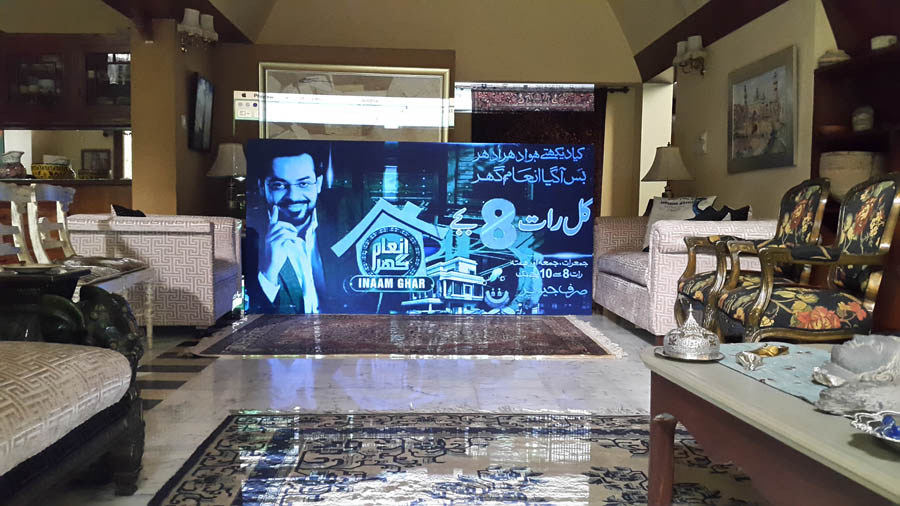
These photographs delineate the history of a people from a milieu where multiple forces and frictions are in action. So if images are of destruction of houses in a neighbourhood of Lahore, there are snapshots of mosque and church from Murree. Views of desecrated graveyard of a persecuted community, banners at the back of a rickshaw supporting religious fanaticism, photographs of burka clad women, son of a former prime minister proudly posing next to his expensive car, pages of an illustrated manuscript about strange creatures from the Lahore Museum, and screenshots of posh chairs from different sites are a few example in which the artist has not only revealed her stream of thought, imagery and inspiration but mapped the fabric of a society that is subject to different pursuits, pressures and fascinations.
One, the major, site/sight of these fascinations is the social media. So in this body of work, Khan has printed a substantial number of pictures from the Internet, selling the dreams of comfortable life through numerous products which are spotted in today’s homes. In fact, the work can be viewed as a comment on marketing the ideal of beauty, lavish living and pleasure in the age of globalisation where capital is the only value. But being an artist of intelligence and imagination, Khan refrains from making a direct comment; instead one gets and grasps the concept by looking at the sequence of pictures which record how the citizens of a state exist and think.
Amid all this, one can detect a sense of humour as the artist combines elements which suggest another text alongside the main narrative. For instance, a cook in his apron appearing at a demolished building of Lahore; projection of a TV preacher inside a fancy sitting room; rural women standing in front of Eiffel Tower, and many more bring forth the contradictions of a culture, with a pinch of salt.
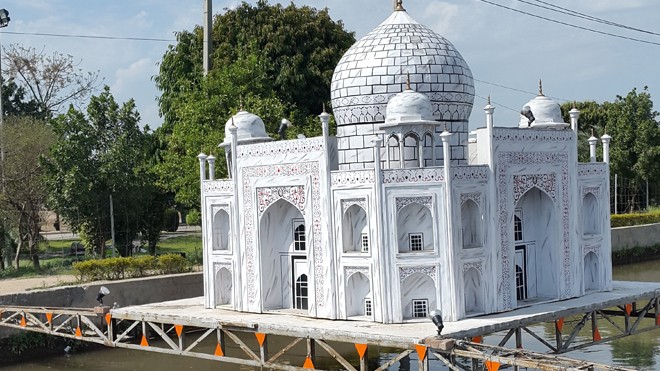
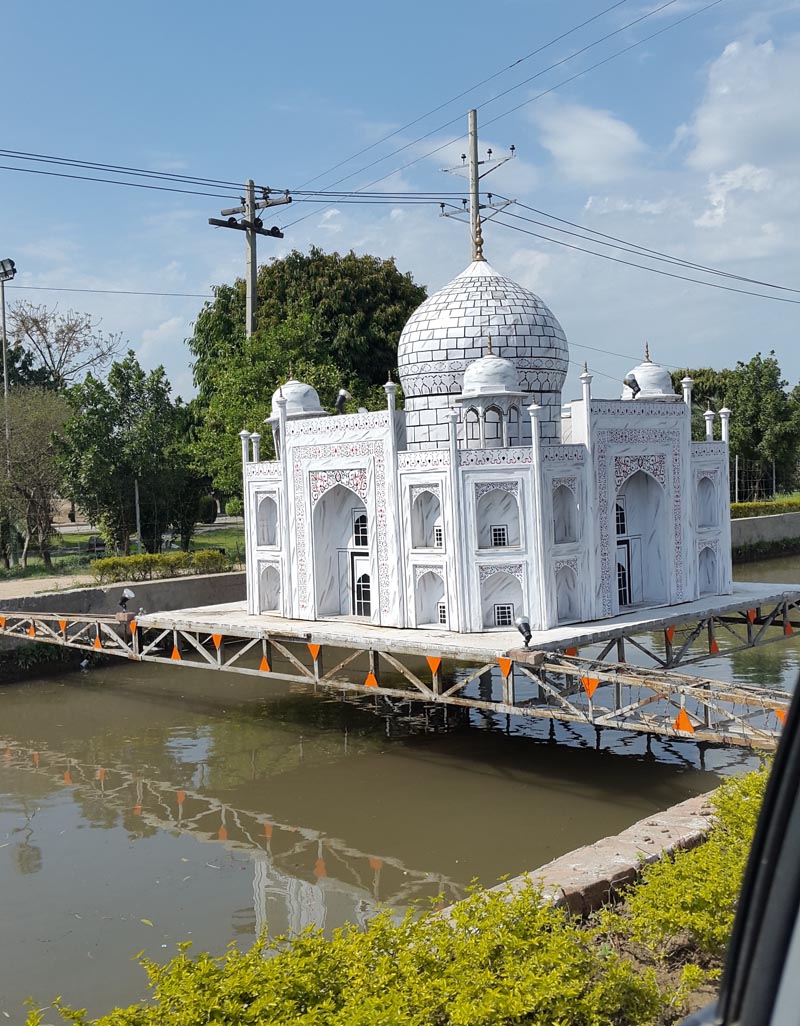
No one should be surprised at the Punjabi village maiden visiting Paris, because the famous French monument is erected in Lahore, in a housing society known for bringing internationally-known structures to its inhabitants through their replicas. But the epitome of this craze, as observed in one of the photographs by Saba Khan, was the large scale model of Taj Mahal -- that ode to love in marble, reconstructed in small scale on the top of a narrow waterway. This image certifies the condition of our world, in which our dreams, desires and desperations have no limits. At the same time, it affirms that we belong to the era of photography (or mechanical reproduction -- if you follow Walter Benjamin) in which nothing is unique or rare, and everything is reproducible - like Taj Mahal, Eiffel Tower or a photograph!