Print Story
X




The sale and purchase of traditional musical instruments is on the decline. Why?
Close to the rear walls of the Lahore Fort and the Badshahi Mosque, lies the famous Shahi Mohallah aka Heera Mandi. The locals say it was so named after Maharaja Heera Singh, son of one of Maharaja Ranjit Singh’s favourite ministers, during the Sikh rule in Punjab.
The Mohallah has enjoyed prominence, as people would go there to experience dance and musical performances by the nautch girls. The place has also served as the breeding ground for many a renowned singer, composer and song writer. Some parts of the locality have also been notorious for being dens of the ‘oldest profession’.
Over the years, the situation changed drastically and a large number of natives moved to other parts of the city. Most of them rented out their properties to businessmen. As a result, this once predominantly residential locality turned into a wholesale market for shoes, leather accessories and also a hub of traditional musical instruments and repairing services.
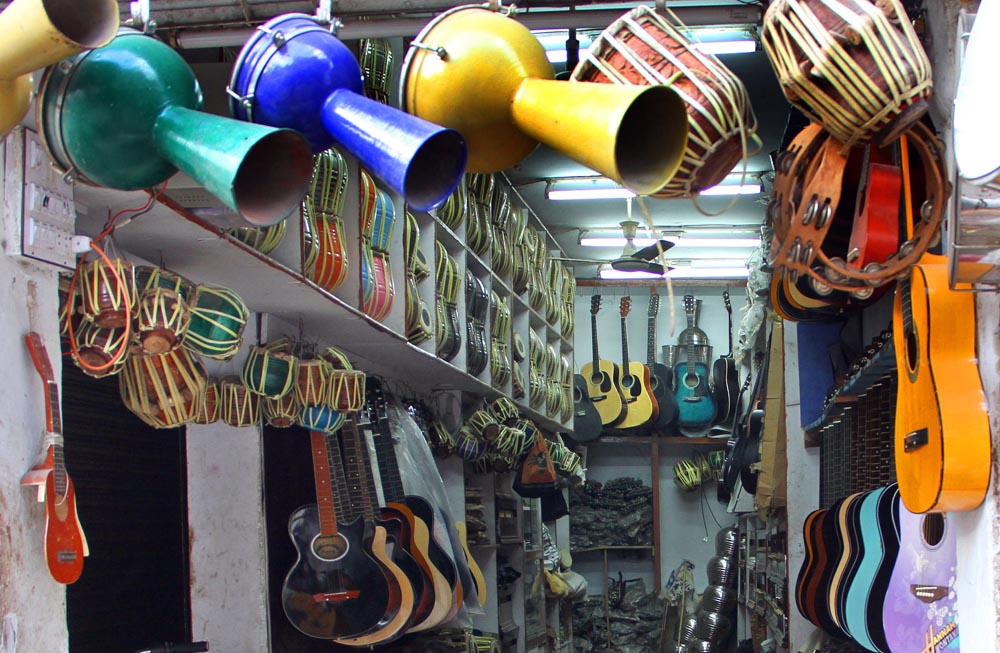
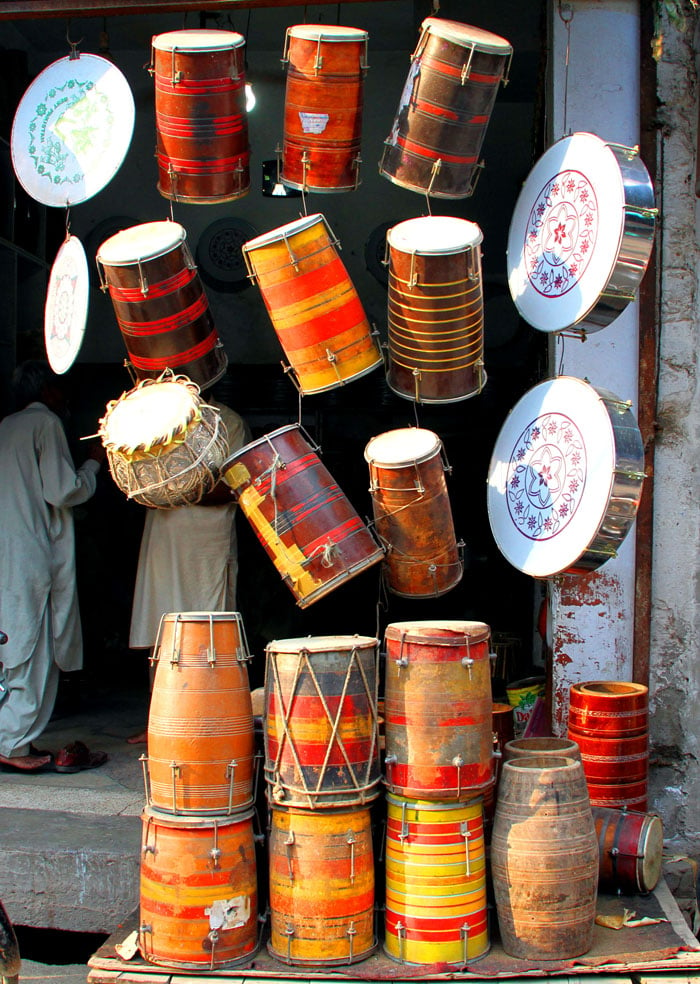
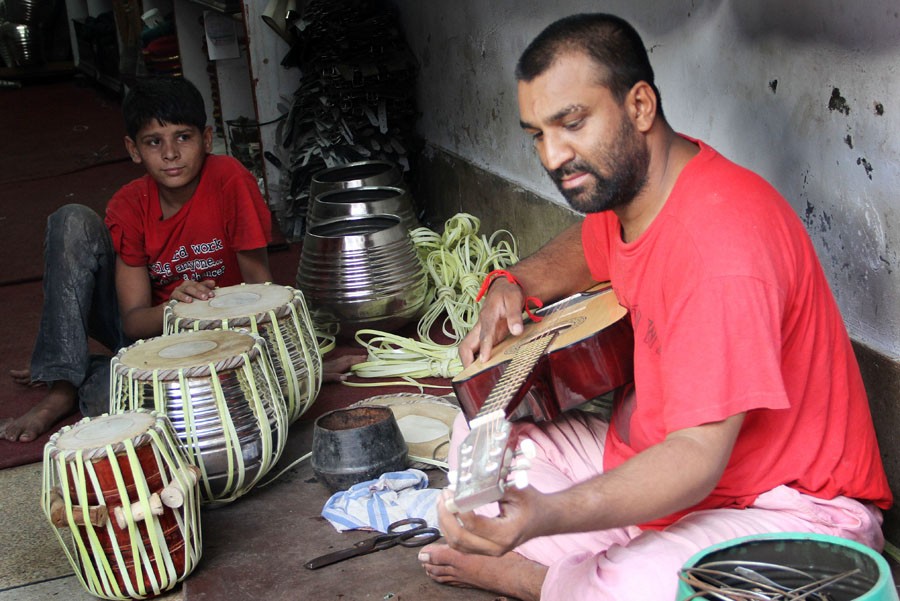
If you take a tour from the main Heera Mandi Chowk towards the Pani Wala Talaab, you cannot miss lines of shops displaying musical instruments such as guitars, harmoniums, sitars, flutes, drums, dholkis, dufs, and also ghungroos on their walls and racks. You also find shops that are littered with broken, damaged and worn out instruments brought here for repair.
The exact name of this bazaar is Langa Mandi and it has been here since the pre-partition days. However, over time, the number of shops selling the musical instruments has come down considerably. Today, the landlords want to rent out their properties to shoe manufacturers who are ready to pay far higher fares than the sellers of musical instruments. For the latter, of course, it has been increasingly hard to make ends meet.
"More and more people are leaving the trade," says Muhammad Tahir, Proprietor of Master Music Store.
A dejected artisan who learnt the skill of making musical instruments from his father, Tahir says the people do "no longer have a taste for classical music, nor is such music patronised by the government. That is why the demand for traditional musical instruments has dwindled."
His point is, obviously, that when there is no interest who will invest in these objects.
Talking to TNS, Tahir says his survival depends more on the repair services he provides and less on the sale of new products. "Replacing the damaged wire of a guitar can fetch you Rs50-60 and the goat skin sheet of dholki Rs100. But this does not mean there are no buyers of the new equipment."
His regular clients, who are interested in purchasing new instruments, are mostly Christians, Sikhs and Hindus. "It is part of their religion to sing psalms, bhajans etc, set to instruments like harmonium and dholak," he explains.
The high quality of his products, Tahir claims, brought such acclaimed artists as Asad Amanat Ali, Hamid Ali, Hussain Buksh Gulloo, Fida Hussain, and Mubarak Ali to his place repeatedly.
A significant quantity of musical instruments on sale here have been imported from other countries as manufacturing them indigenously is not feasible at all. For example, medium quality guitars available here can be bought for anything between Rs4,000-6,000 and all of these have been imported from China.
Harmoniums are both manufactured locally and imported from India. Even those manufactured here have reeds imported from India installed in them and can be bought for Rs20,000 to Rs 40,000 depending on the quality. The harmoniums with German reeds installed in them can cost between Rs150,000 and Rs200,000.
Ijaz Ali, a dealer in second-hand musical instruments, says the modern digital gadgets have replaced the traditional music instruments such as sarangi, pakhawaj and tabla to an extent that the new generation cannot even identify these. "Still, some rich kids buy these [instruments] for the heck of it."
According to Ali, a range of miniature musical instruments is also available in the market that cannot be played but are meant to be placed as showpieces.
"Earlier, the mosques would have drum-like instruments called nobat and these would be beaten with sticks to make announcements such as prayer timings, sighting of moon etc.," he adds. "But now all the mosques have sound systems and speakers.
"Such changes have also affected the trade."
While the bazaar gives an overall gloomy look, Nasir Pervaiz, owner of Millat Music Palace, is quite upbeat. He sees a lot of potential in the trade: "The factory manufactures four harmoniums every day, which means there are enough buyers of the product.
"I have personally shipped musical instruments to countries such as Kuwait where we get regular orders from."
Pervaiz says that even though some instruments have become less popular, there are those that are high in demand. He gives the example of dufs that are in-demand as these are extensively used by naat khawaans.
"The main Minhaj-ul Quran madrassa in Lahore buys at least 100 dufs every week from our store. Besides, there are many others that have their own demands."
He urges the government to give incentives to the trade and also facilitate soft loans for businessmen so that they can set up factories of musical instruments. "Even if these [musical instruments] do not have a high demand here, they can always be exported, like China is doing it.
"We have high quality leather, accomplished artisans and labour available at competitive costs. Why can’t we capitalise on these?"