Print Story
X




What goes on at the age-old Chamra Mandi dealing in animal hides, on Eidul Azha
Eidul Azha holidays brought with them the much-needed respite for commuters who could now move freely on the roads that had very little traffic, and without having to hear the deafening noise of horns honking endlessly at them.
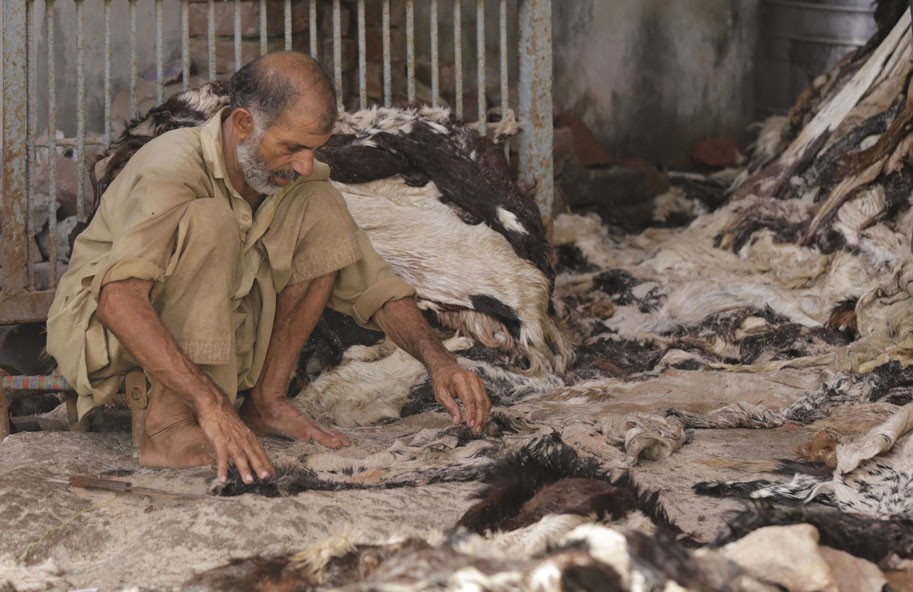
While much of the city wore a deserted look, there was a place that was bustling with activity and crowded by people. The roads leading to this place were choked and the traffic, mostly comprising trucks and loaders, moved at a snail’s pace. It was the wholesale Hide Market, popularly known as Chamra Mandi, where most of the province’s trade in animal hides is carried out.
It’s a commercial centre which is situated right in the middle of some densely populated residential areas of Northern Lahore. No wonder the activity that goes on here creates health and other problems for the residents.
The market has been there for well over half a century, despite several announcements made by previous governments to move it to the outskirts of Lahore. Back in 2007, the then chief minister of Punjab Chaudhry Pervaiz Elahi issued instructions in this regard but the process could not be initiated.
Visitors to the Mandi smell a strong stench as soon as they enter the place. Individuals associated with the trade say the stink is caused by rotting of the fat that is left inside the skins.
Interestingly, the workers at these godowns and the traders don’t have such complaints.
"Truckloads of hides arrive at Chamra Mandi from time to time throughout the year but the volume of trade swells manifold around Eidul Azha," says Tahir Bashir, a local trader who buys this commodity for onward selling to different tanneries and stockists.
Bashir has installed a tent over a small area in the market and can be seen arguing with the sellers over the rate of hides that he plans to purchase. Random testing of selected samples of hides from the truck gives him the idea of the quality of the stock and he makes an offer.
Bashir says he was sleep deprived during the Eid days and could only visit his home once. "A good merchandiser cannot miss the opportunity to buy high quality skins that are available only on Eidul Azha. Sacrificing sleep is worth the benefits involved.
"As people opt for healthy and good looking animals for slaughtering, their hides and skins are also of high quality," he adds. "Otherwise, only the end-of-career, old and weak cows, bulls and buffaloes are brought to the abattoir."
Like in any other market, it is the big players that call the shots here. The buyers who can purchase huge stocks can get a price of their choice. Similarly, the sellers with huge stocks for sale can demand a higher price.
One can see the trucks of organisations like Shaukat Khanum Memorial Cancer Hospital Trust, Jamaat-e-Islami, Dawat-e-Islami, and Minhaj-ul Quran lined up on the roadside with banners, carrying their names, splashed all over them.
Sheikh Mubeen, a purchaser, says the Minhaj-ul Quran Trust could get Rs273 for a goat hide and Rs135 for sheep hide as it had a sizeable stock of these commodities. "These rates are much higher than those the individuals trying to sell small number of hides would get.
"The Trust handles skins very well whereas a large number of those brought by individuals and small traders are destroyed by unprofessional butchers. If a hide is not removed properly and has cuts and meat attached to it the price offered is naturally low. There is no exploitation involved."
A major change observed at the Hide Market this year was that no member of any banned outfit could be seen trying to sell the stock. The City District Government Lahore (CDGL) strictly monitored the hide collection and took strict action against the organisations trying to collect these without having a No Objection Certificate (NOC) issued to them by the concerned authorities.
A CDGL official reveals that 75-odd organisations were allowed to collect hides in designated areas of the city. There was also a ban on the use of loud speakers to call for donations. It was learnt that the administration and police removed 49 illegal camps, confiscated 342 hides of sacrificial animals and arrested 27 people for collecting hides without permission on the first day of Eidul Azha. On the second day, another 10 illegal camps were removed and 129 hides confiscated. The number of people arrested for violations was 10.
On the likely purchase of hides from representatives of banned outfits, a cashier working in the raw material purchase section of a tannery says, "It is quite possible. It’s difficult for traders to identify them if they change their identities.
"The main responsibility of rooting them out lies with the state. However, we can ensure that we will not buy anything knowingly from such elements."