

Print Story
X

Age of Extremes is a book by a renowned British historian Eric Hobsbawm that gives a critical appraisal of various trends punctuating twentieth century with its emphasis on political wrangling of the Western powers. However, the title of the book suits Pakistan best in its current stage of existence.
In these times of strife and uncertainty, individuals invested with readiness to spawn a calming influence on people could be counted on fingers. Some bask in the limelight but a few work in silence and they remain obscure. Prof. Tariq Farani is such an unsung soul who is striving to tone down the belligerence and brutality operating in the guise of religion through his passion -- music. Farani is the principal spirit who is keeping alive the Nazir Ahmed Music Society at the GC University Lahore.
This year the number of students seeking membership of the society exceeds 230. In this day and age when Pakistani middle classes are generally overtaken by puritanical religiosity, attracting that many students to do music, is undoubtedly a great source of solace for him.
The music society was founded somewhere in 1930s but its name was Culture Club. With Partition it lost its existence. Subsequently, it was revived in the 1950s and named as ‘Music Society’ by Dr Nazir Ahmed, the legendary principal and then the professor of zoology. After his demise in late 1980s, it was named after him as ‘Nazir Ahmad Music Society’ (NAMS). Music was a part and parcel of the college culture from the very outset; however no record of any society entrusted with the task of promoting music existed prior to that. The room above the office of the principal was allocated to the music society. Then, only weekly events used to be held and some known artist was invited to perform before the audience, comprising mostly of the teaching faculty. It had to have several intermittent breaks.
The big change occurred only when Tariq Farani assumed its charge. After taking over as an incharge /president in 1981, he galvanised the society which emerged as the only one of its kind in the entire public sector university circuit, in quite a radical sense. Music when not used instrumentally, like beating of the drums in wars and battles during the medieval ages, tends to blunt the somewhat natural human instinct for violence. It brings out in humans their sublime self, essential for cultivating empathy.
In the particular case of South Asia, like in other cultures too, music in a very subtle fashion obliterates the exclusionary girdles, separating one group of the humans from the other. The musical melodies and tunes do transcend the cultural, ethnic or communal specificities. Music highlights the shared socio-cultural ethos. It is worth noting that the mature nations and communities lay emphasis on values they share with others, rather than focusing solely on the discrepant socio-cultural behaviour patterns.
In the particular context already spelt out, all that Farani is doing for the promotion of music in one of the premier educational institution of the country becomes extremely significant. He took an initiative of training youngsters, endowed with natural talent and the will to excel. It is important to mention here that Farani started this from 1981, when Zia ul Haq’s rule had virtually marginalised music and the practitioners of the music both.
Ever since that time, students congregate every Thursday to perform in front of their peers and Farani listens to everyone with a keen ear. Important to mention here is the famous tabla player Jaffer Hussain and his 22 years association with NAMS.
Born in a house-hold of educationists, Tariq Farani holds a degree in English literature. What caused him to gravitate toward music remains unclear even to him. The burgeoning passion could be the only explicable answer. However, the intensity of his passion for music defies description. Being a flute maestro, he won many laurels but he is singularly proud of his pupils, scores of them went on to attain international acclaim.
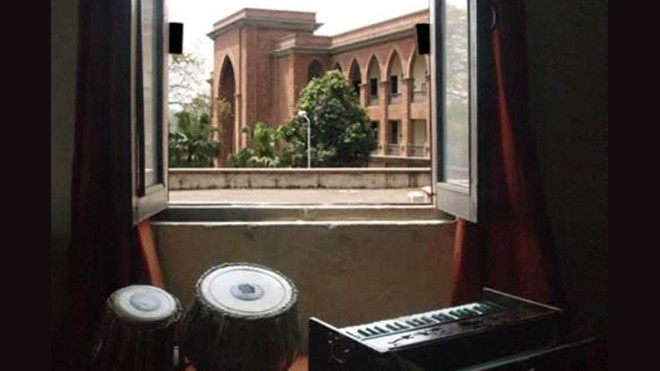
The department of music at GC University Lahore barely comprises a single low-ceiling room that acts as a classroom as well as Farani’s office. It is embellished with the photos of great musical maestros, meant to inspire the young musical enthusiast. Some photos carry the images of the old Ravians who excelled in music, like Khawja Khurshid Anwar, Hamid Ali Khan and Shafqat Amanat Ali Khan to quote a few. Then a portrait of Mirza Ghalib demonstrates Farani’s fondness for the great Urdu/Persian poet of the 19th century. The location of that one room department is enviably central as it exists on the top of Bokhari auditorium. But that room is squarely exposed to the sun. A few bracket fans and the open windows provide a semblance of a breeze which at times has a cooling effect.
With all these inadequacies, I usually wonder how he negotiates with the scorching heat during inordinately prolonged summer when the luxury of air-conditioning is not available to him. But Farani, an epitome of stoicism and forbearance, never complains. He seems to have reconciled with the marginal status accorded to him by the University administration. Like Prof. Zaheer Ahmed Siddiqi, Dr. Farhat Mehmood and Prof. Hamid Yamin Dar, Farani too is in love with GCU which is unflinching and unequivocal. But he suffers the loves for his alma mater in silence.
During the previous dispensation, Nazir Ahmed Music Society underwent a torrid time because its services were arbitrarily requisitioned by the Punjab Government. The spineless University administration obsequiously followed the instructions from the high-ups to the expense of the budding artists. Selfless Tariq Farani indeed is an institution, also a sole crusader whose aim is to instil the love of music among youngsters, an aim that is laudable to say the least.