

Print Story
X




Costly and gaudy planters emerge on city walls in pursuance of the greener Lahore initiative
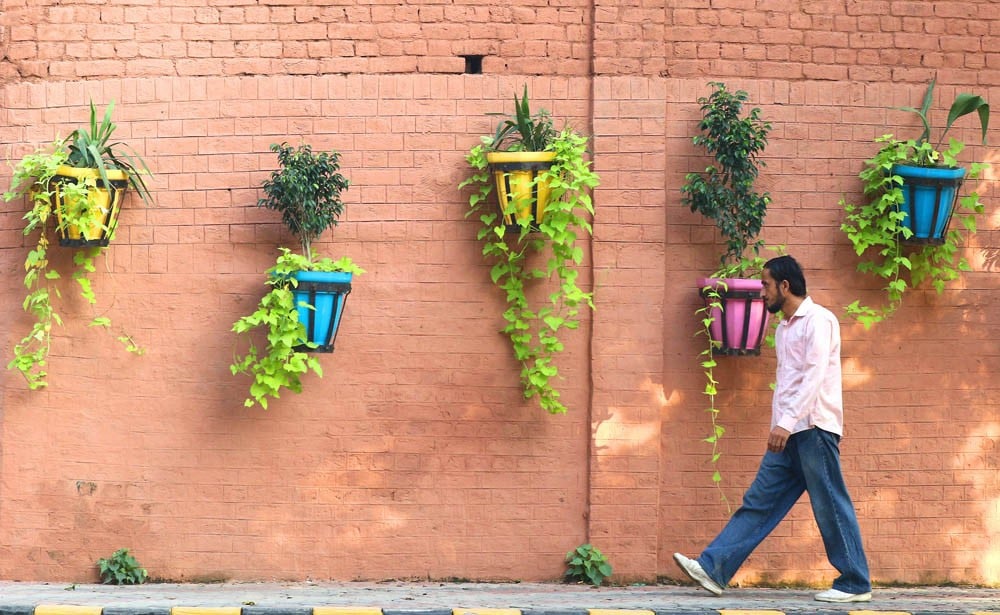
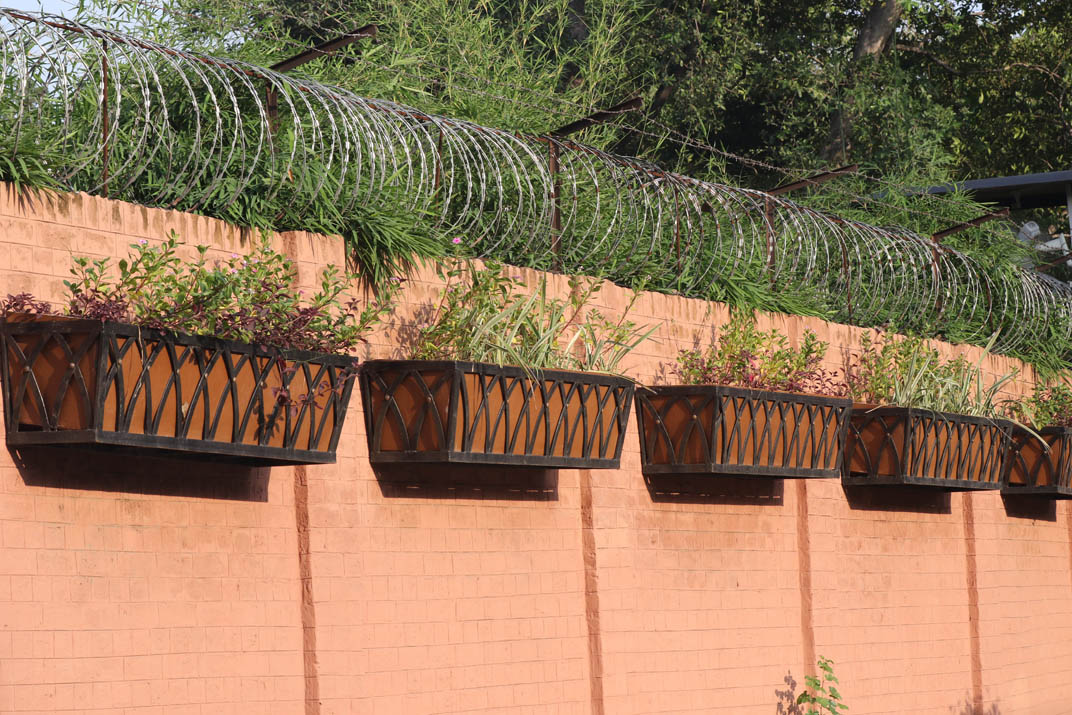
Moving along the Mall, Ferozepur Road, and Jail Road, you cannot miss the metallic frames tacked to the walls of (mostly) government-owned buildings.
There are some private properties also -- for instance, an electric appliances factory on Ferozepur Rd -- that are studded with these structures. These frames come in different shapes and sizes, and are quite visible for their shiny black colour, especially against the walls painted in light hues. The walls of Met Office on Jail Road and the Pakistan Administrative Staff College on the Mall are two such examples.
Interestingly, at some points, the frames are lying empty, whereas at others the flower pots and flowering plants are placed inside them.
The boundary wall of the 130-year-old Aitchison College carries scores of these structures, though it has a green belt and thick foliage of trees surrounding it. The wall of Gymkhana Club along Zafar Ali Road dons dozens of planters as well.
For those curious about the sudden appearance of these objects, the explanation is that these frames are called steel planters and placed at points where there is no ground to grow plants, trees or creepers. Once fixed these are filled with fibre glass pots that carry mud and plants and it is desired that these plants grow over time and cover maximum parts of the walls to make them look green.
"The initiative is part of the ‘greater’ plan of Punjab Chief Minister Shahbaz Sharif to make big cities of the province including Lahore green through horticulture," says Mian Shakeel Ahmed, Director General (DG), Pakistan Horticulture Authority (PHA).
Ahmed says there is a committee formed for the purpose that suggests different solutions and the one that suits a particular situation is adopted. "There are plans regarding developing greenbelts along different roads, planting trees at suitable places, beautification of the path along the railway track with greenery, growing creepers, climbers and vines, placing planters and so on."
The planters have also been placed at points like those at the crossings made of concrete where there is no ground to hold plants or grow creepers.
When asked about their presence on the walls of Aitchison College where there is enough ground, the DG (PHA) says, "It’s an exception." Period.
Manzoor Chaudhry, in his mid 60s, has an objection against this activity which is going on in the name of making Lahore green. He says he has spent his youth and middle age walking along the Mall and can associate himself with every tree, wall and building that falls on the way.
"How can anyone even think of defacing these beautiful walls and fixing steel structures to them?" he asks. "It’s like studding your body with sharp nails."
Chaudhry, who is a lawyer by profession, also believes the planters along the Mall are redundant because there is already a lot of green cover.
"Different colours of walls add to the beauty of a place and there is no need to cover the whole city into a coniferous forest. One must find out the cost involved and try to discover whether it was a one-time favour to someone to earn money or not."
The DG PHA rejects this claim and says that the planters were procured from civil contractors according to the prescribed rules and in a transparent manner.
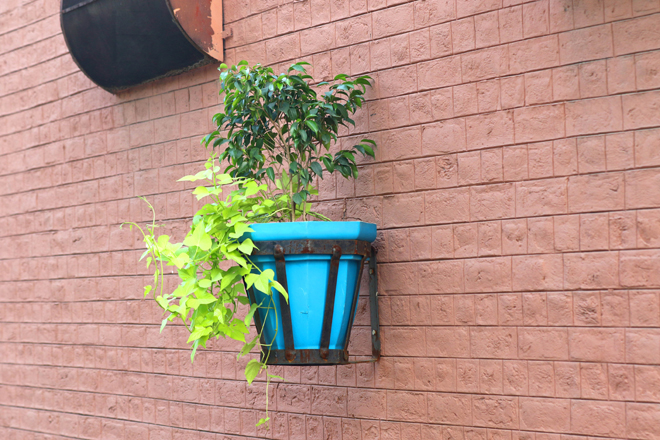
About the cost, he says, it varies with size and shape. "The small ones cost between Rs4,000 and Rs 5,000 per piece; the medium Rs8,000 per piece, and the big rectangular and semi-circle shaped around Rs16,000 per piece. The price includes cost incurred on fixing them, placing fibre glass pots in them and forming base to grow plants."
Presently, the government plans to cover the wall of almost every government building in Lahore in foliage. The process has been started and it may take a few years to achieve the objective.
A study is also being conducted on how to give pillars of the Metro Bus track a green cover as there is an example of such initiatives in Mexico. Legislation to make it binding on owners of private properties to cover the outer walls with plantation is also on the cards.
The District Coordination Officer (DCO) Lahore has already done a survey to spot all the walls in the city that are "eyesores" and need to be beautified.
Kamran Lashari, the convener of the said committee, says the planters will be placed at specific and limited sites as it is difficult and costly to maintain them.
"There is a need to water each and every planter separately and take regular care of the structures that make them not a preferred choice," he adds.
"During monsoons, these may get water naturally but when there are dry spells it will be hard to keep them alive. We’re also thinking about giving up the option in the future."
Another objection comes from the environmentalists who say the Punjab government talks about making Lahore green but actually continues to fell trees. The drive against tree-cutting is likely to pick up pace as road widening at three different points along the Canal is likely to start in the near future.
The DG PHA tells TNS the authority is conscious about the fact and has formulated a master plan whereby different trees (including fruit trees) will be planted along the canal.
"The trees will be planted both on the space between the canal bank and the footpath and on the green belt," he says. "The government has imported a tree transplanter from the US, at the cost of around Rs50 million, which will be used for fully grown trees. Experts from Big John company shall come to Pakistan later this month and train the PHA drivers on how to operate the machinery."