Print Story
X




The recent Lahore High Court judgment, barring construction work near 11 heritage sites along the route of Orange Line, lays down some significant legal principles
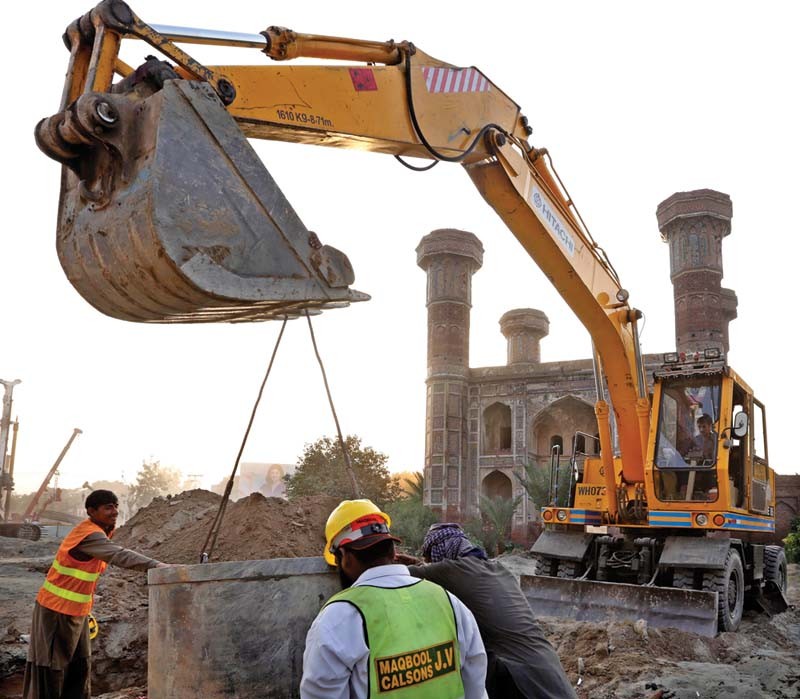
The Orange Line Metro Train (OLMT) project in Lahore faced a major blow on August 19 when the Lahore High Court (LHC) passed an order barring construction work near 11 heritage sites along its route. This decision upheld an earlier stay order issued by the same court while hearing a petition against violation of rules in award of No Objection Certificates (NOCs) by the competent authorities to carry out construction within 200 feet of declared heritage sites.
Under the Antiquities Act 1975 and the Punjab Special Premises (Preservation) Ordinance, 1985, construction within 200 feet of immovable antiquities is disallowed. The law however allows relaxation in this rule, provided NOCs are issued by the Director General (DG) Archeology and Advisory Committee of experts after thorough surveys and studies and exhaustive examination of the sites likely to be affected.
The order passed by Justice Abid Aziz Sheikh and Justice Shahid Karim of LHC mentions that "Original NOCs dated 16.11.2015, 30.11.2015 and all revised NOCs dated 06.5.2016 and all addendum NOCs dated 20.5.2016 under the Act of 1975 and Ordinance of 1985 are set aside being issued without lawful authority and of no legal effect. Consequently, respondents shall not carry out any construction within distance of 200 feet of protected immovable antiquity and special premises mentioned in para 24 of this judgment."
The order further reads: "The Director General Archeology is directed to engage independent consultants consisting of penal of experts of international status preferably in consultation with UNESCO, to carry out fresh independent study/report regarding protected immovable antiquities and special premises."
The request for permission under section 22 of the Act of 1975 and under section 11 of the Ordinance of 1985 will be considered afresh by the competent authorities in the light of study/report by independent experts of international status referred above, it adds.
Read also: Red light for Orange Metro
However, the court said the petition to the extent of challenging environmental approvals granted for the project was dismissed being not maintainable.
Against this backdrop, one feels the need to analyse the contents of the judgment and what it actually entails. While some quarters are taking it to be a final strike-down order against construction near heritage sites, others hold that the court has posed mistrust in the issuance of NOCs and given guidelines to issue them in a desired manner.
The Punjab government, on the other hand, is claiming the honourable court has not raised any question about the transparency of the project which means there is no corruption involved at all.
Azhar Siddiq Advocate, one of the counsels for the petitioners, tells TNS that first of all one needs to know the backdrop to understand the contents of the judgment. He says there are three sets of litigation pending at the court including those related to acquisitions for the project, irregularities in the award of contract and environmental approvals and risk of damage to heritage site.
The LHC, he says, simply took up the matters pertaining to the third set of litigation in this case and did not grant a clean chit regarding matters pertaining to acquisitions and award of contract as portrayed by the Punjab government.
In this regard, he refers to that part of the judgment that states, "However, during arguments, learned counsel for the petitioners agreed that as legality of project being allegedly violative of Punjab Public Procurement Act, 2009 (PPRA), is also subject matter of separate writ petition No. 5793/2016 (which is not yet ripe up for final arguments), therefore, in this constitutional petition, the petitioners will confine their submissions and relief to the extent of "Heritage" i.e. construction within the prohibitory zone of immovable protected antiquity/special premises and secondly "Environment" i.e. legality of Environmental approvals for project granted by Environmental Provincial Agency ("Provincial Agency")."
Siddiq says the judgment has put the government in a difficult situation as it cannot take the risk of engaging international experts like those engaged with organisations of the caliber of Unesco and get the project disapproved for good.
"Such organisations cannot be influenced and proof lies in the observation of Unesco on Shalimar Gardens and the hydraulic works," he adds. "Another important point," he says, "is that the court has set aside the NOCs and not remanded the matter which shows it does not want the same officials to work on these again."
"Though the judgment does not talk about any alternative plan, it does mention the confession on the part of the counsel of the respondent that the original feasibility report had suggested 6.9 kilometers of the route to be underground, and the government got it changed just to bring down the cost," he says.
Ahmed Rafay Alam, a lawyer who specialises in environment, says that it is a very comprehensive judgment spread over 309 pages and "an interesting fact is that two judges have written concurrent judgments. Normally, separate judgments are written only in case of contradictory decisions."
"What is impressive is that the judgment adds "heritage" to the right to life under Article 9 of the Constitution which is too great a development," he says.
The judgment reads thus: "We are, therefore, in no manner of doubt that history and heritage of a person is comprised in the broad concept of the expression ‘life’ and is protected by Art. 9 of the Constitution. That right must be preserved inviolate. The petitioners have thus cause for concern as their right to life is under threat. That right can only be regulated in accordance with law and cannot be taken away. Any threat, howsoever remote, to the historical monuments is a threat to life of not only the petitioners but to the collective right of the people as a whole."
Raheem ul Haq, a teacher and activist, says the court has vindicated the stance of the civil society and not only declared heritage a right to life but exposed the way the government machinery had circumvented rules to their interest.
The observation that NOCs were not maintainable for being based on Heritage Impact Assessment (HIA) and vibration impact study done by people associated with the government hints at this fact.
Siddiq explains that the court has not rejected their stance on environmental approvals and not heard it on grounds that the matter is already pending with an appellate forum. "We are planning to approach the Supreme Court to challenge the metro train project on environmental grounds."
A member of the Punjab government’s legal team says they are working on an appeal to be filed against the LHC decision in the Supreme Court. "We will submit that all requirements had been fulfilled during award of NOCs and the petitioners have tried to misguide the court. Besides, the fact that the high court has not talked about scrapping any part of the project and rejected petitioners’ objections against project’s EIA has strengthened our case."