

Print Story
X




The coup leading to a reign of terror
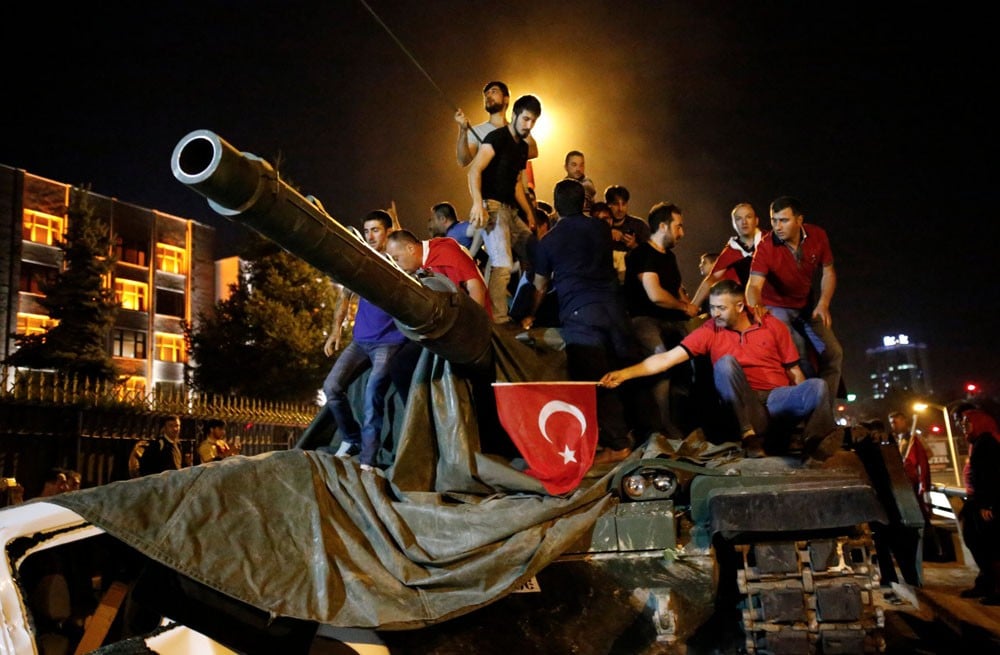
The aborted putsch against Turkey’s President Recep Tayyip Erdogan was greatly hailed by many Pakistani media moguls and self-styled political analysts. The pro-democracy sentiments of Turkish people, who came out to confront the coup-makers on Kizilay Square in Ankara and also on Taksim Square in Istanbul, bewitched many of them.
Thus the attempted coup was beaten back while the pro-Erdogan section of the crowd carried mock gallows, a symbol for death penalty to be restored, yelling at the top of their voice, "Say the word, and we’ll die, say the word and we’ll kill."
It indeed was surreal for us. Such euphoria among the Turkish people was unprecedented and had much for the Pakistanis to draw inspiration from. Some commentators attributed that "pro-democracy" fervour of the Turkish people to the emergence of the middle class, which historically is averse to any coup. That assertion will be analysed in the lines to follow. The undeniable fact remains that Turkish people had never before exhibited such fervour for any civilian leader vis a vis the military take over.
Like Pakistan, Turkey is no stranger to military coups. Interestingly enough, the number of coups that Pakistan and Turkey have been subjected to is exactly the same. Both suffered four coups each (Turkey experienced military takeover in 1960, 1971, 1980 and 1997 respectively). However, what is extremely important to emphasise is the difference in the orientation of both the armies which, of course, is immense. In this article, we are concerned more with Turkish army, therefore Pakistan’s army remains out of our interrogative gaze.
However, it will be pertinent to mention that Pak army went through a paradigmatic shift from the position of socio-religious neutrality to the position of ideology emanating out of religion with and an anti-India peculiarity. Conversely, Turkish army is ideologically embedded and profoundly entrenched in the secular tradition, having its roots in the Kemalist ideology. It invariably assumed power whenever the Army high command sniffed any lurking danger, posing threat to the secular tradition. Besides, Kemal Ataturk himself hailed from the ranks of the Army; therefore the Army had an excuse to wrest the reins of power in order to preserve the ideology that the founder of Modern Turkey so passionately adhered to.
Thus secularism, as it can be inferred from Turkey’s political history, could not effectively be ingrained in other spheres and institutions. Every coup has not only hurt democracy but also fuelled radical Islam. Can Dundar, an Istanbul-based analyst, points to the two extremes of Turkish politics, which adequately sums up the state of that country’s politics. "Turkey’s politics has always functioned like a pendulum: it swings from mosque to barracks, and back again. When it sways too near the mosque, soldiers step in and try to take it to the barracks. And when the pressure for secularism from the barracks becomes too great, the power of the mosques grows. And educated democrats, sitting in between these extremes, are always the ones to take the beating."
With the onset of the 21st century, the pendulum of Turkish politics swung to the mosque. Consequently the likes of Erdogan and his one time ally who subsequently became his arch foe, Fatehullah Gulen, carved out a niche for themselves in the Turkish political sphere. Both of them complemented each other when Erdogan assumed office as the Prime Minister in 2002, and in quite an effective manner sidelined the regime’s critics in the military and civil society. It was then that umpteen number of Gulen‘s followers found their way into the judiciary and the army. Erdogan also introduced religion as a compulsory subject in schools which has started eroding the secular ethos underpinning the plurality of the Turkish society.
Thus the cracks in the Turkish society became wide open which led to a fissiparous polity. Even Erdogan and Gulen fell out and amenity between them became so intense that the former has incriminated the later for orchestrating the coup. Even the religious right itself came to be riddled with open hostility.
Reverting to the putsch which was successfully averted, the much endeared Erdogan came to be perceived by Pakistani populace as an iconic leader worthy of emulation by the entire Muslim world. Particularly among the Pakistani intelligentsia and politicians, Turkey is projected as a model of economic growth and development as well as political stability. But the flip-side of the situation has not been adequately unravelled in the Pakistani media.
What comes up as one of the fundamental postulates is any leaders clinging on to power for inordinately long period which in its very essence is anti-democratic. One may look around in the developed democracies in the post 1945 situation. Margaret Thatcher and Tony Blair, despite winning elections for the third time, opted to relinquish their positions in the larger interest of the nation and democracy. Even if elected by the people, long duration in office breeds autocratic if not outright dictatorial impulse. Many who are concerned about Turkey see Erdogan’s 14 years in power in different capacities as having taken the country down the slippery slope to dictatorship.
The attempted coup has provided him with an ample excuse to unleash a reign of terror. He is trying to rid the military, judiciary and other institutions of dissidents. 16,000 people were detained for questioning and 1,700 officers and junior officers from military including 149 generals and admirals were sacked. The deans of all the universities also fell prey to the witch-hunt. Media was already gagged but for Erdogan’s further gratification 45 newspapers, 16 television channels, 23 radio stations, three news agencies and 15 magazines were closed down.
He has entrusted himself with emergency powers, practically rules by decree, a practice not at all followed in democracies. He seems convinced that only a radical show of strength can consolidate his shaken power structure which he claims has been infiltrated by the Hizmet movement of Gulen. He is not bothered to introspect and try to set his own house in order. The rot always starts from within. Thus the process of reform should commence from his own son Bilal Erdogan who has been implicated in corrupt practices.
Fabricating conspiracy theories would not help. Erdogan must heed the lessons of the past. What the Turkish citizens urgently need, and the rest of the world will be anxiously hoping to see, is not vengeance, but the restoration of the rule of law.