Print Story
X




Artists at the ongoing Murree Museum Artists Residency break boundaries in many different ways
"The only good things about borders are the secret crossings" -- The Carpenter’s Pencil Manuel Rivas
Borders, besides being boundaries between countries, can be understood in other contexts too. In art, boundaries can be very practical: limited dimensions of a canvas; a sculptor working in a narrow space with specific materials; market demands; family pressure, expectations of fellow artists etc. Artists are also constrained by their own signature style along with the trends of their times, and the structure of the art world that shackles them.
Yet, these frontiers are often crossed -- producing results that are unusual and unexpected. Murree Museum Artists Residency is one such programme where artists are invited to Murree, work in a studio space and produce what is different from their usual practices.
Murree being an exceptional location, the focus of this residency is distinct from other such endeavours. Here, the artists are not expected to ‘produce’ finished pieces which can be shown and sold at galleries but to have an experience that is not possible in their routine environments (in that sense it shares Vasl Residency’s objective and structure). It forces one to leave one’s habits, habitation and comfort zone; in many ways, it elevates the artists.
Being in Murree not only opens up new options in viewing the geography and topography; it also leads one to review one’s pictorial pattern and artistic approach. A person who looks at the world from a higher and unusual position may also see his own art and ideas in a different perspective. The question of personal pleasure and the place of art in a society are important both for the participating artists as well as for Saba Khan, the founder and organiser of the residency.
The artists selected for the third year programme (July 13-August 3, 2016) are not merely liberating themselves from their past practices, they are searching for an idiom that can lead them further. Each of the four participants has individual concerns, yet being in Murree has become a source of inspiration to look beyond one’s regular work. On the basis of their previous works, one can categorise them into two groups: Artists who are addressing political, social and urban issues; and artists concentrating on personal vision and private histories.
In the former group, Pradeep Thalawath (Sri Lanka) and Seher Naveed (Karachi) have been using city and present situation as a means to communicate their concepts. Thalawath was a student at BNU and has showed in Lahore, Colombo and Bangalore. In his works, he has been concerned with how city and interaction with urban population can become a metaphor to communicate the great pain of violence, which many nations around the world and especially in the South Asia have to face/suffer. His home-country witnessed a period of political turmoil and terror, so he translates its aftermath in the way streets, roads and neighbourhoods are altered or disfigured. In his site-specific pieces, installation and performances, Thalawath locates areas in which one could find the impact of violence, and he disrupts the normal course of life through his installation (Bangalore), or his performance by leaving his trail in the form of a tissue paper roll (Lahore).
In a similar sensibility, Seher Naveed has focused on the changing scenario of a city, Karachi, with its layers of protective devices, i.e., containers, barriers and barricades. In the past she had painted, rather spread, the outer layer of containers inside a gallery, invoking the aesthetics of these objects, which have become part of our urban environment of late. In some sense her recent work, inspired from the rooftops of Murree houses and creating these forms in corrugated paper, can be viewed in continuation of her past pieces. Her concerns, which lie in between aesthetics and the changing conditions of a culture, are evident in the way she evolves her minimal language.
The other two artists, Suleman Khilji and Sarah Mumtaz, are more involved with autobiographical or personal interpretation of the outside world. Previously, Khilji had captured characters from his surroundings and, combining them with the figures from Mughal miniature, offered a link towards the continuity of history -- of ideas and images.
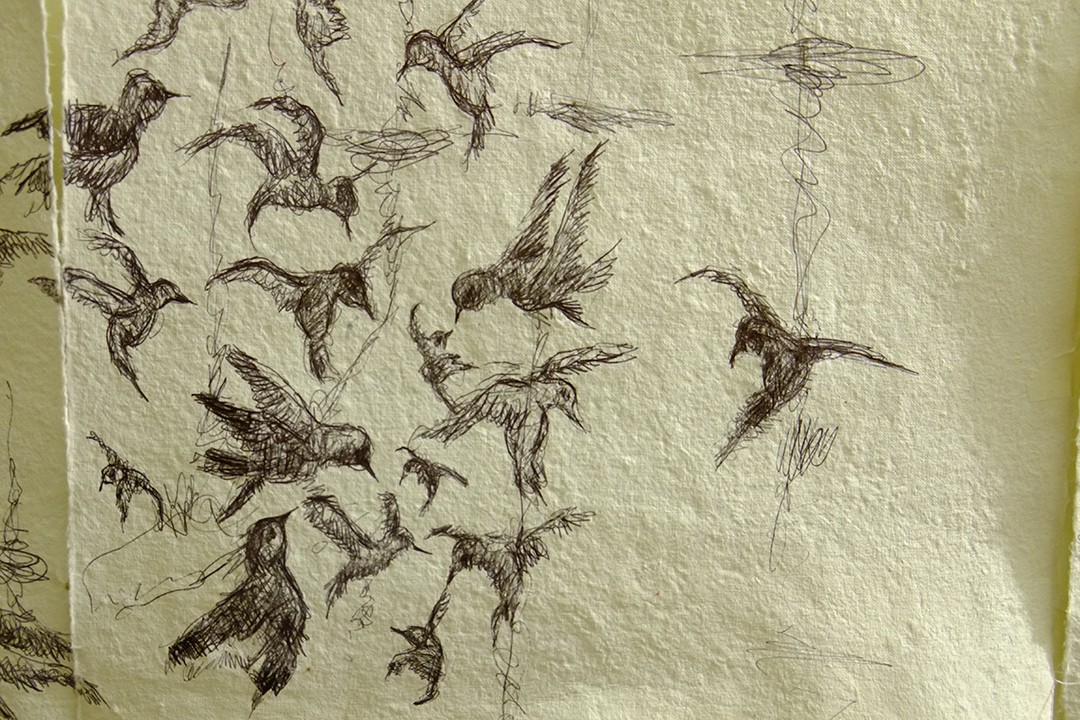
Sarah Mumtaz has weaved a narrative that revolves around her peculiar personality and interaction with the world. Through her work ranging from photographs to performances and prints to drawings, Mumtaz demonstrates a remarkable facility in delineating her self and her imagined companions (bees, birds, animals).
The greatest achievement of Murree Museum Artists Residency is not only to open up new vistas for artists in their art practices (Pradeep is working with cement bags, Suleman is collecting metal wires, and Mumtaz is collaborating with local women in her embroidery-based pieces), but to challenge the boundary between high art and low art, or even between art and natural/normal expressions. The artists have interacted with local children who have produced raw, uninhibited and incredible drawings in these workshops conducted by the artists. Drawings which not only inspire a critic visiting from Lahore, a gallery director in Karachi or a collector in Islamabad, but force a bunch of children to knock at the doors of residency cottage and demand/inquire about the next session of drawing workshop which they can join.
Beyond the tall claims of public art and other such positions, one feels that if a small number of children are eager to be part of a drawing project, the Murree Museum Artists Residency has served its purpose -- to create a conversation between artists and general pubic. A much-needed dialogue, which in most cases is more important for artists in order to analyse their art practices than the kids who taste of feeling the other, albeit briefly, when they draw their surroundings instead of being a part of it.