Print Story
X




Limited jurisdiction and resource crunch render consumer courts less effective than before
About a decade ago, consumer courts were set up in different districts of the province under the Punjab Consumer Protection Act 2005. The aim was to hear and resolve disputes involving consumers and providers of goods and services.
As per law, before approaching the court a complainant has to follow a procedure and serve a legal notice to the concerned person or company.
Soon after their establishment, the district consumer courts were in the news for announcing landmark decisions and challenging powerful business groups, service providers, state-owned utility services and so on. The aggrieved consumers, who earlier had no idea about who to approach, were relieved to find a solution to their woes.
In many cases, the decisions were upheld by superior courts and the overall affect was that businesses started fearing action in case they dealt in faulty productions and offered substandard services.
The courts are still there but over time the consumers have developed a feeling that these aren’t working as efficiently as before and taking far more time to decide cases.
Working under the Punjab Industries Department, these courts are dependent on the budget provided by the finance department on the instructions of the Punjab government and not that available for courts working under the high court. The opponents of PML-N government even claim that the consumer courts are being intentionally neglected as the credit for setting them up goes to former CM Pervaiz Elahi’s government.
Take the case of Lahore and you will find a large number of cases that are lying undecided. Here, the frequent shifting of premises has also created problems for complainant as they find it hard to locate the new office. A general complaint is that the jurisdiction of these courts has become quite limited and unlike in the past these can only hear petty cases.
Muhammad Arshad, a consumer who has a complaint against a housing society, states that he was shocked to hear that his case did not fall in the jurisdiction of the District Consumer Court, Lahore. In another case, in which he accompanied his relative, he says that things moved so slow that they decided to stop pursuing it.
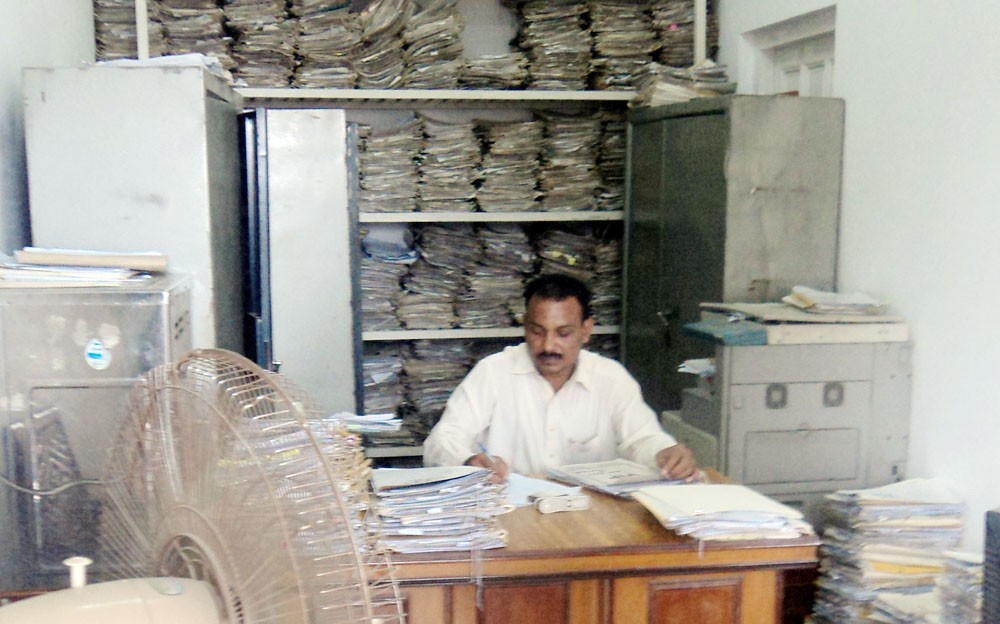
Arshad says that the consumer court in Lahore, situated on the top floor of the Judicial Complex, is so hot and suffocating that it becomes hard to breathe there. "The administrative office is ill-equipped and the staff does not even have stationery. The photocopy machine, computers, faxes are out of order and the air-conditioners are lying on the floor. By no standard it appears to be the office of a special court."
Imran Saleem, an employee with a private company, bought an air conditioner that stopped working the next day. He wants to approach the court but has been advised against it and asked to get the fault removed by paying a cost to its seller. The seller is not ready to accept that the air conditioner was faulty and blames the buyer for using it recklessly.
Saleem says the lawyers are also not interested in contesting such cases as relief given is not sufficient and damages are hardly covered. "Most of the times the defendants are asked to only cover the cost of the faulty goods. In this situation, the complainants do not feel compelled to pay reasonable fees to the lawyer."
Asif Nazir, Registrar, Consumer Court, Lahore, agrees the backlog is quite heavy in the office. Its major reason is that the court is working on extremely limited budget and with a depressed staff that has not been paid salaries for the last three to four months and their contracts have also not been extended.
Talking to TNS, Nazir says the consumers visiting the court are also deterred by the bad working conditions of the place, a proof of which is that hardly 45 cases are being filed in a month. "The figure used to be 250-300 a couple of months ago, and should have increased.
"When people see others moving from pillar to post for years without relief they give up on their plans to approach the consumer court."
He also says that when the court was housed in a rented property in Rizwan Garden, even the women complainants would come there in cars from as far as DHA and Bahria Town. But now they are reluctant to come to the current office in Judicial Complex due to the typical environment of lower courts.
Nazir says the office is without any funds to get the electronic equipment repaired or buy stationery. What’s more, the air conditioners installed in the administrative offices were removed on the ground that these were adding extra load to the power supply paraphernalia.
Amir Mahmood Advocate, a Lahore-based lawyer with expertise in consumer protection laws, says there is a dire need to increase the number of consumer courts and judges in the city as the case load is too much to be tackled by a single court. "The concerned law states that cases shall be decided within six months’ time but the people have not been able to get relief even after the lapse of several years," he says.
"If there were enough courts and speedy disposal, the situation would be otherwise. The extraordinary delay discourages consumers from approaching the court and they stop pursuing their complaints."
Mahmood highlights another important issue which is that the judges of the consumer courts are changed way too frequently: "Hardly any judicial official wants to preside over the court due to which expertise in these laws cannot be developed and decisions are often weak. Once challenged in the high court, half of the [consumer court] decisions are overturned for this very reason."
Mahmood is quite concerned about the limitations being routinely imposed on consumer courts’ jurisdiction by the superior courts. "India’s example should be followed where the scope of consumer courts has increased over time."
He says that he has been practising consumer law since the establishment of the said court in the city. It heard and decided many landmark cases at the outset. "It’s a pity that today cases against SNGPL, WASA, Lesco, PTCL services provided by cellular phone companies, housing services, banking services, education sector, health services and insurance are not accommodated by these courts. Most of the cases heard by the consumer courts are related to purchase of items like fridges, coolers, air conditioners, washing machines, mobile phones, transport services, tailoring services etc.
Amir Mahmood suggests that the jurisdiction of the court should be expanded in the light of Section 3 that states that "the provisions of this Act shall be in addition to and not in derogation of the provisions of any other law for the time being in force."
His point is that under this section a consumer court shall not be restricted from hearing a case on grounds that there is another law to handle such cases.
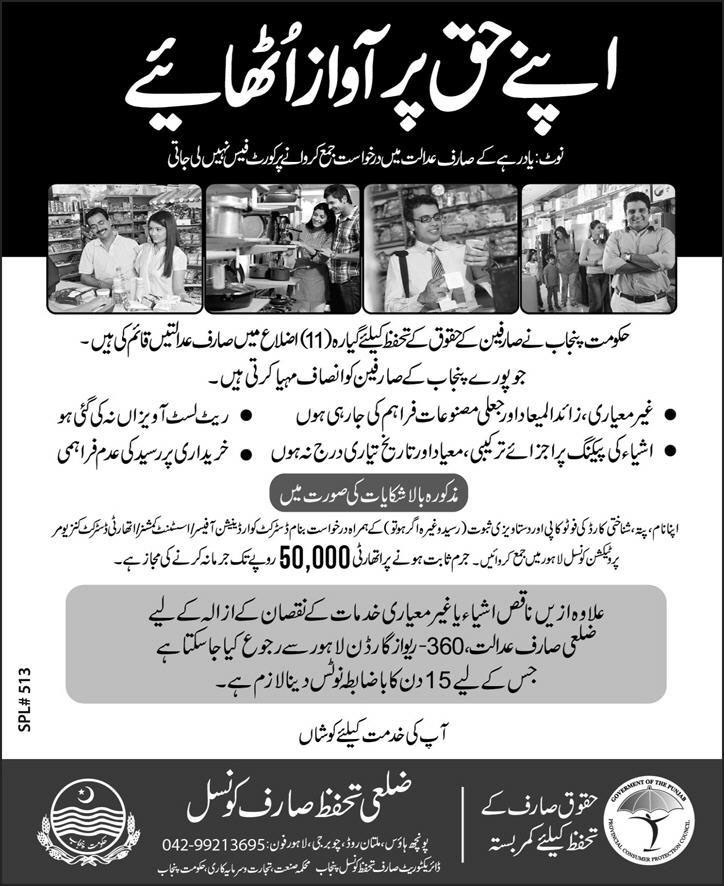
Amir Zameer, Director, Consumer Protection Council, Punjab, says all-out efforts are being made to increase public awareness about consumers’ rights so that the common people are able to approach relevant forums to have their grievances addressed.
Towards this end, he says, a comprehensive campaign was launched under which advertisements were placed in the mass media through the Directorate General of Public Relations (DGPR) Punjab. "The aim of the campaign was to tell the aggrieved consumers about the options they had at their disposal, and explain the procedures that they should follow to seek relief."
According to Zameer, efforts are also under way to strengthen the department and there is a suggestion to grant powers to the officer of the rank of assistant director (legal) to impose a fine of up to Rs50,000 on violators.
"At the moment, such powers lie only with the district coordination officers (DCOs) who are often too busy to look into matters where consumers’ rights are compromised."
He says that recommendations have been forwarded to the concerned department for amendments in consumer protection laws to make them effective and clear. "No doubt, there are definitions that are not quite clear and lead to ambiguities; they must be simplified.
"Laws are being introduced to make it binding on manufacturers to print prices on the packaging of consumer goods, which is not the case at the moment."