Print Story
X




Many local Pashtuns are suspected of being Afghan refugees and hounded by the authorities
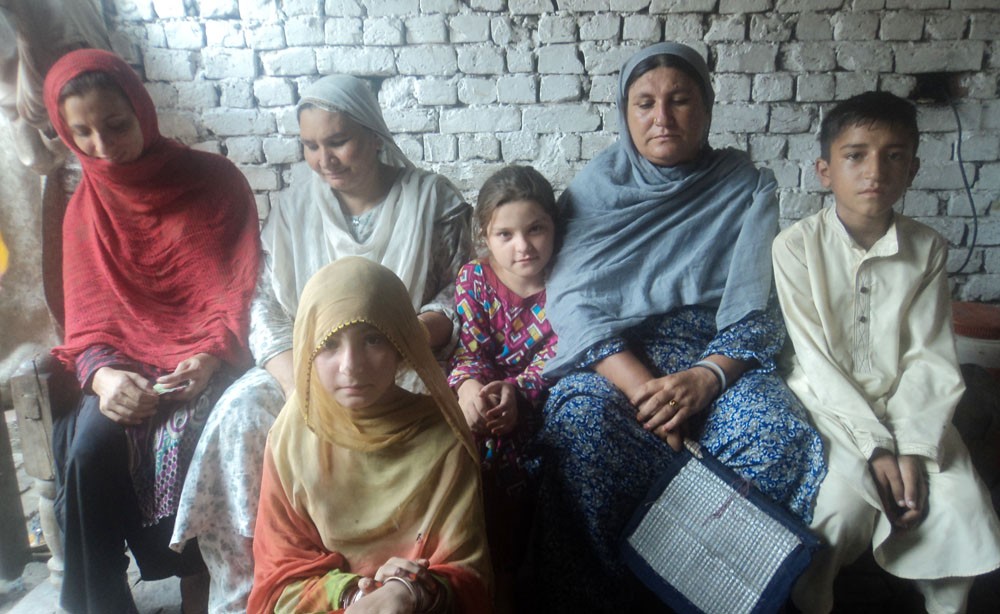
Shamim Bibi, in her early 40s, is a home-based worker who lives in Noor Colony, Shadipura -- a slum lying along the Grand Trunk (GT) Road in Northern Lahore.
She claims that her ancestors came to Lahore from Mohmand Agency some 50 years ago and settled at first in Muridke and later to their present place.
The reason for migration was purely economic as means of livelihood were extremely limited in the mountainous region that they ultimately left behind. Here they strive to earn their livelihood -- the women do embroidery and men mostly work as rickshaw drivers and push donkey carts.
In this locality, there are around a dozen families that came from Mohmand Agency. The total number of their members is 150 or so.
With two generations born here, their links with their ancestral land in Mohmand Agency are not so strong. Many of them have never gone back even once. Whenever there is a death or marriage or an important get-together, a couple of males travel up north to give their token presence and return as quickly as possible.
The Pashtun identity of this community was never a source of worry for them. But recently they claim they are being hounded by the authorities and asked to prove they are not Afghan refugees living here as Pakistanis. The CNICs they possessed have become redundant. They complain of being punished for the crimes of others -- the refugees who fraudulently earned Pakistani identities and the corrupt officials who helped them out.
"My grandchildren have been expelled from the school for not being able to produce B-Forms and my daughter’s marriage cannot be registered as she has been denied the CNIC," says Shamim who has been asked by the National Database Administration Authority (Nadra) to provide a ration card issued to her forefathers to prove that she did not come as a refugee to Pakistan.
Both she and her husband have Pakistani CNICs but their children have no identity.
Shamim tells TNS that her son drives a rickshaw and every other day faces harassment at the hands of the law enforcement agencies for failing to produce their CNICs.
"There are many Pakistani Pashtuns who were picked up and moved to undisclosed destinations for interrogation in cases of terrorism only because they failed to produce their CNICs," she says.
The problems cited by Shamim are very real. These are faced by hundreds of thousands of Pakistani Pashtuns settled all over the country. Their similarity in appearance to Afghan refugees has landed them into trouble as the Pakistani authorities are trying to find out the unregistered Afghan refugees or those holding fraudulently earned Pakistani CNICs.
The scale of the issue is also huge, as the country has the world’s second largest refugee population, with more than 1.5 million registered and about a million unregistered refugees from Afghanistan. They are deemed as a big security risk.
According to Nadra spokesman Faik Ali Chachar, "Not everyone is declared as aliens, even though they are marked for suspicious identities and their cases are probed."
Chachar says that the authority sees whether the family tree is complete or not. It wants to ensure there is no dubious entry.
When asked as to why the parents with valid identity cards are unable to get their children registered, Chachar explains they have the orders to validate these cards also. "These parents should be able to establish their links with the land and prove that they are not Afghan refugees who earned Pakistani CNICs through bribes and frauds.
"For this very reason, the Pashtun applicants who claim they are Pakistanis living in different parts of the country are required to bring ration cards issued to families, before the influx of Afghan refugees, that would carry names of all the family members.
"This is not the only requirement," he insists. "In case an applicant does not have it, he or she can furnish certificates from political agents or provide any other proof that their ancestors were also Pakistanis."
However, there are cases where the victims of terrorist activities have also been seen with suspicion. For example, the father of a slain student of the Army Public School (APS) Tufail Khattak found his CNIC blocked and asked Nadra to unblock it as he was planning to go for the Hajj along with his wife in order to come out of the trauma.
To establish his credentials and Pakistani identity, he mentioned his late father retired as a junior commissioned officer (JCO) and his elder brother retired as a colonel.
Besides going for the Hajj or Umrah, the sale and purchase of properties or seeking loan from any bank, CNIC is also needed -- for preparation of documents like driving license, children’s admission, employment, visits to any restricted building, obtaining visa, etc.
Sobia Sharif, another resident of Noor Colony, has not been issued her CNIC. The reason cited, according to her, is that 13 dubious CNICs have already been issued on the basis of her father Muhammad Sharif Khan’s CNIC.
The amazing part is that a person shown to be Sobia’s sibling in Nadra record is older than her father in age. "I am told my CNIC is ready but it will not be issued till all these anomalies are removed. My father has no knowledge of how his card was used. I am totally at a loss on what to do."
The Nadra spokesman agrees that many such irregularities are the fault of the registering authorities but adds that the problem is that the burden of proof lies on the applicants with incomplete forms and without supporting documents. "It is no secret that a large number of Afghan refugees have got themselves registered as Pakistani nationals in the past. They had hoards of wealth due to their unlawful activities such as drug trafficking and arms smuggling. They could pay any price to get their status changed from a migrant to a national."
Chachar also says that verification by an elected representative from the area where there are suspected applicants or CNIC holders is not sufficient as it is too serious an issue and directly linked with the threat of terrorism. The elected representatives are also not taking the risk out of fear of any reprisal in case of wrong certification. The Interior Ministry is following the zero-tolerance policy and has recommended a 14-year jail term for those who do not disclose their true identity. Anybody who surrenders the fraudulently earned Pakistani nationality will be pardoned and his status will be changed to that of a refugee, he adds.
However, Chachar does not buy the allegation that many CNICs have been blocked without justification. "There’s always a reason. There is a mathematical formula applied to the database that tracks all transactions made against a particular CNIC number, the holder’s travel history and pattern, the log of calls made against a sim issued against that number (with the support of PTA) and so on.
He cites the example of a family in Murree that raised hue and cry for not being accommodated and later had to confess in the face of undeniable evidence that they were Afghan refugees. They had bought property in the area and had been living there for decades.
Muntazir Mehdi, SSP Operations, Lahore, says it is not as simple that any person without CNIC is treated as unregistered Afghan refugee and repatriated to Afghnaistan. Such people, he says, are taken into custody and their photos and fingerprints are sent to Nadra for matching with their family trees, if there are any.
"If there is no record, a case under foreigners’ act is registered and a suspect is handed over to the Federal Investigation Agency (FIA). Once the agency is able to prove the person is an Afghan refugee, only then he is repatriated."