

Print Story
X




On paper Pakistan team looks competitive -- a combination of young and experienced players, but the team’s bowling will be our strength
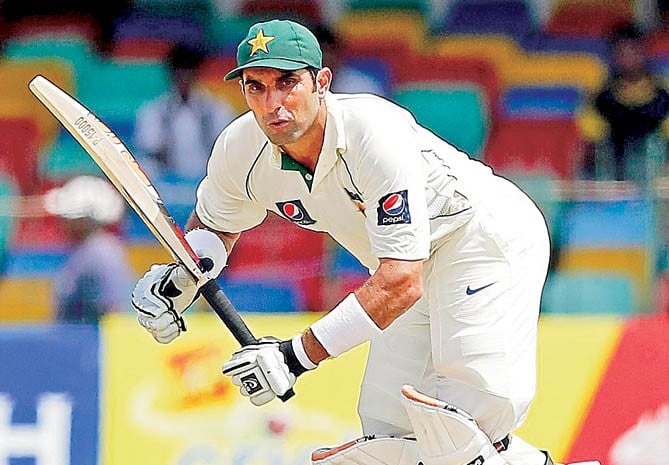
Pakistan are currently in England to face the English challenge in tough conditions. The Test series between Pakistan and England will be a real test of Misbah and Company.
On paper Pakistan team looks competitive -- a combination of young and experienced players, but the team’s bowling will be our strength.
Keeping in mind the inconsistent performances of the other players, Younis Khan and skipper Misbah-ul-Haq are the backbone of Pakistan batting. They are the only dependable batsmen in middle-order.
Younis is the highest Test run-scorer from Pakistan with 9,116 runs, averaging 53.94, including 31 centuries and 30 fifties. Misbah’s average of 48.89 in 61 Tests proves his importance in the middle.
Pakistan’s unpredictable top order has made Misbah’s job difficult. In many matches he has come in to bat very early, with the innings needing consolidation after the loss of early wickets.
Misbah is the most suitable person to lead Pakistan cricket team. He is a decent captain with a great personality. He’s done an admirable job, especially bringing stability and consistency to the team.
Misbah deserves to be treated with honour and respect. He took over when the team had lost 10 out of its last 15 Tests. He was named captain after the spot-fixing scandal during England tour of 2010.
He was preferred over senior cricketers Younis Khan and Mohammad Yousuf as captain. Misbah proved his selection and transformed a demoralised Pakistan team into a fighting unit.
He will be remembered more for his achievements as captain than as batsman. He did not get an opportunity to lead the side at home.
Misbah is Pakistan’s most successful Test captain with 20 wins in 42 matches, surpassing Imran Khan and Javed Miandad who won 14 Tests each out of 34 and 48, respectively.
Wasim Akram led the team admirably in 25 Test matches, winning 12 and losing eight, while five ended in draw.
His pace partner Waqar Younis was impressive too. He captained Pakistan in 17 Tests, won 10 and lost seven.
Misbah is the oldest Test and ODI captain in Pakistan cricket history. He will lead the Test side against England at the age of 42 years. Imran led Pakistan Test team at the age of 39 years and 43 days in January 1992 against Sri Lanka.
Zaheer Abbas captained Pakistan at the age of 37 years and 139 days.
Misbah silenced his critics who accused him of being a defensive captain by equaling Viv Richards’ 56-ball hundred record. He also has the record of fastest Test fifty -- 21 balls and in 24 minutes, against Australia in Abu Dhabi.
Mishbah’s performance as captain is much better than only as batsman. In 42 Tests as captain he scored 3,344 runs at a high average of 56.67, registering seven hundreds and 28 fifties. He had scored only 1008 runs in 19 matches when he was not skipper, at an average of 33.60. He had only two centuries and four half-centuries.
Former Pakistan coach Geoff Lawson also praised Misbah’s captaincy and said that he believed "Misbah has the best cricketing brain within Pakistan and will do incredibly well".
He also won the first Pakistan Super League (PSL) crown for his team Islamabad United earlier this year.
Misbah made his Test debut in 2001 against New Zealand at Auckland in which he scored 28 and 10.
After the defeat in Twenty20 series against England in 2012, Misbah stepped down as Pakistan’s Twenty20 captain and Mohammad Hafeez was named to lead the national side in the shortest version of the game.
He also left the captaincy of One-day International in 2015 after the World Cup. But since his retirement from ODI, the team’s ranking has gone down to ninth, just ahead of Afghanistan, Zimbabwe and Ireland.
Misbah is not worried about his future but has stressed that several talented young players are capable of taking over from him and should be groomed for the captaincy.