


Print Story
X




The state of affairs at the Punjab Information Commission is quite bad. Here’s how
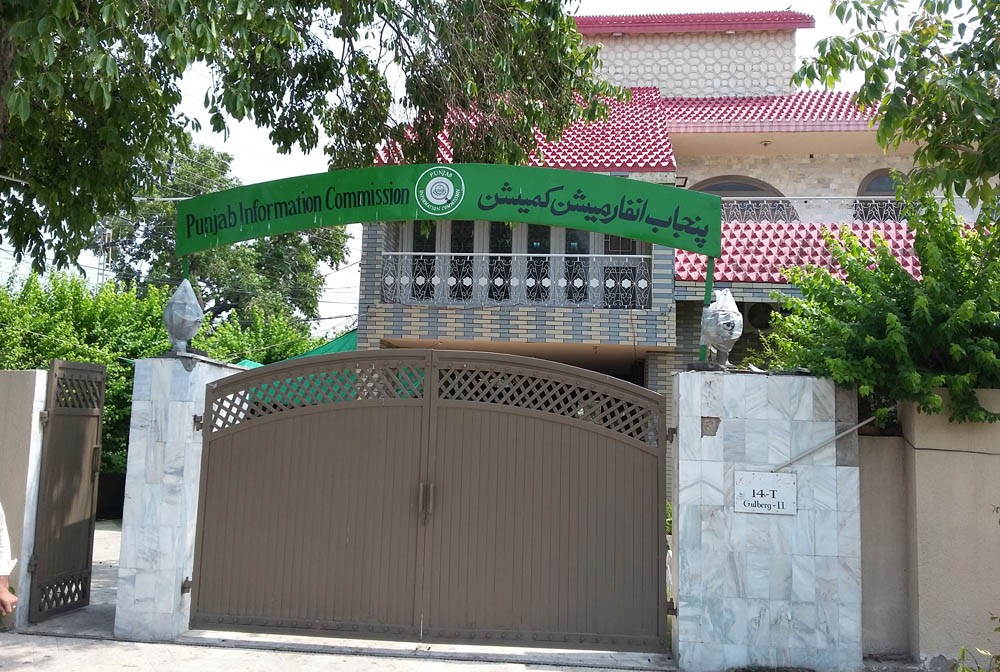
Over the years, the awareness about the right to information has increased in Pakistan, leading to the promulgation of the Right to Information (RTI) laws in different provinces.
The Punjab Information law has proved to be quite a useful law that affords the citizens the right to seek information from public bodies and organisations.
Besides, there is a provision in the law for applicants to approach the provincial information commission that would thereby heed to complaints in cases where the concerned departments failed to respond to the information requests. The commission may be approached after a lapse of 14 days since the filing of the request.
In Punjab, this forum exists in the form of the Punjab Information Commission (PIC) since its inception in the last quarter of 2013, and has so far received around 2,500 complaints and disposed off almost half of them, though with delay.
The PIC comprises three members -- two information commissioners and a chief information commissioner. It decides whether the excuses given by the departments are valid and also determines whether a particular piece of information can be withheld under the exemption clause or not.
Unfortunately, the state of affairs at the PIC is quite bad. It is working with just one administrative staffer against the sanctioned strength of 43. The Commission’s service rules have not been drafted. After much struggle, the department got permission to hire six daily wagers whose contract had to be renewed after every 89 days. But this could happen only twice. Now just one or two of these staffers visit the office and the Commission members compensate them out of their own pockets.
The budget allocated to the department has also faced regular cuts. The amount sanctioned for advertisements, external communication and public awareness campaigns that was Rs30 million in the launch year has come down to just Rs1 million for a year.
"It is very hard to clear cases in this situation where no government officer is willing to be deputed here because there are no official vehicles for them, nor are there any incentives like additional salaries," says Mukhtar Ahmed Ali, Information Commissioner, Punjab.
According to Ali, the PIC is not functioning to its full capacity because of the (abovementioned) issues.
The many roadblocks have caused disappointment among citizens. Abdullah Malik, President, Civil Society Network Pakistan, has his own grievances and terms the Commission "helpless before the powerful and secretive bureaucracy."
He tells TNS that his experience with different departments covered by the RTI has been dismal: "They do not take it [PIC] seriously and make fun of the people who try to use this law to get the information they need.
"It is quite possible that the bureaucracy wants to render the Commission ineffective, by holding back funds and keeping it understaffed."
Malik says that a year and half ago, he filed a request with Punjab’s secretary finance asking him to release the details of the government adverts placed in the mass media and the procedures followed for this purpose. "But there’s no progress on it so far. The bureaucracy has a hundred and one ways to delay things but the worst part is that the Commission cannot do much about this.
"We are soon going to file a writ petition in the Lahore High Court (LHC) in which we shall ask for more powers [for the Commission]. There is no use having a toothless body."
Mukhtar Ahmed Ali seconds Malik in regards to the issue of pendency and backlog, and says that these are big issues but terms the shortage or non-existence of staff at the Commission as the main reason for the situation.
Ali also says that it is very tough to deal with such a large number of cases with only a one-man staff.
Even correspondence, he says, becomes a challenge as most letters, notices, follow-up communication have to be specific and not generic.
Ali shares that he has to often draft letters, maintain files and records, take minutes of meetings, as there is no stenographer or computer operator in the office.
On the reluctance of bureaucracy to share the requested information, he says the problem is very much there but "things are improving, especially in the departments that have the experience of dealing with the commission."
He also claims that the PIC is quite powerful despite all odds. "Proof of this lies in the fact that in almost all the complaints [the Commission has received], it has rejected the pleas made by the respondent departments and asked them to reveal the information requested of them.
"However, sometimes it is advised that sensitive information like personal contact details and CNIC numbers of women involved should be withheld."
An official in Punjab Finance Department, who does not want to be named, confirms there has been a regular cut in the budget of the Commission and terms non-utilisation of funds by it as a likely cause for the situation. "When some funds lapse in a particular fiscal year, there is an understanding that these are more than the actual requirement of the department."
For Ali, the logic does not quite hold: "Some of the Commission’s funds have lapsed for the reason that there is no staff and no vehicles. In this situation, the funds meant for paying salaries, buying vehicles, covering fuel and maintenance charges etc will remain un-utilitised and ultimately lapse.
"It would be highly illogical for anyone to make this conclusion without looking at the circumstances."
Manzar Hussain Minhas, Chief Information Commissioner, Punjab, is quite hopeful about things getting better in time. "No doubt, bureaucracy is making things difficult in some cases, but the silver lining is that many government officers are themselves invoking RTI laws to seek information that helps them secure their rights," he says.
"They often seek information about meetings held to decide departmental promotions, make fresh recruitments etc in a bid to challenge any irregularities in the processes followed."
Minhas hopes the problems and handicaps faced by the Commission will be over soon, and requests the government to tackle these on priority basis.
When asked as to how the RTI law and the PIC have changed things, he says the departments have started organising and documenting their records that would otherwise be in disarray in the past. Besides, there is deterrence on the part of the government that fears any violation of rules and discrepancies could land it into trouble.
Raja Jahangir Anwar, Director General Public Relations, Punjab and the Acting Information Secretary, is of the view that there is a need to streamline the system, decide rules of the game and reach an agreement on what type of information can be sought under the relevant law.
"Right now, people can seek any kind of information just for the sake of it, even without purpose, and increase the workload of the government departments," he says.
Sharing his personal experience, Anwar states that he received an information request from someone who wanted details of all the advertisements, along with the particulars, placed by the department since its inception. "This was quite a strange request in a situation where records are hardly computerised and do not have any backup."
He agrees that there is some delay in the formation of service rules and the matter is with the law department of the province. "I have taken up the matter and am making efforts to ensure that there is a positive development in the next 10 to 15 days.
"Once the service rules are in place, the Punjab Information Commission shall be in a position to advertise for all the sanctioned posts and go for hiring immediately."
He also speaks of the delaying tactics that "ensure that compliance with the Commission orders is 100 per cent. The Public Information Officers (PIOs) fully cooperate with the Commission and make extra efforts to facilitate the applicants. The shortage of staff affects every government department and the Commission is just one of these."