

Print Story
X




The age-old profession of ‘dhobi’ has evolved over time, adapting to changes as per customer preferences

Perched on the floor of his shop in Karim Park, Mohni Road, 26 years old Gulzar Ahmed is keenly piling up the freshly washed clothes, bed sheets, curtains and the like.
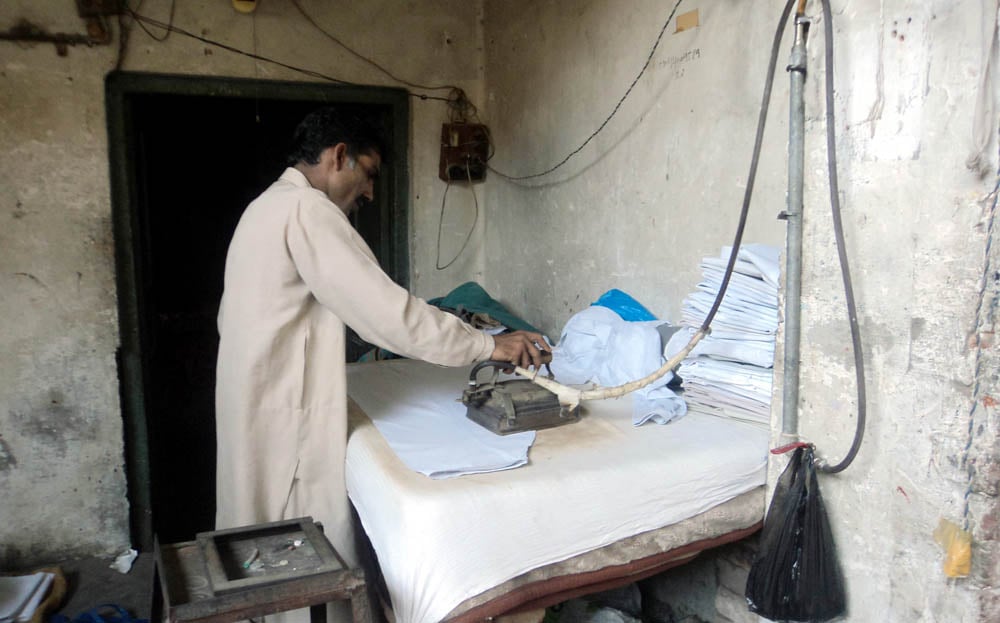
He arranges the laundry according to the type of fabric or cloth, before passing it to a rather young-looking fellow who is supposed to iron them. The fabric/cloth determines the ‘kind’ of ironing that should be done on it. For instance, Ahmed knows that linen requires a more careful treatment, as extra heat can cause it to burn. On the other hand, cotton clothes are resistant to heat and do not deform easily.
But the thread used in stitching is often made of material other than cotton; hence, it must not be exposed to heat for a specified period time. The ‘specified’ time is calculated, based on an understanding Ahmed has developed over time.
Ahmed has got nothing to do with the washing-up. He simply receives orders and hands over the stuff to the representative of a washing plant in the neighbourhood. He gets them back within a day or two -- washed and dried. Only the ironing is done at his shop.
For his part, the washing plant owner has made an agreement with as many as 15 shops and charges them per piece. The rate may fluctuate depending on the volume of the order. If the order is big, a concession is made. It works as an incentive.
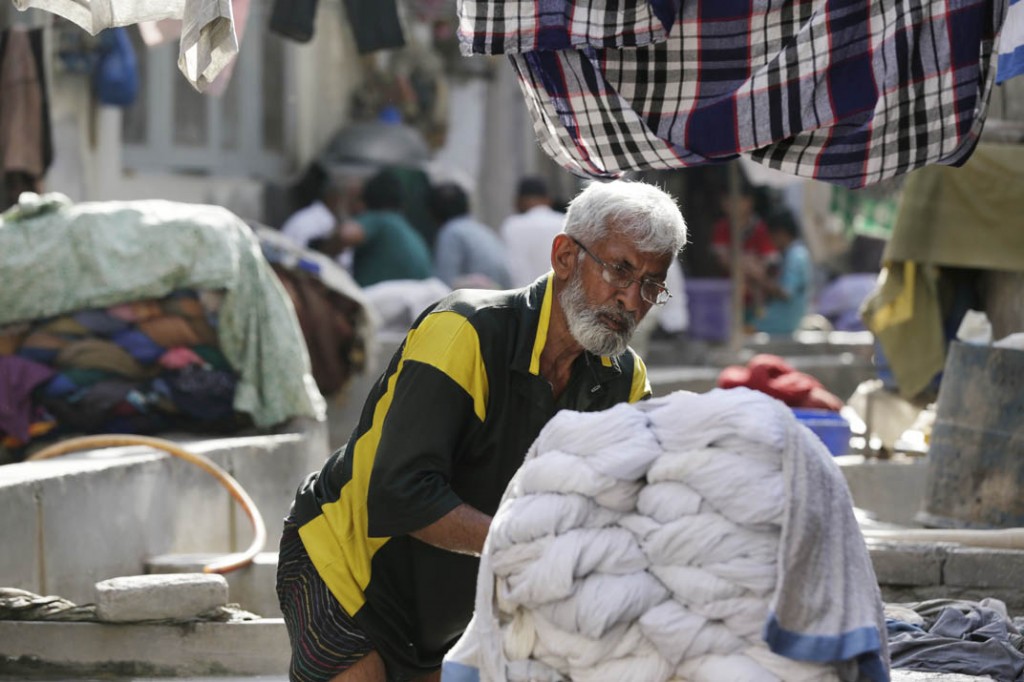
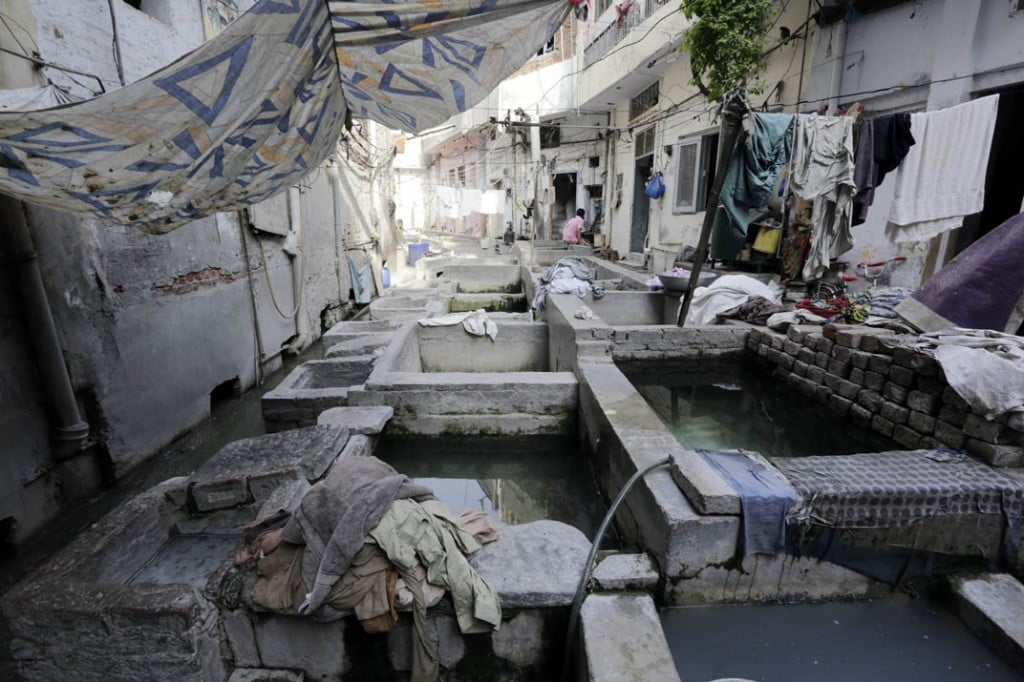
Gulzar Ahmed’s shop is owned by his father, Abdur Rasheed, who is said to have set it up a good three decades ago. Back then, the washermen used to collect laundry personally from the houses in the vicinity, and carry it to the ‘dhobi ghaat’ -- a sort of an open-air equivalent of laundromat, except that it does not involve machines and isn’t coin-operated.
A dhobi ghaat had traditionally an easy supply of water at its disposal, which would be ensured by their owners. Mostly, these were set up close to tubewells or along the river banks and any other natural streams of water.
The washermen followed a very interesting ritual in doing their job: they would hit the clothes on concrete platforms, in a peculiar manner. This helped to remove the stains and also worked as a spinner.
Besides, the place would have large, open space where they would hang-dry the clothes. Of course, the ironing would follow.
Things have changed with the advent of technology and availability of affordable home appliances like washing machines that come with inbuilt spinners and driers. For Abdur Rasheed, this means a lessening demand for laundries and, therefore, fewer dhobi ghaats in the city.
"At many places, the dhobi ghaats have been replaced by houses and commercial shops," he says, talking to TNS. "Running [dhobi ghaats] is no more a viable option for the owners of such privately-owned facilities."The ones at community-owned locations have also been abandoned and are now put to some other use, as washermen have moved to the washing plants."
All is not lost for Rasheed and his friends in the business. "Even though people have generally started washing clothes at home, a large number of them send their laundry to shops like ours, in order to have them properly ironed. They believe they can’t get the same result if they iron the clothes themselves.
"Besides, there are certain items like bed sheets and curtains that you cannot easily wash at home. That’s where we come in."
Rasheed also says the city population has increased manifold overtime, and there is a huge segment of people that live independently -- for instance, the students who’ve come from outside the city, unmarried youths living in hostels, and also families where both the spouses work. For them it’s easier getting their laundry done by professional washermen.
Lovers of starched cotton shalwar-kameez also revert to old-style laundry.
Then there are people in the Walled City and other congested parts of the city who don’t get enough sunlight to dry their laundry clothes. For them, a dhobi is a blessing.
Liaquat Ali, 55, who has been a washerman since 1971, says a dhobi ghaat named Gao Shaala is situated near Mohni Road but not many washermen frequent the place. "It’s a sad fact because despite the ever increasing price of electricity, we have kept our charges reasonably low.
"We’ve also adopted newer methods," Ali says. "Our people have innovated ironing machines that can run on LPG, sui gas supplied through pipes, and also coal. Though, coal is no more feasible because it is not easily available and may cost Rs60 per kg and above.
"When I say ‘coal,’ I don’t mean the mineral coal extracted from mines. We use the coal obtained by burning wood. The best coal can be obtained by burning keekar wood which is hardly available around the city."
Ali also seconds Abdur Rasheed by stating that it is not possible to get the desired result by doing laundry at home. "Can you believe the iron used by dhobis weighs 18 pounds, and is manufactured by the local people based in Gawalmandi?"
This weight has been brought down to 14 pounds now, he says. "People are now not strong enough to lift a heavier iron," he chuckles.
Ali has taken a major entrepreneurial decision and started to take dry-cleaning orders also.
Sheikh Mushtaq, a businessman in Shah Alam Market, admits that he hardly gets his clothes washed and ironed at home. "The reason is simple: there’s a marked difference in the quality of work. And I care for these matters. After all, it adds to your personality."