Print Story
X




Most women face hardships and gender-based discrimination at the workplace
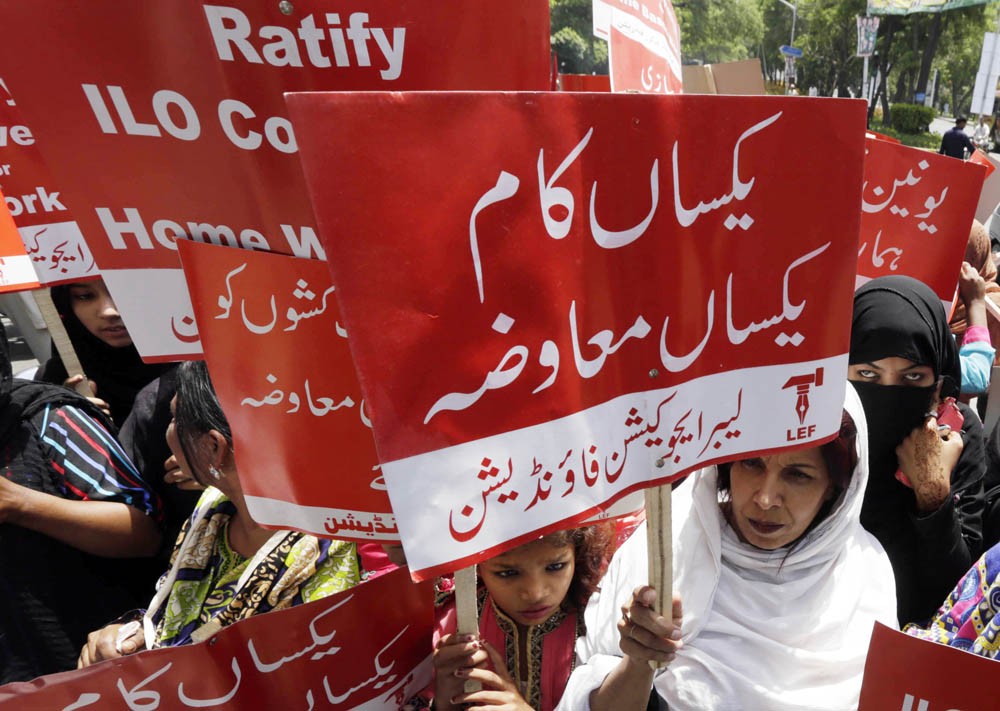
It did not come as a surprise when the World Bank, in its World Development Indicators in 2014, mentioned that labour force participation of women in Pakistan was approximately 25 per cent as compared to more than 50 per cent globally and 58 per cent in Bangladesh.
Almost similar results were obtained during the Labour Force Survey in the country that put female labour force participation figure at 24 per cent as compared with the 82 per cent for men.
The survey results revealed that most of these working women work in the agriculture sector or the informal economy where exploitation is common. In fact, many of them are employed through contractors/middlemen to cut costs as they are not in a position to pressurise employers to increase wages.
The explanation for Bangladesh is that women workers are preferred by employers, especially in export-oriented sectors, as they were ready to work on lower wages.
In Pakistan, apart from social factors, mobility issues and common perception that women are supposed to rear children and look after their homes, there are several reasons that discourage their participation in the workforce, especially in the formal sector.
"For example, there is a big difference between the wages paid to men and the wages paid to women doing the same amount of work," says Shaukat Chaudhry, Deputy Secretary General, Pakistan Workers’ Federation (PWF). He tells TNS that during one of their surveys they found that women would be paid between 50 per cent to 70 per cent of the wages paid to their male counterparts doing the same amount of work.
"Employers know women cannot easily move to another workplace or city like men do. Hence, they capitalise on this and make them work for smaller salaries." He says the exploitation is even worse in the case of Home-Based Workers (HBWs). So, they accept whatever little is paid to them. "As they work on piece rate, they spend long hours and make family members, including young children, to work to raise production. This takes a heavy toll on their health and the general well-being of the family," he adds.
Khalid Mahmood, director Labour Education Foundation (LEF), says even if women break social taboos and land into jobs, the overall work environment at workplaces is highly discouraging for them. "Sexual harassment is common and there is hardly any awareness about the sexual harassment act at the workplace and the committees to handle complaints. There are no separate washrooms for women at many workplaces."
There are fewer working opportunities for married women, fear of termination from jobs for expecting mothers, more workload for women as compared to men, limited chances of promotion, appointment on managerial positions and so on.
Read also: Labour brief
On difference in wages of men and women, he says, "it is an issue even in the US where the Senators rejected a bill calling for wage parity last month saying their economy was not in a position to bear any additional burden."
Munawar Sultana, Project Head of ILO Pakistan’s Gender Equity For Decent Employment (GE4DE), says their organisation is aware of the working conditions for women in the country and has made certain interventions to improve the situation.
"They have engaged with the government and other stakeholders at policy level and succeeded in getting labour-friendly policies approved. Domestic workers’ policy has been announced whereas HBWs’ policy is awaiting final approval," he adds.
Besides, she says, ILO has helped developed a gender-sensitive labour inspection toolkit and mechanism that leaves no space for oversight. In Punjab, the ILO has worked with Women Development Department (WDD) and promoted the idea of daycare centres for working parents.
Recently, they have held training of the staff of 60 daycare centres in the province. Sultana says that another important initiative was the review of different labour laws as there was gender-based discrimination in these laws that were drafted long-time ago.
Javed Iqbal, former director labour, Punjab seconds her. There is a term "workman" but there is no such phrase as "workwoman". "It is quite understandable as these laws were drafted at times when there was no concept of women coming out of home and becoming part of the formal labour," he concludes.