Print Story
X




The post Gulshan-i-Iqbal dynamics of the new operation in Punjab
After every major act of terrorism in the country, efforts to act against extremist elements are made with a renewed resolve. A major offensive against terrorists began after the bloodshed in Army Public School, (APS) Peshawar on December 16, 2014. That act of terrorism forced the army and the government to urgently come up with a 20-point National Action Plan (NAP) against terrorism.
Though the main focus of the military operation was the tribal areas of the country, the NAP agenda aimed at purging the country of militancy and extremism. The federal government urged the provinces to specially focus on search operations, crackdowns, controlling hate speech and to strictly step up against militants’ facilitators and sympathisers.
The Punjab became the prime focus of this strategy. On paper the Punjab government has claimed it has so far successfully implemented the NAP and targeted militant groups.
Many experts disagree with this claim, believing these achievements are on paper only, and less has been done on ground. Some recent incidents -- like army operation against the Chotu gang in South Punjab, state’s helplessness in removing a few hundred extremists protesting against the hanging of Mumtaz Qadri from D Chowk Islamabad, and failing to foil an attack at Gulshan-i-Iqbal Park in Lahore on March 28, cast doubts over the Punjab government’s capability to act against extremists and terrorists.
A Joint Investigation Team (JIT) constituted for probing the attack in Lahore’s Gulshan-e-Iqbal Park has also not come up with solid developments yet. The report suggests enhancing the scope of investigation to other provinces.
"The pace of NAP’s implementation is slow in the provinces due to political compromises," says Khawaja Khalid Farooq, former head of partially active National Counterterrorism Authority (NACTA).
"There is not much action against extremism and terrorism, especially, in South Punjab where it was required under the NAP," he says, adding, "On the political side, we see lots of verbal commitments but, practically, things have not been done satisfactorily."
Farooq also cites the recent incident of capture of D Chowk by protesters in front of the parliament in Islamabad. "They demolished the writ of the state and ultimately the government had to sit with them and talk. Is this the way to implement the NAP and curb extremism?" he asks. "The civilian government should implement the NAP. Police should have the autonomy and capacity to do all this," he maintains.
Giving another example of lack of seriousness by political governments on this issue, Farooq mentions the case of inactive NACTA for the past several years.
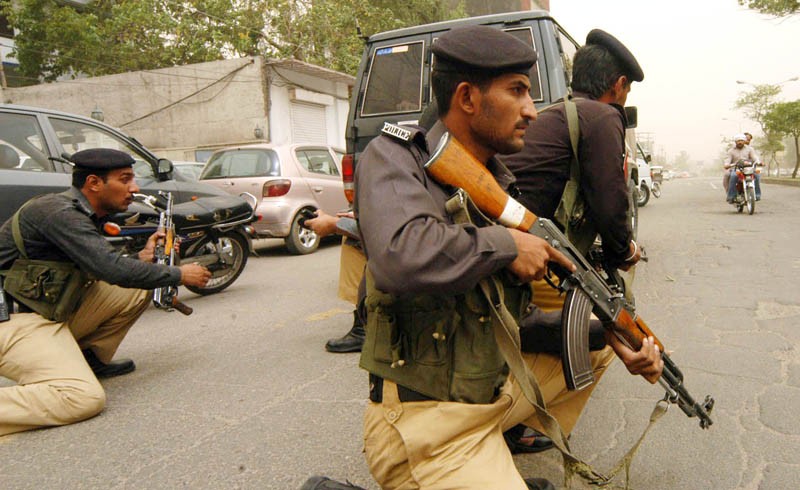
According to official figures, obtained from Central Police Office (CPO) Punjab, since March 28, a day after the terrorist attack in Gulshan-e-Iqbal Park Lahore, more than 4,300 "search operations" have been conducted across the province by law enforcement agencies.
From March 28 to April 20, police conducted 2,043 "search operations" in which 84,393 people were "questioned" to check their links and sympathies for militant organisations. After that 83,205 people were cleared and 1,093 were detained for further questioning.
Similarly, Counterterrorism Department (CTD) of Punjab police has conducted 49 intelligence-based search operations in which they interrogated 1,086 people. Out of them 1,070 were set free and 16 were detained for further questioning. The Intelligence Bureau (IB) also conducted 1,092 search operations in which the agency questioned 31,839 people and declared 31,011 free, holding 776 people for further inquiry. While, military squads have also conducted many such "search operations", questioning and interrogating people.
After the APS attack in December 2014, the total number of search operations were 38,448 till the end of 2015. According to official figures, 12,10,576 people were questioned and 6,417 cases were registered during this year. Eighty-eight ‘hardcore terrorists’ were killed; as many as 250 leaders and activists of proscribed religious groups were arrested; and 301 militants were captured in 2015. Till April, at least 30 ‘hardcore terrorists’ were killed in different encounters with the police.
The operation against the Chotu gang was also part of this action as Punjab Law Minister Rana Sanuallah, at a press conference on March 29, announced that some Kacha areas had been identified where security operation would be launched by the police, elite force, and the counter-terrorism department.
By the end of 2015, the Punjab government had claimed "vigorous action" under the National Action Plan during which a total number of 48,617 cases had been registered while 53,151 accused had been arrested for various offences, including hate speech, wall chalking, display of arms and other offences. The government has also claimed of killing 88 ‘hardcore terrorists’ in police encounters in 2015 and 29 such criminals by the end of March 2016.
Political and security commentator and former Air Marshal, Shahid Latif, is of the view that sample testing is the best way to judge things. "Performance of the police in such actions was tested in a recent operation against the Chotu gang. The police failed; lives of seven policemen were lost and resources were wasted proving the reality of such operations, crackdowns and actions against terrorists and criminals."
He says many actions against terrorism are cosmetic. "Actually, there should be regular updates and separate committees to separately review and share the progress of each point of the NAP and these briefs should also be shared with the parliament," he suggests.
He calls for police reforms and making these reforms part of the NAP but asks how governments can bring reforms when they use police and even criminals as their tools.