Print Story
X




The bone of contention remains the Punjab Private Educational Institutions (Promotion and Regulation) Bill (Amended) 2015, which seeks to regulate private schools, force them to register with a competent authority and keep a check on their frequent raises in tuition fees

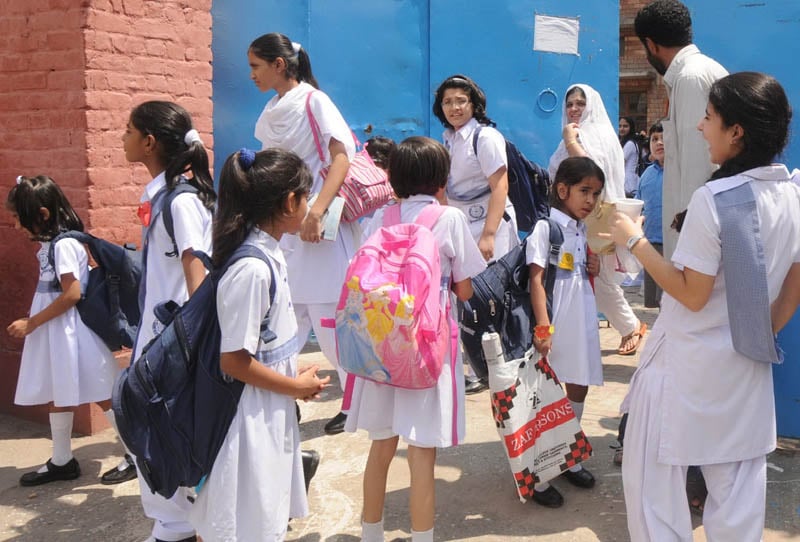
The schools in Punjab had just opened after the spring vacations when confusion got the better of the students and their parents. Thanks to a protest, announced by the different associations of private schools, against the alleged interference of the government and what they termed "concerted attempts" to stifle their constitutional right to do business.
The owners’ associations announced that all the private schools in the province would be shut on March 8 and 9 and, if their demands are not fulfilled, for an indefinite period.
There were also groups that did not support the strike call and chose to negotiate with the government. This put the parents of the students in a situation where they could not decide whether to send their children to the schools or not.
For the uninitiated, the bone of contention in this regard is the Punjab Private Educational Institutions (Promotion and Regulation) Bill (Amended) 2015, passed by the Punjab Assembly to regulate private schools, force them to register with a competent authority and keep a check on the frequent raises in tuition fees and other expenses.
The biggest concern for them, however, is that the Punjab government has put a maximum cap of five percent annual increase in the tuition fees charged by the private schools. Now, an application for fee raise shall have to be filed three months in advance and the proposed raise shall be subject to approval by the district education regulatory authorities to be set up for the purpose. In case there is no approval, there will be no raise. The authority may approve of the raise equal to five percent or less.
While the private school owners cite the ever-escalating input costs as the reason for the frequent fee raises, the parents have heaved a sigh of relief on the passage of the law. Madiha Junaid, a mother of three, complains that all the private schools "follow the same method to extract money from the parents. It’s as if they have entered into a competition for this purpose.
"For the first time, the government has showed it cares about the common people. We hope it will not give in to pressure from the very influential school owners."
She further says that every year the fee is raised without any genuine justification and the parents have no option but to pay up.
Another worried parent of a teenager is of the view that the private schools charge a "very high, one-time, non-refundable admission fee. It’s not justifiable. "The idea, to my mind, is that you are rendered unable to move your child to another school. Because if you try to do so, you have to pay the huge admission fee all over again and clear all the dues before you can get the school leaving certificate. This is sheer exploitation."
The abovementioned law clearly states that one-time admission and security fees cannot be more than the monthly tuition fee charged by the institute.
According to Section 9 of the law, the word "fee" means admission fee, tuition fee, security, laboratory fee, library fee or any other fee or amount charged by an institution from a student. It also prohibits the schools from asking the parents to purchase uniform, textbooks or other educational material from a particular shop.
"Such are the ways in which the private schools multiply their earnings and get away with it too," says Razia Munir, a housewife whose husband runs a small business.
Munir believes the parents have to purchase the things from designated shops that can charge whatever amount they want to. "If you don’t make the purchase from there, they impose heavy fines on the students."
She also says she is uncomfortable with the idea of changing the course books every year or so. "I remember as a student I could use the books of my older siblings or cousins. But now it is ensured that not even a single book is reusable, so that the booksellers’ nexus flourishes."
She urges on the government to check this practice.
On the other end of the spectrum, Kashif Mirza, President, All Pakistan Private Schools’ Federation (APPSF) says the government is not fulfilling its duty of providing education to the masses through the public sector. "In fact, it [the government] is trying to destroy the private sector."
Mirza is the main person who announced the recent closure of schools in protest against the said law.
Talking to TNS, he rejects the condition that the private schools should be allowed to raise fees only by five percent per annum. "Schools, especially the smaller ones, will not be able to survive with this kind of restrictions.
"The inflation rate is 15-20 percent per annum but the government is adamant on putting a maximum cap of five percent on the fee raise. This is totally unjustified."
Mirza says the government gives Consumer Price Index (CPI) as a justification for putting this cap on fee raise but the fact is that this is not a reliable measure even for households. "For private schools, it becomes completely irrelevant as the cost of operating schools increases by an average of 15-20 percent per annum.
"We are prepared for an intelligent debate with anybody on this issue," he declares.
According to the APPSF President, the private schools are treated as fully commercial entities by the government, and they are made to pay 33 percent income tax, 17 percent GST, 3 percent super tax, 6 percent EOBI, 6 percent social security, heavy property commercialisation fees, commercial property taxes, school registration fee, registration visit fee, sports funds, school affiliation fee, building hygienic certificate fee, commercial utility bills, service tax, professional tax, trade tax, building board rent tax, scouting fund, armed license fee and a host of other taxes and levies.
"Most private sector schools in Pakistan operate out of rented premises," he continues. "The rents increase by 10 percent per annum at the least. Typically, every 3-5 years, the lease agreements are renewed, at which point the landlords aggressively renegotiate lease terms.
"The landlords are well aware of the fact that schools have limited options because their cost of relocation is very high. Isn’t the government adding insult to injury by making things tougher for private schools, especially when the latter are carrying the torch for providing quality education to the masses?"
Sonia Iftikhar, who represents the Lahore-based Private Schools’ Parents Association (PSPA), rejects Kashif Mirza’s argument and says the association has got proper documentation to prove that the private schools have earned profits ranging from 40-200 percent.
"If the government goes for a proper audit, everything will be exposed," she says. "It was because of this unchecked profiteering that an elite school in Lahore was able to erect a 52-kanal campus in the city and another took over private schools in foreign countries like the United Kingdom. These schools are talking about freedom to raise fees. My point is they shall be asked to pay back the unjustifiable earnings they have made in the past to the parents."
Shahid Noor, Chairman, Pakistan Educational Council for Private Schools (PECPS), counters the argument by saying that thousands of low-to-middle range private schools are being bracketed with the good few elite schools that cost a fortune to students and their parents. "There are many schools that charge between Rs1,000-5,000 as tuition fee for providing high quality private education," he says. "Even the Punjab Minister Rana Mashhood understands this fact and has promised to give exemption to the schools from a host of restrictions."