

Print Story
X




The political responses typified in the Pakistani political public sphere
Politics as a conceptual category cannot be described as a singularly-defined formulation, though in a classical sense it connotes "an art of the possible". But that connotation of politics too makes it amorphous or quite an open ended activity.
To elucidate that point one can say that the very act of dominating someone is politics so is an act of resistance from the dominated. Any group or faction striving for liberation from imperialist power or any imperialist power vying to subject some tribe or community to subservience are doing politics. In a similar vein, some powerful group exercising control over the dominated and the multiple responses like protest or demonstration from the latter too are act(s) of politics.
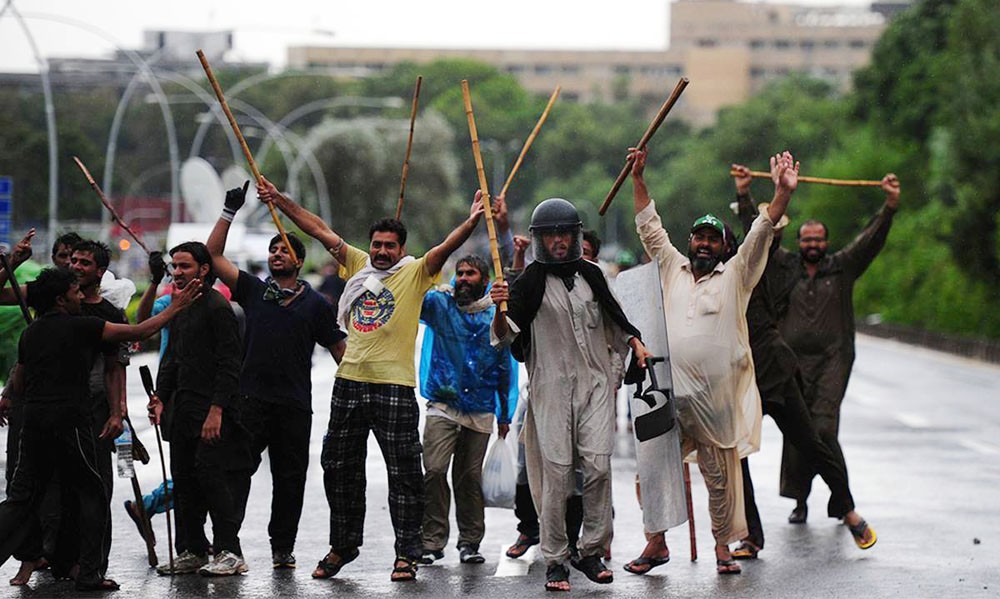
In this article, I will underline the political responses typified in the Pakistani political public sphere like demonstration, protests (like dharna, taking out of processions or ransacking of the property etc.) with specific reference to modern history. It is also emphasised here that the mechanism of political control is as old as human history. However, in the South Asian context like in several other regions of the post colonial world, the form of political control kept changing and so did the form of response/retaliation with the changing temporal context.
Particularly, with the dawn of modernity, the centralised mechanism of control left little space for the subject, which was quite serendipitous vis a vis the previous power structures. Such control took into its fold almost every individual. Similarly, the methods of resistance to that all-encompassing mechanism of control too took several new turn(s). Some of these forms have been mentioned above.
Here is a reflection on these newly devised methods of political dissent by alluding to a few instances in history.
During the medieval ages, the recurring method of political dissent to stark domination was armed rebellion. Generally, during the pre-modern era, people were wooed through politics of patronage, the method which even the British employed to very good effect. A few individuals of unusual political insight like Jalal ud Din Akbar, the Mughal Emperor, pre-empted dissent and gave currency to the politics of matrimonial alliance(s). Hence dissenters were won over.
However, even during the reign of Akbar, political dissent was not countenanced and the eventual fate of its perpetrator was death. The Emperor being an epitome of the divine right of kingship was the fountainhead of all power, which could not be shared. Loyalty to the King was the biggest political virtue. Therefore, any dissent or disagreement with the authority of the Emperor/King was considered seditious for which the penalty was death. That was the commonest way of settling political disputes during the pre-modern period of Indian history. In that region, various forms of dissent or protest emerged on the political landscape only with the advent of modernity.
After the British took over the reins of power after 1857, tolerance towards the political dissention became the part of the new rulers’ policy. The Muslims of South Asia waging an armed struggle (or Jihad), took to the modernist methods of protest or dissent. The Urdu Hindi controversy in 1867 spurred Muslims of United Provinces to launch protest against the British policy which ostensibly favoured Hindi (Devnagri script) in the lower courts. Similarly the annulment of the partition of the Bengal (in 1911) and subsequently the Masjid Cawnpore incident forced the Muslims of Northern India to protest against the British highhandedness.
But some political issues did get addressed through dialogue or negotiation. Similarly negotiation among the disputants had become an important modus vivendi for conflict resolution. While looking a bit closely on the politics of All India Muslim League under Muhammad Ali Jinnah, one can easily decipher negotiation as the centre piece of its politics. Jinnah of course played a pivotal role in devising that policy for the Muslim League. The entire struggle for Pakistan was spearheaded by the country’s founder by the means of negotiation. Contrary to the method adopted by the League, the religious parties deployed protest and violence as their prime instrument of doing politics.
Khilafat movement (1919-1924) is the most explicit illustration of such peculiarity. That movement set the political tone for the religious parties to follow in the days to come. That event undoubtedly had the profoundest impact on the future trajectory of Muslim politics in the subcontinent. It was marked by protests and demonstrations which in most instances turned violent; processions and violation of regulations were the key features of that movement.
Such politics left an indelible imprint on the politics of Pakistan. One may argue as well that in the collective subconscious of the rank and file of religious parties, waging of jihad against the infidel lurks in a very explicit manner. Majlis-i-Ahrar, Khaksar Party, Jamaat-i-Islami and later on Jamiat-i-Ulema-i-Islam are some of those religious parties which have practised violence as their means to the political ends. Pakistan National Alliance, Sipah-i-Sahbah and much afterwards, Tehreek-i-Taliban Pakistan adopted violence to the detriment of the Pakistani state.
Casting a cursory look at the politics of negotiation in the post-independence era, only instance worthy of our notice was the passage of 1973 constitution during Zulfikar Ali Bhutto’s rule. All else in the entire history of this hapless country is nothing but politics of patronage and those trying to detest that abominable practice to register their dissent are using the politics of protest and violence. It seems as if the government functionaries are not properly equipped to hold negotiation with the protestors which are growing in number with every passing day.