

Print Story
X




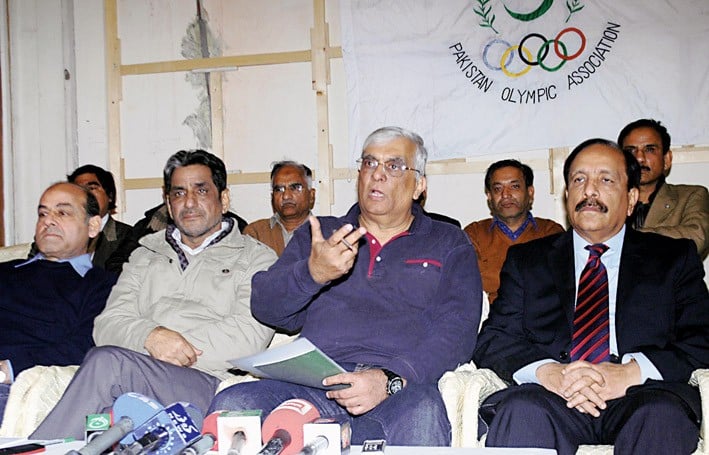
There are fears that Pakistan Olympic Association (POA) and some national federations might face stiff opposition from those who have already filed several cases in various courts against them
The International Olympic Committee’s (IOC) president can serve for only two tenures. In the past unlimited, the length of its president’s term of office is now fixed at eight years, renewable once, for four years.
However the same restriction is not applied to the IOC’s affiliated National Olympic Committees (NOCs). Their general councils have the power to legislate on any issue.
It may seem a bit irrelevant but needs to be mentioned here for reform purposes that the American president cannot serve for more than two tenures.
FIFA is also set to enforce a tenure-restriction clause for its president after it was hit by corruption scandals.
In the wake of the conflict between Pakistan Olympic Association (POA) and Pakistan Sports Board (PSB), the IOC advised POA to convene its general body meeting and decide whether it needs a tenure-restriction clause for its top officials in its constitution. The POA held a meeting and decided that there was no need for it.
A few days ago, Lt Gen (retd) Arif Hasan was elected as POA’s president for the fourth successive four-year term – a great achievement for Arif, who is the second longest-serving POA president.
His predecessor Syed Wajid Ali Shah stayed in that position for around 26 years. Arif succeeded Wajid in 2004.
Arif, also Pakistan Archery Federation’s president, claimed 80 votes in the 127-member General Assembly. His rival Maj Gen (retd) Akram Sahi got 35 votes.
Sahi, also Athletics Federation of Pakistan’s (AFP) president, had also contested elections against Arif in 2012. Sahi lost once again but altogether it was a healthy contest and in future the competitive environment could further grow in the Olympic family which would be helpful for Pakistan’s sports.
The election commission, headed by former justice Qazi Ehsanullah Qureshi, is yet to notify the results of the elections because of a stay order issued by Peshawar High Court (PHC) on the plea of a senior sports official and former JUI-F senator Haji Ghulam Ali. The court issued the order a day before the electoral meeting on January 23.
Farman Haider of Kuwait witnessed the electoral process as the observer from IOC and Olympic Council of Asia (OCA). IOC member in Pakistan Shahid Ali also cast his vote.
I don’t want to write anything about the election commission and election rules on which Sahi group has raised objections.
I foresee that the POA and some sports federations might face stiff opposition from those who have already filed several cases in various courts against them.
The litigation which could become prolonged might keep in strain the country’s sports for an indefinite period. Both POA and Pakistan Sports Board (PSB) will have to think about establishing a National Arbitration Commission (NAC) to deal with legal issues in sports. Without such an arrangement, crucial time and resources would be wasted on legal battles which would further damage Pakistan’s sports.
In the last four years, no significant progress could be made in sports as most of the time was spent in the conflict between POA and the government on the issue of enforcement of national sports policy. Pakistan hockey team not only failed to qualify for the World Cup during this period but it also did not make it to the Olympics, which will be hosted by Brazil this summer.
During these years parallel federations and associations were seen working against each other without realising that their struggle for power was destroying the future of numerous players and their families.
Football, one of the growing sports disciplines, also fell prey to political victimisation.
Boxing is also not in adept hands. Squash, in which once Pakistan ruled the world, needs to be resurrected.
Pakistan’s sports touched the rock bottom during all these years. If Japan-based judoka Shah Hussain did not qualify, Pakistan’s contingent for Rio Olympics would comprise only a few players who would be awarded wild card entries by the IOC. Arif has to work extra hard to put sports back on track. He will need to clean the system, enabling it to produce world class players.
During an interview with ‘The News on Sunday’ a few days after he got elected as POA’s president for the third time in February 2012, Arif had promised that the POA would hold sports conventions throughout the country but he failed to manage them because of his conflict with the government.
This time he will need to hold such conventions and seminars on sports in various cities to which sports experts, journalists and people from corporate and government sectors should be invited to discuss how sports in Pakistan could be developed.
It is extremely necessary to involve media and corporate sector in sports development. The joint venture of POA and PSB would be needed if sports are to develop in the country.
Arif is also liked by the PSB Director General Akhtar Nawaz Ganjera. It is a testing time for both of them to deliver. The unnecessary foreign tours of sports officials should be strictly checked and the savings should be spent on the welfare of the athletes.
The federations should be made accountable for their performances whatever group they may belong to. What happened in the past should be forgotten and the sports fraternity should join hands to bring the sports out of crisis.
The POA needs to give viable short-term and long-term plans to the government for sports development. Once the election commission issues notification, Arif should let people know what he will do for sports promotion during his next four-year tenure. It’s time Arif clicked. If he succeeded in putting Pakistan’s sports on track of revival, his name would always be remembered.