

Print Story
X




With review of GSP Plus status due this month, Pakistan Workers’ Confederation takes lead, launches report on compliance
Around two years ago, Pakistan secured the long-awaited duty-free access to the European markets, courtesy the EU’s Generalised Scheme of Preferences (GSP) Plus status. The regime came into force on January 1, 2014 and offered the country’s businesses an opportunity to make use of increased market access in Europe. The country had applied for this status which was awarded to it under the condition that it will show progress on compliance with 27 international conventions on human and labour rights, environment and good governance that Pakistan has already ratified.
Of these 27 conventions, eight relate to environmental protection, eight to labour rights, seven to human rights conventions, three to narcotics control and one to corruption.
The plan was that the first review will be due after two years. The European Commission will prepare a report on the basis of information received from different sources including the government and the civil society and present it in the European Parliament for review. The decision on extending the status will be taken after the review. There is an example of Sri Lanka which was deprived of this status for failing to show progress on compliance with international conventions. Therefore, it must be kept in mind that this can happen to Pakistan as well.
The first review is due this month and the status on ground is that the government of Pakistan has not yet provided its input. Reportedly, it is working on the scorecard developed in collaboration with the EU and has sought some grace time to provide the required information. The civil society comprising NGOs, labour rights organisations and advocacy groups are also not there on the scene.
Against this backdrop, an interesting development is that the workers of the country under the umbrella of Pakistan Workers’ Confederation (PWC) have launched a report titled "European Union GSP Plus and Challenges of Labour Standards in Pakistan" with the support of Friedrich-Ebert-Stiftung (FES). FES is non-profit German organisation working in Germany and abroad to promote freedom, solidarity and social justice through political process.
The report submitted to EU gives situational updates on eight of these conventions that directly relate to labour rights. These are ILO Conventions No. 87 and 98 on Restrictions on Freedom of Association and Rights of Collective Bargaining, ILO Conventions No. 100 and 111 on Discriminations and Inequalities in Labour Market, No. 138 and 182 on Child Labour and No. 29 and 105 on Forced Labour.
The report is being discussed at different levels and taken as a benchmark by different players who are working on their reports. There are others as well who have questioned the professional capacity of workers who have authored this report and the objective behind its launch before the official version could be out.
Zahoor Awan, Central President PWC, says they had a few questions in mind that they wanted to be answered through a study done on ground. These questions included: Are the benefits of enhanced exports reaching common workers who produce these goods for foreign markets? Is the government serious about implementing its international and national obligations, and improving the lives and livelihoods of those workers? Have employers started sharing their enhanced earnings with workers?
He claims "only workers and their representative organisations, which are uniquely placed in the cycles of productions, can monitor and provide evidence of improvement and implementation of workers’ rights as conditioned in the GSP Plus scheme." This is why PWC -- the most representative national body of Pakistan’s unions -- decided to issue its own first report on the GSP Plus schemes and its implementation status, he adds. Awan says Chaudhry Muhammad Yaqoob and Shaukat Ali Chaudhry, President and Deputy General Secretary of PWC Punjab, travelled along the width and breadth of the country to gather data, information and responses from local workers’ unions to obtain results that could be incorporated to the report. What is unique in this report is that no help has been taken from any consultant and every word has been written by the workers’ leaders. However, technical and financial support of FES has always been there for them, he adds.
On freedom of association, the report states that:
"To start forming their unions, workers have to first undergo a complex lengthy union registration process with the Registrar Trade Unions. With vast discretionary powers, registrars often misuse, delay, or deny the registration process in collusion with employers. As explained in the text box above, the IRAs impose a condition of at least 20 per cent membership of total employees for the registration of third or more unions in an establishment. This was included in the law to inhibit the proliferation of unions. But, what if the first two unions are pocket-yellow unions?"
On discrimination it says:
"Another aspect of labour market discrimination concerns workers from religious minorities and migrant workers, who are segregated into low occupations (janitors and sanitation, social taboos also play its part), forced to work in brick kilns and agriculture. Migrant workers in search of shelter, food, and the basic necessities of life are forced into inhumane working conditions of bondage and domestic work, in violation of labour laws."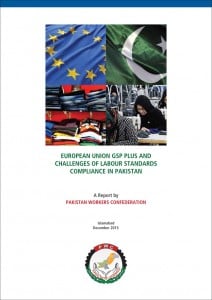
The report comes hard on the labour inspection mechanisms, calls for improvement and terms the existing lacunae major cause of most problems faced by the country’s labour force. It says: "A thorough examination of working conditions is also important to bring to the notice of administrative authorities loopholes and defects in existing laws. Pakistan has ratified the ILO Labour Inspection Conventions No. 81 which is in force since 1953. Health and safety of workers are guaranteed in the national constitution. But how seriously the labour inspection is taken up by authorities is evident from the facts that labour inspection had remained banned in the province of Punjab for 10 years and was only lifted in 2013 when the disastrous factory accident of Ali Enterprise in Karachi occurred in 2012. In Sindh, the labour inspection has remained practically discontinued. Consequently, an alarming number of 2.3 million workers suffer on annual basis from occupational accidents and hazards along with huge number of unreported cases and violations of labour laws."
The report refers to a working paper prepared for a recent (2015) meeting by the federal Ministry for Overseas Pakistanis and Human Resource Development (OP&HRD), in 2014. It says the number of total registered factories all over Pakistan were 23,983, shops and establishments were 327,706 while the appointed labour inspectors were only 547 (2 lady inspectors). The strength of labour inspectors has not appropriately increased since 1970, indeed because the independent inspection was completely abandoned for long time.
Shaukat Ali Chaudhry, co-author of the report, says they are not against the award of GSP Plus and hope it continues and achieves its objectives. "We have not only described the existing situation; instead we have also come up with suggestions and highlighted the positive steps that we have taken," he adds.
For example, he says, the federal government and the Punjab government have created special GSP cells to coordinate and monitor the activities. Pending country reports for the ratified ILO conventions have been submitted. More frequent meetings of the national and provincial tripartite bodies have taken place. At the non-governmental level, GSP Plus has helped revive the social dialogue forum between workers’ and employers’ organisations, as well as the reorganisation of Workers Employers Bilateral Council of Pakistan in two provinces (Punjab and KP).
Suggestions, Chaudhry says, include formation of dedicated benches in High Courts that can take on labour cases on an exclusively priority basis, taking of immediate steps to connect households plagued with child labour and bonded labour to existing national and provincial social safety net programmes and undertaking long-pending national statistical surveys to assess the state of child and bonded labour. Simplification and consolidation of labour laws is also a priority.
A sample survey was also carried out to give a holistic picture of what exists on ground. Some interesting findings of the report follow:
Overall employment of women is 10 per cent, with highest in media sector followed by garments and sports industries;
In total, permanently employed workers are barely above 50 per cent. In the case of women workers mere 19 per cent have permanent employment status;
Less than 50 per cent workers have written employment contracts (women only 19 per cent);
59 per cent respondents reported the presence of union at their workplace, but 77 per cent of them reported their union is a ‘pocket union’. In 18 per cent units the presence of 3 or more unions were reported;
Only 37 per cent respondents confirmed availability of maternity leaves and 69 per cent for general medical leaves. Only 12 per cent reported the facility of day care;
Overall 50 per cent responded to have worked more than 48 hours, while only one-fourth receive the legal payment (double-rate) for overtime work compensation;
65 per cent reported the payment of minimum wages, 61 per cent confirmed the wage discrimination to women workers and 60 per cent reported delayed payment of salaries.