

Print Story
X




Are we trained to work harder, smarter and better?
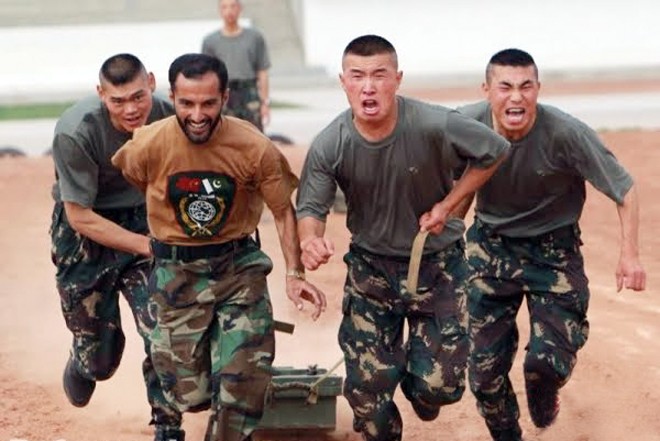
Pakistan’s security situation and administrative snags are likely to impede the smooth and timely completion of the China Pakistan Economic Corridor project. However, the Chinese are also concerned about the deficient skills and lack of self-discipline among the Pakistani workforce.
To overcome this challenge, Ahsan Iqbal, the person entrusted with the task of overseeing the process of CPEC, has coined a motto for Pakistani workforce - "work harder, smarter and better". The sagacity of Iqbal’s self-proclaimed dictum can hardly be questioned. But, in the absence of any mechanism or institutional framework deployed to train and upgrade the capacity of labour, his statement is high sounding and vacuous.
So far as the Chinese workforce is concerned, one must not lose sight of the ever-lasting impact of Confucian traditions on the Chinese people in general which has ingrained in them stringent if not rigid work ethics. Confucian tradition cultivated in them the inclination to work hard, and for longer hours. After the 1949 revolution, their potential of working hard was channelised towards making China into a robust economy, a milestone which it achieved in the span of 50 years.
The fact, however, remains that the severe control by the dictatorial dispensation with flagrant violation of human rights and absolutely squeezed space for any individual action, is the price that the Chinese have paid over three generations. While carrying out different projects in Pakistan (Shahrah-e-Karakoram, for example), their engineers and technicians were on several occasions kidnapped or killed. But the Chinese government did not seem to be bothered much.
Also, the Chinese are coming with their own labour, technicians, and security. While they live and work, the Pakistani state will have no control or authority over them. If that happens, many eyebrows will be raised and questions related to sovereignty will be asked.
Reverting to the point pertaining to labour and its skill, most of the ‘skilled’ labour in Pakistan gets training on job, as apprentices. The government has not aimed at any sustained effort to provide formal instruction or intensive training to labour. Some of the professional skills even to this day are limited to familial setups, as nothing concrete has been done to bring in vogue occupational mobility. A person born in a family with a certain set of skills should be free to opt for other skills.
Unfortunately, the people running the state apparatus seem quite impervious to carrying out such reforms which may eventually facilitate the skilled labour.
Therefore, the inference drawn here nudges us to doubt the capacity of the policymakers to measure up to the rigour and fastidiousness of the Chinese. One must add that the lack of capacity of those overseeing the whole project is not the only thorn in the flesh.
While talking to the Reuters, the governor of the State Bank of Pakistan, Ashraf Mahmood Wathra remarked in a candid manner that "CPEC needs to be made more transparent", going on to indicate that many crucial details of the various projects to be executed under the CPEC umbrella remain hidden even from him. For example, he said that out of $46bn, he does not know "how much is debt, how much is equity and how much is in kind".
Why are these details not being made public?
Similarly, a question raised at the policy dialogue at the conclusion of the CPEC conference at the GC University, Lahore, was about Pakistan’s share of $16bn. How and from which source that amount which is quite staggering, given the size and extant of Pakistan’s economy, will be raised? All such details should be brought to the notice of the public.
The whole deliberation on the prospective fruits that the CPEC will bear for us, made me infer that we are yet again looking for the necessary stimulus from China instead of generating it from within us. Expecting a foreign power to drag us out of the morass would imply accepting its over-lordship. Any demonstration of confidence from people at the helm to deal with the world’s second largest economy as an equal is conspicuously missing.
I earnestly believe that unless the nation has a stimulus that comes from within, neither the revival of the sapped economy nor regaining the political stability can be attained. To enable our workforce to match the workaholic Chinese, some stimulus is absolutely necessary -- but for that the political leadership, in cahoots with intelligentsia, need to play a proactive role to instill hope in the people. That will only be possible if leaders give priority to national interests over personal ambitions, and don’t hold anything from the people. The university academia must at least be taken on board while making decisions that have far reaching implications.
Another interesting aspect will be the nature of response from the religious right. Thus far we have not heard from them. But such substantial Chinese involvement is ought to influence our culture and society. Whether anybody will issue any fatwa against them as they too are kafirs operating in an Islamic country? They are workaholics but also cut-throat and much more imperious than British or American.
Despite all that has been said one should hope for a better future.