Print Story
X

Fast bowlers play an important role in any team’s victory, especially in Test cricket. Australia have a long history of producing great fast bowlers like Jeff Thomson, Dennis Lillee, Craig McDermott and Glenn McGrath.
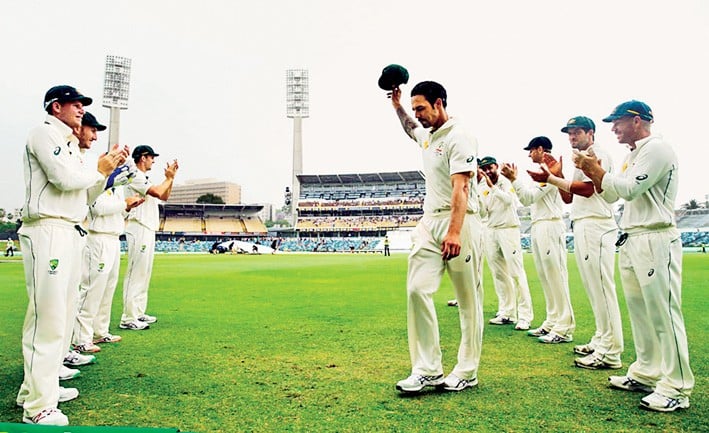
Australia’s fourth highest Test wicket-taker Mitchell Johnson announced his retirement from all international formats of the game after the second Test against New Zealand in Perth. He took two wickets in the final innings of the drawn encounter.
In the nine Tests that Johnson played in 2015, he took 30 wickets. Despite this reasonable performance, he was not satisfied and said that he could not continue competing consistently at the level required to wear the baggy green.
Australian cricketers usually leave the game when they can still play for a few more years. This positive approach shows their sincerity with the game and the country. That’s why the Australians remain on the top.
The 34-year-old ended his career as the fourth highest Test wicket-taker for his country with 313 wickets at an average of 28.40. Dennis Lillee (355), Glenn McGrath (563) and Shane Warne (708) were the only ones whom he could not surpass.
Johnson’s career-best Test innings figures (8-61) came against South Africa in Perth in 2008, but his efforts was not enough as Australia lost the Test.
His career-best Test match figures (12-127) were also against South Africa in Centurion in 2014 which enabled Australia to win. Johnson also scored 2,034 Test runs with a top score of 123 not out.
He also played 153 One-Day Internationals and took 239 wickets at an average of 25.26 and a strike rate of 31.3. He featured in 30 Twenty20 Internationals in which he took 38 wickets.
Johnson terrorised batsmen of all opponents with his speed and aggression. Johnson rated winning the Ashes 5-0 in 2013-14 and the victory in World Cup 2015 his most memorable events.
He was part of the undefeated 2007 World Cup Australian squad but unfortunately didn’t play a single game.
Johnson had an excellent record against England, with 87 wickets in 19 Tests at an average of 25.81. During the Ashes whitewash, he took 37 wickets at 13.97. It was five short of breaking the record for most scalps (41 wickets, but in six matches) in an Ashes series set by Rodney Hogg.
Johnson made his ODI debut against New Zealand in Christchurch on December 10, 2005, but remained wicket-less and conceded 64 runs in a high-scoring game as New Zealand chased the 331-run target in 49 overs.
In his seventh ODI, he was given the new ball along with Glenn McGrath against India. He got the important wickets of Rahul Dravid, Sachin Tendulkar, Yuvraj Singh and Irfan Pathan.
Two years after his ODI debut, Johnson was included in the Australian Test squad against Sri Lanka on November 8, 2007, at the Gabba as a replacement for McGrath. He claimed 2-49 and 2-47.
After one year, Johnson showed his true potential at WACA against South Africa when he claimed 8-61 and 3-98.
Johnson received the ICC Cricketer of the Year award in 2009, beating Gautum Gambhir and MS Dhoni with 70 wickets from 15 Tests at an average of only 27.6. He was also named in the World Test XI for 2009.
In 2014, he was once again named Player of the Year due to his 59 wickets from eight Tests at an average of 15.23. He also won the Allan Border Medal in 2014 as Australia’s most brilliant cricketer.