Print Story
X




How the status of history is being lowered in the competitive exams
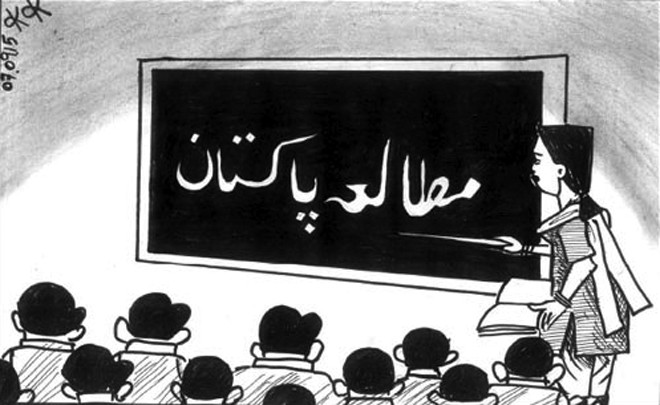
In Pakistani academic and administrative circles, the discipline of ‘History’ is increasingly being viewed as a branch of knowledge which we can do without. Bureaucrats, policymakers and many people of their ilk, in whose hands lies our destiny, are quite sure about it as a redundant and irrelevant subject.
Ironically, bureaucrats are not the only species holding on to this view. Deprecation for history runs far deeper in the Pakistani society which calls for some introspection by the people knowing the true worth of the discipline.
In the realm of the Pakistani academy, ‘history’ has barely existed and that too on the margins, unlike what happened in the countries in our neighbourhood like India. The difference in the treatment of history in the two countries is simply because Indian national narrative is predicated on history whereas our national narrative is embedded in the abstract idea whose ‘abstractness’ is its defining feature.
The point made in this space earlier and being reiterated here yet again is that abstract ideas like ideology of Pakistan are antithetical to history, geography and culture. Thus, all three branches of knowledge become irrelevant in a polity that defines itself as ideological.
The dismal state of the history departments across the country bears ample testimony to it. One wonders how the policymakers in Pakistan will make sense of the fact that the History faculty at University of Cambridge consists of more than 80 members and that the University of California, Los Angles has 120 members in its history faculty. These universities must have some plausible reasons to hire such a large number of historians, which the Pakistani policymakers have not ventured to look into.
Up until ten to fifteen years ago, these departments used to attract good students who had been aiming to get themselves enrolled in the glorious cadres of civil service or other such services considered at par with it in power and prestige. The ostensible reason for youngsters enrolling in history departments, despite their not so proficient teaching faculty, was history’s worth in the competitive exams. From a total of 1100 marks in the exam of Central Superior Services, more than half were covered through one’s grasp over various branches of history. Pakistan Affairs and Current Affairs, too, had a strong connection with history.
Similarly, history was considered extremely important in the Provincial Services examination too. It was inconceivable to get through these exams without having a good grounding in history. Thus, the bureaucrats working at the top and middle level were vicariously conversant with history. Importantly, history and English literature for civil and the allied services were accorded a primacy by the British from the very outset (since 1858). These disciplines were considered seminal for equipping the administrators with the vision and social insight which is inculcated through history and literature.
History was considered significant because it provided the young officers with the context of society and culture of the people they were supposed to administer. The steel frame of British India, as the Indian Civil Services was described, squarely rested on the knowledge of history. Many of those officers were historians like James Mill, Mountstuart Elphinstone, Henry Maine, William Wilson Hunter and Vincent Smith etc. The modernist tradition in Indian historiography was virtually started by these officer/historians. All the major historians from India, despite their strong objection over the inferences drawn by the British officers/historians, followed their style.
I too am trenchantly critical of the way the history of the subcontinent was constructed and the imperialist vision that underpinned that sort of history-writing. Nevertheless, I have to admit that because of the endeavours of these officers, history-writing entered into a new phase -- from waqaya navisi (writing incidents as they meet the eye without critically analysing them) to actual history-writing.
Reverting to civil servants and their connection with history, one may assert that writing district Gazetteers and settlement reports was a mandatory task that most of the officers had to perform. For all such obligatory work, the subject of history which involved extensive narratavisation and writing had been a handy tool to train young inductees in civil service.
The unalienable bond between history and the officer corps remained intact for several decades after Pakistan’s independence. As few historians argue, the sustainability of Pakistani state became possible only, in the midst of various political crises and military coups, because of a well-knit effective and competent body of bureaucrats. One may argue here that bureaucrat in cahoots with military dictators have put all sorts of impediments in the way of democratic norms to strike roots. Instead of lending support to political governments in its bid to attain stability, they have tended to destabilise it.
That role notwithstanding, a stable and well-versed bureaucratic set up is sine qua non for any self-sufficient and promising polity. It is not any easy assertion to make but it’s equally hard to refute the fact that bureaucrats draw much of their insight from history. Bizarrely, quite recently in the competitive examination syllabus, the status of history has been drastically lowered -- by retaining only one subject worth 100 marks. Which means the future bureaucrats will be substantially devoid of any sense of history which up till this time had been their biggest asset.
The sagacity behind such a move is hard to discern.
The Punjab Public Service Commission in its bid to recruit lecturers and assistant professors in history has introduced a formula of giving short questions of quizzical nature for the candidates to solve. That is a test of memory and not of their skill as historians. One wonders where is the inspiration for treating history with such disdain coming from.
We may come across the departments of Physics and Chemistry getting closed in the United Kingdom but no department of history has ever been closed down ever. For such demeaning treatment to history, Pakistan must be a unique case.