

Print Story
X




The academic who held a Pakistani passport and came to be recognised as a keeper of humanity’s conscience
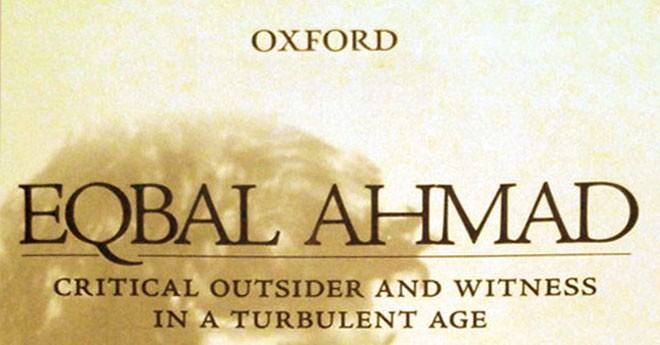
Eqbal Ahmad was more than a scholar of international relations and politics; he was what the French made fashionable, the public intellectual, and keeper of not only the nations’ but humanity’s conscience. Eqbal Ahmad thus had a view on about almost everything of public import and cared about the well-being of people living in the contemporary world.
He spent most of his life teaching and researching at the famous educational institutions of the world. Despite being left-leaning, there was an absence of a dogmatic adherence to ideas and theories that many followed slavishly. He had his own understanding and take on issues and policies on momentous developments taking place in all areas while drawing his basic rationale from a deeper understanding of Marxism.
The author of the book Stuart Schaar is eminently qualified to write on Eqbal Ahmed. Not only is he a scholar of great repute and author of many books like The Middle East and Islamic World Reader, The Birth of the Arab Citizen and the Changing Middle East he was also a very close friend of Eqbal Ahmed and knew him personally and very well. He met Eqbal Ahmed in Princeton in 1958, visited Pakistan in 1980 and again after the death of Eqbal Ahmad in 2004.
According to the author, Eqbal Ahmad had predicted that the consequence of Iraq invasion would be catastrophic, that the Afghan jihad organised by the United States would have great blowback effect, that Iran would become a highly centralised sate under religious command, that Israel would never be defeated militarily and Palestinians should launch massive campaigns of civil disobedience and large-scale non-violent actions, had foreboding of the people’s rebellion to challenge the old dictatorial order in the Middle East and rejected that cold war prevented a nuclear annihilation of the world, being more concerned about the proxy wars that took their toll.
The attraction of fundamentalism was that it reduced complex religious systems and civilizations to one or another versions of modern fascism and so he was concerned about the manipulation of Islam by Western powers and blamed the United States for resurrecting the medieval concept of jihad as holy war by aiming and funding Islamic radical radicals recruited from all over the world to fight the Soviets in Afghanistan.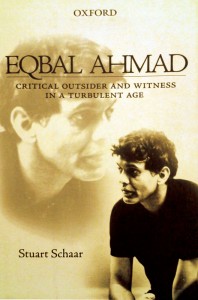
Eqbal Ahmad was born in a landowning family in district Jahanabad of Bihar. He had the misfortune to see his father murdered and then came partition and he came to Pakistan, got himself enlisted as a volunteer to fight in Kashmir but came back after the skirmishes and got enrolled at the Forman Christian College in Lahore. In Kashmir, he was exposed to the communists fighting the war and slowly gravitated to the left while studying at the college. He went to the United States joining the Occidental College in Los Angeles and later Princeton and that began his academic career in earnest.
Though leaning to the left, he never became a card-carrying communist and did not approve of its centralism, its need to extract obedience and its limited tolerance of dissent of Leninism. He was more influenced by the more humane Marxism of Gramsci.
In 1971, the Nixon’s Justice Department indicted him for plotting to kidnap Henry Kissinger and spent a night in jail. By dint of his indictment in 1971 and his trial in Arrisburg a year later when released on bail, he went on the offensive and spoke out against the Vietnam War. Though an academic who held a Pakistani passport, the fact that he was anti-war regarding Vietnam, wrote on revolution and counter insurgency and had oratorical skills made him a celebrity of sorts, a representative of the global left.
Eqbal Ahmad as an intellectual went against the grain of the superpower policy that shaped the world in the post cold war phase. The invasion of Iraq after the invasion of Afghanistan was what Eqbal Ahmad dreaded; both happened and obviously with devastating effects.
Eqbal Ahmad was one of the original thinkers about bringing about changes in various societies of the world because he advocated an end to the slavish loyalty to the western or European concepts or models of change. He was of the view that seeds of change were inherent in every culture and the model of the west needn’t be applied mindlessly. He was critical of the Turkish model, for the west had been blindly imitated by Kemal Ataturk and it brought the demise of much that was beautiful and meaningful in that culture.
And then, in his own country, he dreamt of setting up a university, a seat of higher learning which was not meant to be business-oriented but where people came just for dispassionate acquisition of knowledge. His project initially received help and some land was proposed to be granted to him for the setting up of Khaldunia, but then it was withdrawn because he dared criticise Zulfikar Ali Bhutto, particularly for his role in the Bangladesh crisis. It is said that Benazir Bhutto was miffed being present in that conference and withdrew the support that was promised by the previous regime.
Being fearless and outspoken, Eqbal Ahmad stood his ground, suffered and was not allowed to see his own dream being realised. In the end, he cut a tragic figure as an outsider, a critical outsider, a witness to a turbulent age, conscientious but powerless to prevent the decisions taken for narrow gains by dominant forces.
The book is a sympathetic account by a faithful friend. It is often stated in the book that Eqbal was very faithful as a friend and placed friendships above principles. It seems Stuart Sachaar too has towed the same line and has been kind to his friend and not recounted the various failures that he faced despite being on the right path. There must have been great levels of frustration piling up and Eqbal Ahmad may have died an unhappy man.