Print Story
X

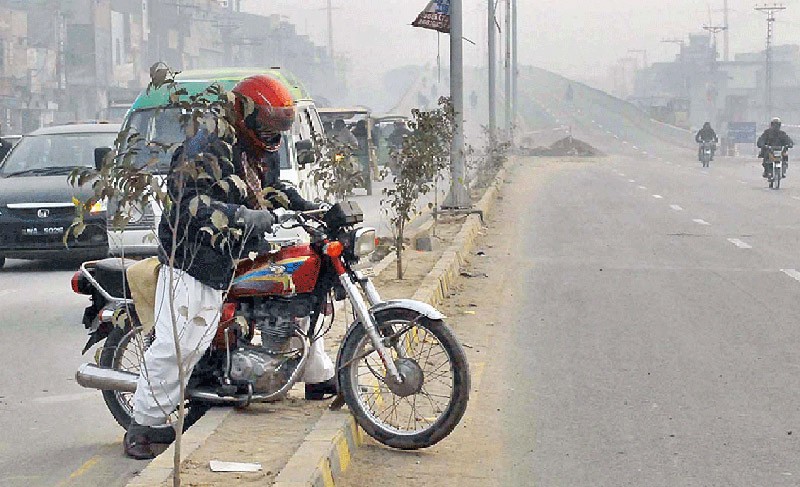
Very simple questions at times prove quite vexing when they need to be answered with precision and cogency. A couple of young undergraduate students, while conversing with me on random issues, threw in my direction one such question. I was asked, "When will Pakistanis move on from being a crowd to being a mature nation?" My answer: this would happen when people start abiding the rules and regulations that our law-making bodies legislate. The flouting of rules and regulations is evident in the way people conduct themselves while driving their vehicles around town.
At times, one feels that by violating the law people derive some kind of pleasure. Or as if halting at a traffic signal is beneath one’s dignity. Such behaviour signifies an insatiable urge to transgress the law, which in fact is meant to bring order to the society. The populace tends to celebrate such transgression of the edicts promulgated by the state.
Once, a populist legislator from District Muzzafargarh was travelling post-haste to his home town on the eve of an election. He was stopped by members of the traffic police for over speeding. Irked by such ‘unnecessary’ interruption, he lost his temper. An altercation ensued and both parties somewhat lost control of themselves. The fracas reached a point where, incensed over the temerity of the policemen, the ‘honourable’ Member of the National Assembly not only blurted out vituperative language, but also slapped the officer in charge. His opponent in the elections tried his best to make a big issue out of this, but, to his utter dismay, this perpetrator of an act of violence against a police officer was hailed as a hero by the electorate, as a true exemplar of Punjabi masculinity. This appreciation was obviously reflected in the outcome of the elections as well.
Thus, society and state seem at cross-purposes.
How can this phenomenon of divergence between society and state be explained? It is indeed a thorny issue requiring very serious scholarly deliberation. Participation in corrupt practices is not at all considered antipathetic to public life; instead it has become a necessary qualification to enable entry into politics. Honesty and rectitude are usually set aside as markers of meekness and a foppish disposition. ‘Stupid’ is another ‘honorific’ which is usually associated with people who opt to steer clear of amassing wealth by unfair means, Asghar Khan being a case in point.
Would it be legitimate to attribute such conduct as an echo of anti-colonial behaviour? A political theorist may argue that the legal structure and the business code of Pakistan were promulgated by the oppressive regime of the British which was established for the purpose of enriching the British while controlling their subjects. Therefore, the whole corpus of law enforced during the British rule bore hardly any reflection of indigenous socio-cultural norms.
But does this assertion still hold water 68 years after the end of British rule? Many of us feel absolutely repulsed when some reference is made to any honest individual.
In a gathering of his closest friends and kinsmen, a respectable civil servant, known for his rectitude, was sermonising on the advantages of being honest, and in his speech he quoted the former Prime Minister of India, the late Lal Bahadur Shastri (1904-1966), who was known for austere lifestyle. At the time of his death he did not even have a house of his own, which left the Indian state perplexed for quite a while as they tried to work out where his widow should be accommodated. Most people in the gathering were not impressed and one of them nonchalantly dismissed Shastri by asking what sort of a man was he who could not make a home for himself? How could such a person lead a nation? That sort of derision for an honest and austere leader left the narrator of the whole episode absolutely dumfounded.
Ironically, the people holding that opinion were not uneducated. In this example, personal gain held precedence over a desire to strive for collective good. It would be interesting if some assessment of a reformer par-excellence such as Abdul Sattar Edhi were to be carried out through a survey or a Gallup poll. I shudder to think of the results, but I would imagine that Edhi sahib would be bracketed alongside the likes of Shastri by the vast majority of us. Such characters are of course misfits in the social scenario that we are talking about.
Yaran da yar (friend of the friends) is an aphorism ubiquitously used in the Punjab and Sindh. What it implies is that one ought to go to any extreme for friends. For their sake, rules and regulations can be bent or altogether disregarded. Doing one’s utmost for a friend, however illegitimate the act of benevolence, is the defining feature. Anybody balking at doing his/her absolute best for a friend, for the fear/respect of law, will not last long in Pakistani politics.
Unfortunately the trait of going the extra mile to serve the interests of a friend has crept into other fields, such as the civil service. As a result, impersonal rules and regulations exist only on paper. A personal reference or a connection with a person in a position of power is what really matters.
Thus I wound up my conversation with the students by saying that the majority of individuals must agree on socio-political norms which then are abided by all and sundry. That will be the most decisive step towards a maturity which, at this moment in time, seems quite distant. The most important instrument to lead people to this end is education. It cannot be done by a single leader at the top. Things change for the better only gradually and only through institutions. Among these the educational institutions are the most vital. One hopes that one day the people sitting at the top of the political system realise that.