Print Story
X




The work of Hyun Ju Kim recently displayed at Taseer Art Gallery reminds of the forgotten potential of the technique of print making
In the art of printmaking, etching is a process in which an image is printed in reverse. So if you inscribe something in English, it may come as if written in Korean. But what happens when you write in Korean? One must use one’s imagination or information to guess it.
But language plays other marvels too since as it is not limited to words only; it is the reflection of culture, and a manifestation of its users’ worldview. Whether language changes our ideas and customs or is formed and modified on the basis of our thoughts and practices is still a moot point.
Yet, one can investigate how speakers of certain tongues have peculiar ways of expression, which may not have a direct link to vocabulary or diction. The world of visual art is one example, because while constructing or confronting a flat image, the makers’ or viewers’ experience of reading a text (from left to right, right to left or top to bottom) determines, or dominates, how it is created, conceived and perceived. Similarly, a certain culture adds or alters the way an artist visualises or treats his work, a realisation that becomes obvious when the artwork is moved to another place and seen in a different context.
One was reminded of this difference of aesthetics at the solo exhibition of prints by Hyun Ju Kim. The South Korean artist is visiting Pakistan for a short period, initially as the Artist in Residence at the National College of Arts Lahore, and now scheduled to join Murree Residency at the end of July 2015.
Her exhibition ‘An Otherworldly Creature’ (held from July 7-13, 2015) at the Taseer Art Gallery was unusual, not for the reason that during the holy month of Ramazan when galleries are displaying calligraphies or hosting jewellery shows, an important gallery decided to exhibit etchings and lithographs, but because of her peculiar approach toward printmaking, which was distinct from the popular practice of the genre in Pakistan.
Generally, printmaking (especially etching) here is treated as a particular method of composing an image, in which initial drawing is combined with layers of shades achieved through aquatint, or by adding various impressions and textures. Most printmakers have treated the medium as a means to create effects which in a way replaces the efforts to define, decide and delineate complex imagery with its multiple possibilities in drawing and subtle tones.
Hence, in our printmaking studios, chicken wire mesh, muslin, leaves were some of the preferred materials used for fulfilling the pictorial surface or imagination. This custom was enhanced by the option of textures managed through inserting etching plate in acid, thus getting diverse textures at random. In fact, the element of chance is not uncommon in art, nor is it discouraged, denied or decried. But if accidents take over, it is the artist who is the first casualty.
The trend of treating printmaking as mere play of textures was one of the few factors that led to the existential crisis of the discipline of printmaking. In a number of art institutes, for some reason, the subject is reduced to a small faculty. Yet, the presence of Hyun Ju Kim at NCA somehow suggested a hope for the subject since her work, like many other Pakistani artists who made prints at one point in their life before reverting to painting and other mediums, reminds of the forgotten potential of this technique.
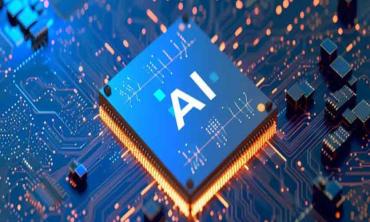
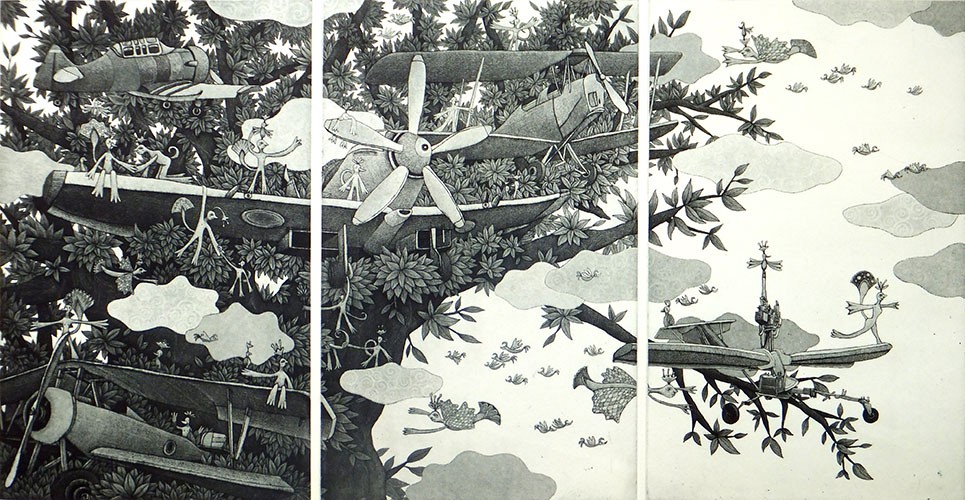
The most important and impressive aspect of her prints is the use of line. The line is not employed as a boundary of an area; it becomes a sensitive entity to show volumes and the life of bodies. Her sense of manoeuvring this basic element of pictorial vocabulary indicates a meticulous method of image-making.
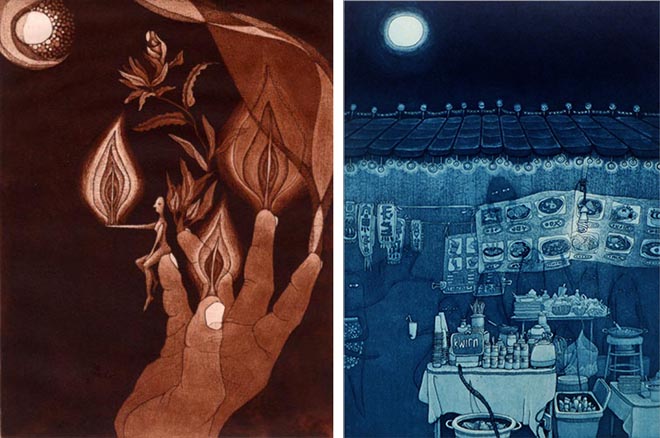
The images in her prints from her solo exhibition survived on the threshold of reality and fantasy. In these amalgamations of fact and fiction (though one often doubts the distinction between the two), Kim has created a world that is near to us, yet we are not aware of its presence or existence. Strange species and odd creatures crowd her prints but in an uncanny way these do not look alien since these appear as shadows of our dreams, desire and delusions. Kim has picked the metaphor of animals to denote human beings. In one of her prints, a pig’s face was placed on the body of a female, and a hen-like creature was composed with human head and a child in its lap. In several works, Kim has combined different animals to create an imaginary creature, with some details of human/female anatomy.
The world forged by Kim in her prints can be located in our surroundings, and which we might not feel comfortable with or confident to encounter. Yet the contours of that ‘otherworldly’ hemisphere are convincing due to her immaculate skill in drawing the details of bodies, their shadows and background. Thus the most fantastical settings become believable through her craft. In one of her works, men and women are sitting on a bench at a bus stop (one person is lying on another bench) underneath a tree with a cluster of branches and leaves. Across the sign of bus stop, another world starts emerging in which huge birds are perched in an indefinable space. Yet the way of drawing human beings and the manner of rendering birds blends two hemispheres -- real and imaginary -- so convincingly that it all turns into a single situation.
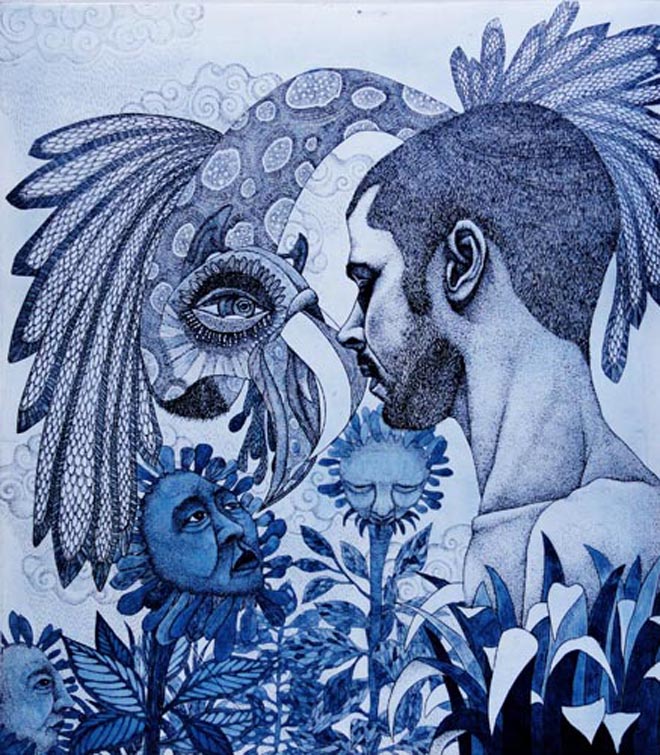
In another of her etching prints titled ‘ Please Come In’, the view of a normal dining place is drawn -- with tea cups, glasses, pots and other utensils stacked on top of tables, illuminated by an energy saver bulb, with moon on top of the image. On a closer look, one starts recognising/reading shapes of seal-like bodies which, like souls, exist inside and outside of things.
This kind of atmosphere recalls the atmosphere created by Kafka in which a man is confronted with his inner fear -- enlarged and materialised in the most unexpected forms. A number of other writers across the world ahave used the metaphor of animals for depicting human conditions -- from George Orwell to Urdu writer Syed Rafique Husain.
We don’t know Korean language; there may be a tradition of infusing human and animals in its literature too. But by looking at the work of Hyun Ju Kim, one is conscious of man’s problems in the world, which you can not cope with unless and until you find the secret or scared animal within you.