Print Story
X




More money and efforts need to be directed towards maintenance of railways infrastructure
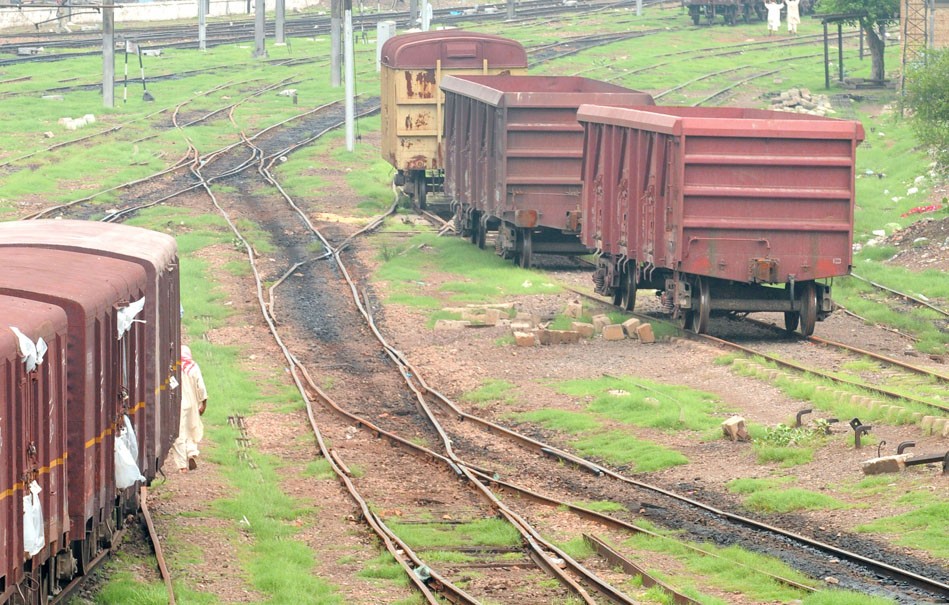
The tragic train accident in Gujranwala has led people to question the state of Pakistan Railways’ infrastructure. Over the decades, hardly any effort has been made to upgrade the infrastructure or the required capital injected by the state to achieve this end.
Though the cause of the accident is yet to be established, it is known to everyone that the railways is running its trains on worn-out tracks with a small number of functional locomotives. A large number of bridges, tracks, and compactions under the railway lines are in a dilapidated condition and in need of repair.
Pakistan Railways Minister, Khawaja Saad Rafique, has declared that a stunningly huge amount of US $12 billion are required to completely revamp the infrastructure of this state-owned organisation.
On the other hand, Pakistan Railways officials claim that political interference and corruption have plagued the railways.
One can look at the details of the basic infrastructure of Pakistan Railways to determine whether it is possible to make it a viable entity without making major capital injections or introducing revolutionary reforms.
As per the figures on June 30, 2014, railways track comprises 7,791 kms route and 11,778 kms track. The route length of a track is the length of the total route that it covers while the track length is the combined length of all tracks in the network.
Besides, there are around 14,000 bridges, 3949 level crossings, of which 2540 are unmanned and 1409 manned, 70,100 residential buildings, which include 67939 staff quarters, 1,809 houses for senior scale officials and 423 officer’s residences. Service buildings, which include stations, schools, hospitals, offices, stores/sheds, workshops, rest houses and running rooms etc, occupy an area of 25.807 million square feet.
Of the bridges, 532 are major bridges and 13,309 are minor. Most of these bridges were constructed when railways system was introduced in the subcontinent in 1870.
The length of track where trains can run at 105 km per hour is 3283 km, where they can run at 95 km per hour is 2807 km, where speed can be 75 km per hour is 1184 km, where it is 65 km per hour is 1,506 km and the track length where speed has to be 55 km or less per hour per hour is 312 km. Even lower speed limit can be fixed at places where track needs repair.
The total number of functional locomotives is 280 which are handling passenger, freight, and shunting services. The number is very low, keeping in view the scale of the network and demand for railways’ freight service in the country.
Humayun Rashid, Additional General Manager (AGM), Infrastructure, at Pakistan Railways tells TNS that railways systems are capital-intensive and even the developed countries face resource-constraints in this regard. He says the challenge is big but they carry out regular installations of tracks, bridges, etc, and the government provides them funds under the Public Sector Development Programme (PSDP) to take care of the infrastructure.
The AGM explains that there is a proper system of inspections in place where assistant engineers make periodic visits to track sites and bridges and determine faults. "If there is need for minor repair of track at a place we impose speed restrictions for trains. If there’s need for placement that portion is closed down and trains diverted."
The AGM explains that most of the bridges were built to allow flood water to pass through in case of floods. Besides, he says, there are others built over rivers, canals and other water ways. He tells TNS that railways had declared 159 bridges unsafe and had decided to rehabilitate them. Of these, work on 73 bridges has been completed and 21 more will be ready soon.
Read also: A safer mode of travel
Pakistan Railways has also been criticised for failing to add to the length of the track laid by the British. Rashid disagrees with this claim, saying the track was extended at different points. "The reason why it has not reflected on the total length is that several narrow-gauge routes have been closed down for rail traffic as they do not suit the locomotives in use which have much wider frames," he adds.
He points out that the track that Pakistan Railways has laid includes around 500 km from Shahdara to Lodhran and 350 km in D G Khan area. There is a plan as well to connect Gawadar with the main line near Jacobabad through a 1,050 km track, he adds.
He also dispels the impression that Pakistan Railways is overstaffed. In fact, he says, they are understaffed as there are 81,000 employees against the sanctioned strength of 95,000. "The department is in a restructuring phase and has done away with jobs that have become redundant. For example, the posts meant for steam locomotives/engines had to be abolished as these are no more in use."
A Railways official, who does not want to be identified, blames successive governments for bringing this organisation to the brink of collapse. To him, it was neglected to facilitate road transport and cargo sector. First, he says, the revenue-earning freight business of Pakistan Railways was given to National Logistic Cell (NLC) run by the Army and then the passenger traffic diverted to private transport sector.
"What is the logic of appointing Ghulam Ahmed Bilour minister of railways when he owns road transport business? Why will he revive an organisation which he himself is competing?" he questions.
On the acute shortage of locomotives, Rauf Tahir, Director General (DG), Public Relations at Pakistan Railways hopes that things will improve fast. He tells TNS that purchase agreement of 55 locomotives of 4000 horsepower each has been finalised and the first delivery of the order will arrive in November 2016 and the final in March-April 2017. These locomotives, he says, are of American make and many of these will be used to transport coal for coal power plants.
He says 20 more locomotives of 2000 horsepower to 2500 horsepower capacity will also be purchased soon, under a special agreement. "Under this agreement, he says, only two ready-made engines will be delivered by the supplying company while the remaining 18 will be manufactured at Pakistan Railways’ Locomotive Factory in Risalpur. This will help in ensuring transfer of technology and enabling the factory to manufacture similar locomotives itself," he says.