Print Story
X




The killing of two lawyers at the hands of a policeman in Daska has raised some important issues about police reform and lawyers’ solidarity
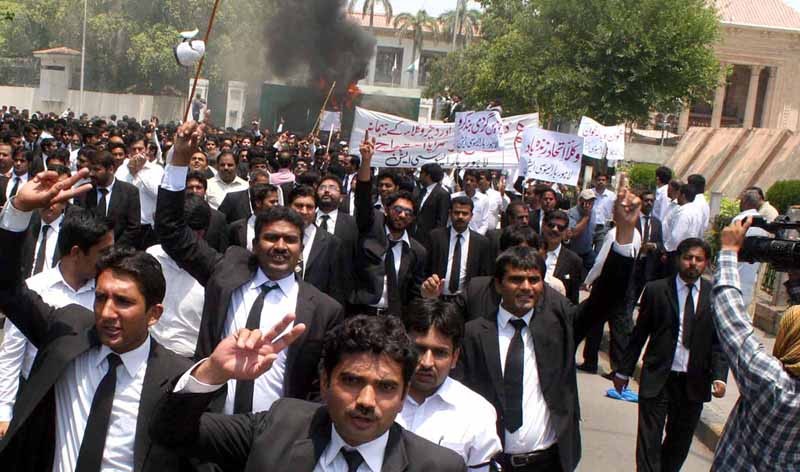
The recent killing of two lawyers in Daska, a large town near Sialkot in Punjab, by a police inspector who was head of the local police station, has enraged the lawyer-community, forcing them to come out in protest across the country.
Shahzad Warraich, the SHO, reportedly emptied his automatic gun on a handful of lawyers after hearing them shout and abuse the police for not listening to them over an issue. Rana Khalid Abbas, elected president of Daska Bar Association, and a young lawyer died while two lawyers were injured as a consequence of Warraich’s fighting.
According to the initial police report sent by the District Police Officer (DPO) to the IG office, on May 25 around 11.30 am, some lawyers got engaged in a quarrel with the local town administration. "The lawyers also used harsh words against police and then gathered outside the police station sloganeering and resisting against police. Due to firing two lawyers died and one was injured. The necessary action has been initiated accordingly," the report reads without mentioning who opened fire.
A local lawyer, however, says two young lawyers went to the town municipal office to get a birth certificate for a client. Owing to delay in their work, an argument started that turned into exchange of harsh words from both sides. The situation worsened and became a scuffle. The administration called the police while the young lawyers called the Bar President Rana Khalid Abbas for help.
As per his "eye-witness account" at the police station, a handful of lawyers, including the bar president, reached the police station. "Lawyers were angry while the police officer was rash. The situation worsened when they started exchanging harsh words. Lawyers threatened the police of going to the high ups. Meanwhile, an official guard of the SHO, who was with the officer, punched on the face of the bar president for abusing his boss. This further instigated the situation. The SHO took the gun and started firing on the lawyers," he recalls.
Violent protests erupted in several cities following the killings. Legal fraternity gave a call for nationwide strike and boycotted court proceedings across the country. In Daska, protestors comprising many people other than lawyers, burned some official buildings. In Lahore, some lawyers tried to break into the Punjab Assembly building. Protests were registered in various other cities of Punjab. Police stayed away from the courts and refused to produce under-trial suspects in district courts.
On its part, the Punjab home minister formed a Joint Investigation Team (JIT) to investigate the incident.
Clashes between lawyers and police are not new. Especially, after the Lawyers’ Movement for the restoration of judges in 2007, lawyers started acting as a vibrant and sometimes unruly pressure group. They often misbehaved with judges at the local level too.
Likewise, the public mistrust of police is already established.
Ever since the incident, both communities are active against each other on social media, making Facebook pages demanding justice. A page from supporters of police titled "We support SHO Shahzad Warraich" terming him "a man who dared to stand before the lawyers-mafia" with around 8,000 likes displays pictures of the SHO and his children and lawyers’ violent protests. There are also pages calling "Justice for Rana Khalid Abbas advocate", another one raising a demand to "Hang SHO Shahzad Warraich" (not available now) showing pictures of the murdered lawyers.
Azam Nazir Tarar, Vice Chairman Pakistan Bar Council, demands a complete investigation of the case in two weeks and finish the trial in the next two weeks, to set an example regarding this sensitive matter. "The officials of law enforcement agencies, especially those who carry weapons, are supposed to be extremely tolerant, even in bad situations," he says.
Tarar says that only a few among the more than 200 bar protests turned violent. This was not endorsed officially as it was not a collective act of lawyers’ fraternity. When people label lawyers as violent community they should realise that the community always denounces it. "The youth are frustrated all over the country. Young doctors have been violent too. The situation can be normalised through instituting merit and rule of law which is missing. When they see the country has rule of "might is right", some of them react to it violently."
Saroop Ijaz, columnist and lawyer, says the incident is quite straightforward. "This is a case of extrajudicial killing. Police are representatives of the state and no provocation can justify this act of killing by an armed state official. Its legal trial must go on," he says.
According to him, "lawyers are the most organised community in the country with elected leadership from local to national level. After their significant role in the Lawyers’ Movement, they have captured political space and certain elements still use the aftermath of such incidents to get more space and power. The violent behaviour of some young lawyers is not a collective face of the community and senior leadership of the community should play its role in putting a stop to it. But, to stop such killings by the police, we need police reforms."
Shahzad Warraich, the accused SHO, is a man in his 40s. He had a reputation of a tough officer. He was said to have been recruited in the police force through "political connections" with the political backing of ruling PML-N. He was appointed SHO Daska City a couple of months ago.
The recent incident has brought back memories of June 2014 when the police was reported to have killed at least 11 workers of Pakistan Awami Tehreek (PAT), after entering into a clash with its workers in Model Town, Lahore. The PAT, a religio-political party, has announced a countrywide protest movement after a Joint Investigation Team, instituted by the government, recently bailed out the government bigwigs of responsibility for the killings.
Shaukat Javed, former IG Police Punjab, believes such acts are a result of neglecting police reforms, putting the forces’ capacity-building on the backburner and using the police as a political tool. He terms the police inspector’s act was above the law for which "he would have to face trial".
About the police coming in clash with the lawyers not too infrequently, Javed says the lawyers, especially young ones, have gained a lot of strength due to the judicial activism of past few years."Now, they act like gangsters and have made it a habit of going to the lower courts in the form of groups, trying to manipulate the court in different cases. They also beat policemen and even judges at the local level, as we often see in the media."
Lawyers, on the other hand, argue that this attitude is only a response to the "gangster policemen" in the courts and they have no choice but to act like this.
Javed says if we continue with political compromises and pressures, this will add to the level of violence and then it would be hard to get good material for police recruitment. "At the moment, extrajudicial killings are rampant across the country and add to violence in police attitude."
While the accused SHO is on judicial remand, lawyers in various cities, including Daska, are regularly protesting demanding a speedy trial of the culprit. Meanwhile, the police are avoiding going to courts. It has become a test case for the government. Whether the government opts for merit or yet again enters into a political compromise with the lawyer community to save the police officer remains to be seen.