Print Story
X




A group exhibition at National Art Gallery and an installation at a public park in Lahore are both artists’ revolt against violence through images
We have come to see some strange connections between words: for instance, pain and Peshawar both begin with the letter ‘P’, just as Karachi and killing share the same first letter. The connection is purely coincidental but, in the hidden scheme of things, these may be mysteriously or logically joined.
The fact that we live in perpetual danger of violence is a reality that can not be avoided. Two recent incidents in the last six months -- massacre of children at the Army Public School Peshawar and shooting of Ismailies in their bus in Karachi -- certify that the militants can cross all limits and strike at will.
Like other sections of society, artists have also been touched by this most important war in the history of this country. They have long been delineating sorrow, grief and suffering of humankind through shaping forms on canvases. From the first painter who rendered blood in his work to contemporary creators who are depicting violence in their images, artists are very much conscious of distress in their surroundings.
Violence in any form evokes strong reactions, especially among creative people. But these people face a dilemma when confronted with a subject that is so contemporary and convincing. Writers or artists, no matter how strongly they feel against acts of barbarism, face a problem every time the ‘news’ is converted into an artistic concern. Because a work of art or a piece of literature does not address its own time, ideally it must extend its relevance to distant ages and regions. The poet, painter or performer transforms events, characters and settings. He expands the meaning, context and impact of his creations.
However, this should not imply that there is an attempt to dilute or diffuse the nature of atrocities that generated the work in the first place. Thus, the immediate audience of art or literature that is also the first recipient of such news or is affected by those acts can comprehend the background of the art piece and connect it with the terrible happenings of its epoch.
For an artist living in Pakistan, the choice to work on this subject is not merely a formal or pictorial endeavour; it is a conscious decision to take part in the war against terror, bigotry, and all those who inflict narrow views through savage power.
A recent exhibition ‘Massacre of Innocents’ held at the National Art Gallery in Islamabad from May 17-31, 2015 brings forth the artists’ responses against the terrorist attacks at the APS in Peshawar. The exhibition, a joint venture of Shakir Ali Museum and Artists’ Association of Punjab, include works of various artists in multiple mediums and formats, yet each piece on display reflects the artists’ condemnation of violence. Some works directly use the pictorial reference of the incident, while others address the theme in a more general and wider tone.
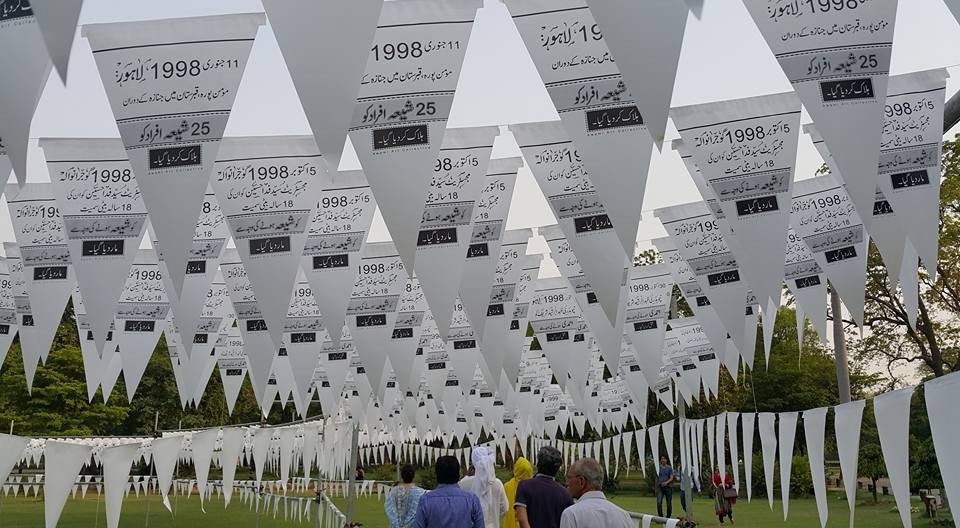
What happened in Peshawar was a continuation of a history of violence in our culture. This lineage of the last three decades is investigated and invoked in an installation "Hum Jo Tareek Raaton Me Marey Gaye" at a public space by the Awami Art Collective that includes a number of practising artists and social activists. In a passage constructed with pipes at Lawrence Garden, visitors are invited to walk and, as they move in a circular pathway, see white buntings hung on top. Each bunting carries a news of violence, including sectarian, political and religious killings.
In a span of a few minutes, one gets a chance to relive the dark past of our society. One can read the names of people who were assassinated for belonging to a separate sect or being followers of another prophet. Mass murders of Shias, Ahmadis, Christians and even majority Muslims are notified on these large buntings. The similar size and pattern of buntings may have a similar effect on the viewer who has got so accustomed to watching and reading news of violence that it almost turns into a pattern.
In the middle of this circular structure, burning incense sticks are stuck in the ground. So long before spotting the installation, one becomes aware of an unusual smell that is associated with graves, tombs and mausoleums but not with public parks. It makes the ordinary visitor who has come to enjoy flowers and trees uncomfortable.
The smell from the incense sticks invites people and even if not viewed can be felt strongly. The air turns into a door that leads to the installation which unfolds -- in detail -- thirty years of unbearable heritage. Even if one does not read the text on the buntings, the smell of burning incense is reminiscent of death.
Both the display at Lawrence Garden, Lahore, and the group exhibition at National Art Gallery, Islamabad, indicate that the artists of Pakistan recognise their issues and are courageous enough to voice their anger and defy brutality and cruelty. The works not only recall thousands or just one bleak day in our history, these remind that through images we need to speak and communicate our position.
In a society such as ours, one can not remain indifferent to what’s happening around. Just as the form is attached with content, pain is connected with painting and both are linked with Peshawar. Likewise both Lahore and laho (blood in Urdu) begin with the same letter ‘L’; and in this scheme killing is connected with Karachi, the two words which can be grouped with Kunst, the German word for art!
The installation will remain open at Bagh-e-Jinnah till June 8, 2015.