


Print Story
X




A new cadre of food safety officers is trying to enforce food standards, amid stiff challenges
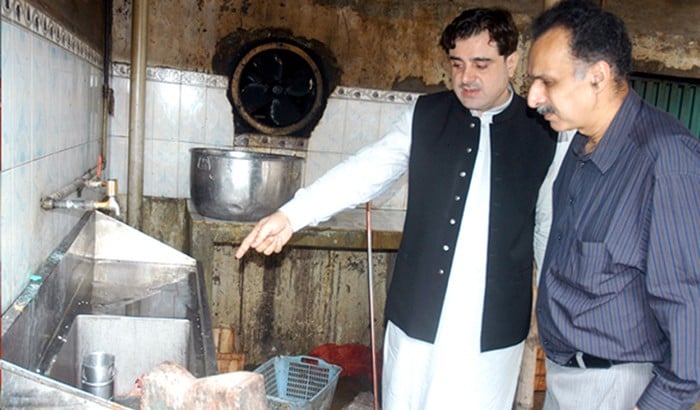
A couple of people, clad in formal dress, hop out of their cars, stand on the roadside and wait for an approaching vehicle. Some time later, one of them steps forward and, while walking through the moving traffic, beckons the driver of the vehicle, signalling him to stop.
The driver applies brakes to slow down, parks the vehicle at some distance, gets off and walks all the way to the person. The parked vehicle is actually a tanker that just brought milk in bulk to the city, from surrounding areas, for sale at different points.
After some discussion, the driver allows that person to get a sample of milk from the tanker and test it right there on the roadside with the help of a lactometer. Within minutes, a decision is arrived at and the tanker driver is asked to move it to a particular place.
It seems there is some issue with the quality of the milk tested. Some punitive measures are on the cards for good.
Most onlookers are not sure about what is going on here. Their curiosity pushes them to inquire from the traffic police officials standing nearby. It transpires that the personnel are the staff of the Punjab Food Authority (PFA), an autonomous body formed by the government to regulate the food sector.
The authority has the powers to raid restaurants, hotels, marriage halls, shops selling food items (open or packed), milk shops, bakeries etc and check vehicles carrying edibles anywhere in the city. It can make random visits to kitchens of roadside restaurants, eateries in posh areas, upscale hotels etc and issue notices or impose fines in case their standards of hygiene and food preservation are not up to the mark.
It is quite common nowadays to read about a particular restaurant or hotel being fined or sealed by the PFA on different pretexts. Interestingly, the office of the PFA is located in a street adjacent to the famous MM Alam Road where the action is. No doubt this proximity has put the crowded restaurants on this road in a disadvantageous position as many of them have been raided and fined.
Arsalan Ahmed, a regular visitor to eateries in posh areas, believes there is a considerable improvement in the quality of service and food offered to them. He says the restaurant owners and staff are aware of the fact that the aggrieved customers can file complaints with the authority and, therefore, try their best to avoid such a situation.
Ahmed says that following PFA actions, many food outlets have improved their kitchens and opened them for their customers. For example, he says McDonald’s now asks the customers to visit their kitchen first to observe the level of cleanliness and compliance with international food standards. "This was not the case before."
On the other hand, there are those also who are least impressed by the performance of PFA formed recently under the Punjab Food Authority Act 2011. Muhammad Zahid, a chemical trader, is one such person who has to travel throughout the day and eat at different restaurants.
He tells TNS that most restaurants operate under extremely poor hygienic conditions and bugs and rodents can be found everywhere. Some of these are said to have been fined by the PFA. But this often proves counter-productive.
Saqib Munir, Deputy Director (Operations), PFA, defends his organisation saying it is doing its best to change the decades old culture which will definitely take time.
He also says that the authority has employed nine Food Safety Officers (FSOs) and 18 Assistant Food Safety Officers (AFSOs) whose minimum educational qualification is MPhil and MSc in Food Technology respectively.
The FSOs are totally different from the traditional food inspectors who used to perform a similar duty.
When asked as to what difference the PFA has made, Munir says it has started with registration of all outlets dealing in food items. The number of registered food businesses before the establishment of the PFA was 350 and the authority registered around 10,000 of them only in 2014.
Munir says medical tests of employees from hospitals on PFA panel and site inspections are compulsory to get registered. Under the rules, he says, every food business will have to get registered and exception will only be for street vendors who will also be asked to ensure cleanliness.
The authority has also taken action against bakeries, egg-processing plants over use of rotten eggs, bottled water plants for irregularities, loose and packed ghee suppliers and so on. This creates a lot of heat and many a time leads to organised protests against the authority.
For example, Chaudhry Shafiq, a milk seller complains that PFA is raiding loose milk sellers’ shops just to give boost to powdered and packed milk industry. The vehicles are impounded for days and shops sealed just on the charges of adding water to milk, he adds.
Things are not that simple, says Munir who has often found urea, formalin, detergents, whey powder and even starch added to the milk to make it thick.
He says the PFA authorities have been empowered to impose fines on the spot and given a go-ahead to act against violators without fear. An AFSO can award fine up to Rs 5,000, an FSO up to Rs 25,000, deputy director (operations) up to Rs 100,000 and the director general up to Rs 500,000.
Besides, he says, the PFA has access to quality food testing laboratories both at the government and the private levels. The authority has signed a contract with Inter-Tech, a UK-based food testing laboratory which has its office in Johar Town. Samples collected by the authority are sent here for examination.
Munir urges the citizens to become active in this regard as things would not improve till the time they played their own role.
He says people must ask for registration certificate from the places where they are dining out or buying loose or packed food. If they find anything suspicious, they must inform the PFA through complaint mechanisms in place.